

“The village is dying,” and a festival? Yes, “Kodyma-Fest”: the first district festival of Southern Podolia. Ethno-ecological. And I’m “obsessed” with “ethno.” And, suppressing my skepticism, I went to the north of the region – to the village of Ivashkiv, Kodyma district. And I didn’t regret it…
Evening of June 17, a village street. Deserted. And it’s the eve of a holiday: Trinity. Opposite the kindergarten, where local teacher Tatyana Melnik kindly accommodated me, is the restaurant “Korchma.” Cozy. Empty. What if tomorrow there are more performers than spectators?.. In the morning, minibuses arrived. With schoolchildren. They don’t count. But adult people started to gather. Unnoticeably, unexpectedly – as if a dam broke! And it started to bubble…
I was very glad to see the people from Odesa. Artist from Odesa Film Studio Serhiy Tarasov arrived. Some journalists. Employees of the Bleshchunov House. Unfamiliar people from Odesa. To get to Kodyma, to get up before dawn, to shake for six hours in a stuffy electric train, and then to take a taxi to Ivashkiv, because the bus service here is twice a week – that’s what the locals told me. And yet, the people from Odesa became interested!
The streets became festively colorful, crowded with villagers in folk costumes. The surroundings began to sing, rumble with orchestras, and sob with violins.
Yes, they worked on the festival project on a large scale. The decoration would have been a credit to a city of a million. On the meadow, there was a stage and “seats” – bales of straw: this is “Klaka.” The word means the same as the more well-known “toloka”: work by the whole community for the needs of the community. Along the stream, there are eight pavilions imitating painted Ukrainian houses. They are hung with bright homespun carpets: local residents have preserved this luxury from their grandparents. Field kitchens, wooden benches of improvised cafes – “Kotunya.” Oksana Tkach, a local native, told me that she has known this name for her grandmother’s kitchen since childhood. But the name of the children’s festival site: “Kotrutsa,” – is unknown to most locals, it’s someone’s personal contribution, and by phonetics, you can guess where it’s from: Transnistria is nearby. “Kotrutsa” means – “stove niche.” For the hostess’s treasures.
THE IDEA OF THE FESTIVAL was proposed by a couple who settled in the village of Shershentsi, as people recall, in 2007. Dmitry Skorik (a namesake of the former governor) is from Odesa, a graduate of Mechnikov University; a photo artist. Nadezhda Skorik is from Kyiv: first philology at the university, then the film faculty at Karpenko-Kary, an artist. They met on a folklore expedition. They came to the village as bride and groom: they had an ethno-ecological and alcohol-free wedding. They started farming. Dmitry organized and headed the “Association of Peasant Producers” in Kodyma.
The idea of a folk festival was picked up by the chairman of the Kodyma District State Administration, Vadym Kozachok. He got excited: the festival must happen! Such a district – and in depression?! Let it shine in two neighboring regions, Odesa and Vinnytsia. Kozachok has been in office for nine months. Economist-financier. Graduated from the famous Odesa “narxoz” in 1998.
The Ivashkiv village council “harnessed” itself to the festival project with all its heart. I heard good reviews from locals about the chairman of the village council, Petro Pohorelyi. Former school principal, historian. So, 50% of the festival organization costs were borne by the Ivashkiv village council and the agricultural enterprise “Ivashkivske,” headed by Mykhailo Pohorelyi (brother); 30 percent was allocated from local budgets, and the rest from sponsors.
…Two hundred pines were planted around the perimeter of the festival space. The pond was cleaned and filled; the bridge over the stream was decorated with stone towers, wooden bridges were thrown across the stream here and there. Students from Odesa’s “Hrekovka” worked on the pavilion paintings and the production of printed materials under the guidance of teacher Viktor Homaniuk. Yaroslava Nikolaenko, for example, who stayed for the festival, will have this work counted as her diploma. The consultant for the decoration work was Tatyana Ishchenko, a wonderful teacher from the Odesa Children’s Art School named after Kostandi. As you can see, the people from Odesa are “close relatives” of “Kodyma-Fest”!
The hit of the children’s playground is a sculpture made of straw. Young Odesa painter Maryna Yandolenko, along with her colleague Marychka Ostrovska, sculpted unseen domestic animals. They tied 3 tons of straw onto frames made of wooden slats. After the festival, I believe, the place for straw sculptures should be in the club, in the restaurant, in the kindergarten.
In one of the pavilions, a 9-meter-long embroidered rushnyk was exhibited. Master craftswomen from each of the villages of the Kodyma district took turns embroidering it… and there was still a place, three meters long, for embroiderers from other districts of the region, and perhaps for the whole country: if needed, we will extend the canvas. The festival will live, we will all be friends.
Total: 21 wooden tables, each for 20 people, 42 benches, 8 summer stoves, plus 250 meters of water pipes and 6 artesian wells.
And the symbol of the festival, as Dmitry Skorik explained, is the local fish – “koblyk”: an almost extinct species. In the past, it was caught by hand. “Koblyk” is the Phoenix of “Kodyma-Fest.”
THE FESTIVAL PROGRAM BEGAN with an environmental seminar at the House of Culture. It was interesting even to me, a city dweller far from agriculture. The discussion was about the implementation of organic technologies: without chemicals, with a gentle regime for the soil. Speakers included: Dmitry Skorik; Kyiv resident Tatyana Sitnik – head of Retail Academy and seminar organizer; microbiologist Volodymyr Bilko; Ruslan Horobets from the village of Kazavchyn in Kirovohrad region – official representative of EMRO Japan in Ukraine; Lyudmyla Klebanova – president of the “Council of Women Farmers of Ukraine”; and other specialists. An eco-platform with master classes and a manually assembled solar collector was working.
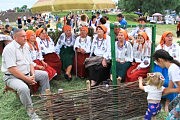
…And now, on the meadow stage – creative groups: about 500 artists came to Ivashkiv. The festival procession began from the local Holy Protection Church. All the regional diversity of folk costumes, well, stylized to some extent, of course: after all, club folklore groups came to show their skills. They walked and sang. Rock bands also came: “VasyaClub,” “Bozhychi,” “Balamuty,” “Rusichi,” “Khoreya Kozatska”…
The program opened with the performance of the Ukrainian anthem. Vadym Kozachok, Petro Pohorelyi, sponsors Mykhailo Pohorelyi and Mykola Sorochan welcomed the festival. The head of the district administration, Vadym Kozachok, presented Mykhailo Pohorelyi with an icon of Nicholas the Wonderworker, embroidered by his wife.
And then informal communication began on many platforms. In general, the festival had an informal, uninhibited, heartfelt tone. In a word: the village!.. Everyone is relatives. They “became relatives” instantly. They quickly got acquainted, found topics for conversation. And it turned out that people in our rural depths are sober-minded and sane. Yes, they are trusting. But they are capable of understanding the essence of the events and giving them an adequate assessment. This, after the demonstrative civil paroxysms of Facebook, was like a mug of water in the desert. Network patriots live in a parallel world. The village is another planet. It considers itself nothing, rushes nowhere, intends to prove nothing to anyone. It simply lives. What it lives by – we will return to this topic later…
And how the village aunts and grandmothers sing! With calloused hands and weathered faces. Oh, I’ve always loved listening to the singing of village grandmothers, with their “authentic” throat voices, with that characteristic three- and multi-part harmony. I heard enough in Ivashkiv. The group “Sing, Soul” by Valentyna Mikhel from the urban-type settlement of Slobidka – well, it’s simply soul-stirring. The group “Istoky” from the village of Zagnitkiv, led by Svitlana and Serhiy Oliinyk. Lyudmyla Chudak’s group “Berehynia” from the village of Perizhna – if only you could hear their “Oh, a viburnum stood in the field!”…
And all this not from the stage, but during a convivial gathering right on the grass. Heartfelt. And on the stage, meanwhile, the performance of other folk groups was announced. Moldavian – “Ethnos” from the village, imagine, Utkonosivka. Bulgarian dance group “Kolorit”…
And the children are not lagging behind: enthusiastic teachers are pulling the thread of tradition to the grandchildren from their grandmothers. For example, young Myroslava Vertyuk from the Ivan Honchar Museum in Kyiv: she has a children’s instrumental group “Oreli.” The children are now playing in the style of Ukrainian village “troista music” – they studied it for a year, and the group has been around for five years, and children come to learn in it from the age of two. “Oreli” are swings on ropes. And a hanging cradle.
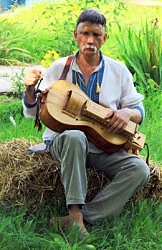
And a group of kobzars! They performed ancient dumy on the church grounds: Oleksandr Honcharenko and Taras Silenko from Kyiv, Oleksandr Trius from Romny, Sumy region, and others. They played the hurdy-gurdy and the kobza. I don’t know how authentic the repertoire about the Cossack, the maiden, and the chains from the school program is, but the religious chants, which, judging by their lexical structure, belong to the eighteenth century, touched deeply, to the point of shedding an involuntary tear. For example, the chant “Through the wide field,” dedicated to the Virgin Mary…
The food was excellent. At surprisingly democratic prices. And the competitions in preparing local traditional dishes, all from grandmothers – I won’t describe them to provoke your salivation…
THE FIRST FESTIVAL EVENING ended with a devastating thunderstorm with a downpour. That was a headache for the sound engineers! And the owners of the “Kotunya” pavilions also got it. And those who slept in tents on the meadow later said that the mattresses were floating under them. But… the rain will wash, the sun will dry: we believe that the cultural shock of the Kodyma district was seasoned with weather extremism. The festival is baptized! Well, in the morning, the electricity and water were turned off, trees fell in the area, and roads were washed out. This did not prevent the planned excursions along the routes of old Kodyma from taking place. Odesa artist Serhiy Tarasov went – and was very pleased and impressed. Many festival visitors were pleased.
The second evening of the celebration was marked by the arrival of the Odesa governor Mykhailo Saakashvili, for whom, as well as for all guests, the Kodyma wedding ceremony was staged in authentic attire, some of which is over a hundred years old.
…And what delicious water, you know, is in the well located inside the church bell tower!











