

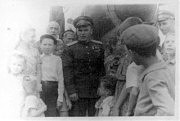
In August 1982, on the fourth page of “Vechernyaya Odessa” under the heading “35 Years Later,” a photograph appeared of the thrice Hero of the Soviet Union Ivan Nikitovich Kozhedub surrounded by Odesans. The author of the note accompanying this photograph, war veteran A. Kryuchkov, reported that the picture was taken in August 1947, on USSR Air Force Day. The renowned pilot was a guest of the Odesans, meeting with them in Shevchenko Park at an exhibition of military aviation equipment. This episode was captured by former front-line photojournalist V. Kolosov: in the background of the picture is a front-line fighter jet, and in front of it is I. N. Kozhedub in military uniform surrounded by children. He held the youngest of them in his arms. “Perhaps one of those children will recognize himself?” the note asked at the end.
At that time, I worked in an organization whose organ was “Vechernyaya Odessa.” The mentioned photograph immediately caught my attention. Our family album contained a clipping from a local newspaper from 1947 with a photograph by Ya. Levit, which captured the mentioned episode, albeit from a slightly different angle. There were also four more photographs of this episode, taken at intervals of a few minutes: Ivan Nikitovich talking with children, addressing the youngest, holding him in his arms. The photographer gave these pictures to my father, having found out that the boy in Kozhedub’s arms was his son.
We happened to be at the exhibition that day not by chance. I. N. Kozhedub was a veteran of the 5th Air Army, and he met with his combat friends, among whom was my father O. A. Stamboltsyan, who fought as part of the 5th Air Army. In 1947, he was an officer in the staff of this army, which was stationed in Odessa after the war.
In the 1980s, due to my official duties, I had to meet with the editor of “Vechernyaya Odessa,” B. F. Derevyanko. I shared this information with him. Boris Fyodorovich suggested writing about it in the newspaper, but I did not take him up on the offer.
Another 33 years passed, and now, studying the combat path of the 5th Air Army and the exploits of its renowned heroes, I remembered this small episode in post-war Odessa. I wanted to learn more about the person who held me, a two-year-old, in his arms.
From my mother, who also fought as part of the 5th Air Army, I know that I. N. Kozhedub was her countryman, a native of the Glukhov district of the Chernigov province. During the war, legends circulated about him in the units as an invulnerable pilot – the scourge of the fascists. And this was true. I. Kozhedub, constantly participating in combat operations, was never shot down by the enemy.
Ivan Nikitovich Kozhedub was born in the village of Obrazhievka on June 8, 1920. According to the new administrative division, this is the Shostka district of the Sumy region. As a child, Vanya was no different from other peasant children; he attended the local school. After completing seven grades, he entered the Shostka Chemical Technology College, which trained personnel for the rapidly developing chemical industry at that time. Subsequently, Shostka became the main supplier of photographic film and other photographic materials in the Soviet Union. While studying at the college from 1934 to 1938, he became interested in aviation and, following the example of his peers, joined the Shostka aeroclub. In 1940, his passion led Kozhedub to the Chuguev Military Aviation School for Pilots. The capable cadet was noticed by the school’s command and, as the best of the graduates, was kept there as a flight instructor. It was in this position that Kozhedub received the news of the outbreak of war. His first thought was to go to the front. But the command decided otherwise. The front desperately needed flight personnel. They needed to be trained competently…
Only in November 1942 did Kozhedub manage to get to the active army. It was a unit being formed in the city of Ivanovo: the 240th Fighter Aviation Regiment of the 302nd Fighter Aviation Division. In March 1943, the division and its units were formed and transferred to the Voronezh Front. The Kursk offensive operation was being prepared.
The first combat experience was unsuccessful. The La-5 aircraft piloted by I. Kozhedub was fired upon by the enemy and barely made it back to the airfield. It took another 40 combat sorties before I. Kozhedub achieved his first victory. This happened in July 1943, in the midst of the Battle of Kursk. He shot down a Junkers-87 bomber. The very next day, he shot down a second aircraft, and on July 9, I. Kozhedub shot down 2 German fighters at once. But there were still almost two years of war ahead. In the following 23 months, in battles on the Voronezh, Steppe, 2nd Ukrainian, 3rd Baltic, and 1st Belarusian Fronts, I. N. Kozhedub made 330 combat sorties, conducted 120 aerial battles, and destroyed 64 enemy aircraft. Legends circulated about him. Here are a few episodes from the memoirs of Ivan Nikitovich, published in the newspaper “Krasnaya Zvezda” on September 20, 1986.
In September 1943, I. Kozhedub’s squadron was conducting combat operations in the Borodayevka area, covering our bridgehead on the right bank of the Dnieper. A fierce tank battle was raging below. The squadron, having completed its combat missions, was returning to its airfield. I. Kozhedub was flying last and decided to circle the bridgehead once more to assess the situation. At that moment, enemy bombers appeared in the air. Our tankmen were under threat. There was no time to think. And so, he was alone against 18 bombers, which had already begun to dive on our tanks, infantry, and artillery, preparing to bomb. Gaining altitude, I. Kozhedub threw his plane into a dive at the enemy formation of aircraft. Attacking from above, from the sides, from below, he disrupted their combat formation, causing confusion among the enemy, who began to drop bombs indiscriminately. But that was not enough. Based on his experience, he knew that it was important to stop the leader. And he succeeded! The enemy, attacked from below, fell, engulfed in flames, which decided the outcome of the battle. The remaining bombers began to drop their bombs haphazardly and flee. It was time for him to hurry back to his airfield as well. Fuel was running low. He landed with a stopped engine: the gasoline had run out…
A little later, on October 1, ten La-5 fighters under the command of Lieutenant I. Kozhedub, covering our troops, encountered a large group of enemy bombers and fighters. Fifty-eight against our ten! Our “hawks” had the advantage of altitude. They attacked the enemy from above. The enemy formation was scattered, and four aircraft were destroyed. I. Kozhedub shot down two of them. In total, seven Junkers and one Messerschmitt were shot down in this battle.
The last battle of the Great Patriotic War, in which two Focke-Wulfs were shot down, I. Kozhedub fought in the skies over Berlin.
On August 18, 1945, I. N. Kozhedub was awarded the third Gold Star of the Hero of the Soviet Union for his high military skill, personal courage, and bravery shown on the fronts of the war. During his visit to Odessa to meet with his fellow soldiers in 1947, he was mastering the jet MiG-15 and preparing to enter the Order of Lenin Red Banner Air Force Academy, which he successfully graduated from in 1949. In 1951-1952, he participated in combat operations in Korea, where he commanded an aviation division. In 1956, he graduated from the Military Academy of the General Staff. From 1964 to 1971, I. N. Kozhedub was the Deputy Commander of the Air Force of the Moscow Military District. In 1970, he was awarded the rank of Colonel-General of Aviation. From 1971, he held leadership positions in the central apparatus of the Air Force, and from 1978, he was in the group of General Inspectors of the Ministry of Defense of the USSR. In 1985, I. N. Kozhedub was awarded the military rank of Marshal of Aviation. The life path of the renowned pilot ended in Moscow on August 8, 1991. He is buried at the Novodevichy Cemetery.
The memory of the renowned pilot lives on among his fellow soldiers, in historical documents, and in books of memoirs. The Kharkiv Air Force University bears his name. His legendary La-7 fighter (tail number № 27) is preserved in the Air Force Museum in Monino. Ordinary people, with whom fate accidentally brought him together, also remember the hero.











