

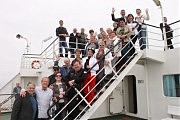
As reported by “Vechernaya Odessa”, from April 30 to May 6, an International Scientific and Practical Conference of scientists and specialists of the maritime complex was held on board the ferry “Greifswald” on the route between Ukraine and Georgia. The conference was organized by the shipping company “Ukferry” and Odessa National Maritime University. During the six-day symposium, reports were heard from scientists from Ukraine, Bulgaria, Romania, Georgia, Poland, Germany, and Russia on the topic “The European vector of development of the Black Sea basin countries and its impact on shipping in the Black Sea”.
Naturally, the main attention was paid to Ukrainian shipping. The main conclusions are as follows: over the years of Ukraine’s independence, the volume of cargo transportation by sea has decreased by almost 16 times. The share of maritime transport in total cargo turnover is only 0.15%, and in passenger transport – a negligible 0.1 percent. This is despite the fact that the volume of maritime transport worldwide is growing every year.
Having all the opportunities for the revival of shipping and integration into the European transport system, Ukraine stubbornly fails to use them. The government’s misunderstanding of the role of national shipping in the development of the Ukrainian economy, unjustifiably high port tariffs, an abundance of controlling and inspecting services, and as a consequence, a high level of corruption make Ukrainian shipping uncompetitive.
The conference emphasized that the effective operation of the national fleet is only the tip of the “shipping iceberg,” which is based on the construction and repair of ships, port terminals, the activities of various specialized design and engineering enterprises and organizations, and the training of highly qualified personnel in maritime universities and colleges. Suffice it to say that in the early 90s, up to 450,000 highly professional engineers and workers were employed in the country’s shipping industry. For example, the Black Sea Shipyard alone, where the famous aircraft carrier “Varyag” was built, employed 24,000 people. Two more ship repair yards also operated successfully there in Mykolaiv. Marine and river vessels were built and repaired in Kyiv, Illichivsk, Kiliya, Mariupol, Izmail… Every year, about five hundred highly professional engineers graduated from the walls of Odessa National Maritime University, who were in demand in the maritime complex of Ukraine, and in countries near and far abroad.
What should be done to revive the shipping industry? The answer is simple: the national cargo base can provide efficient work for dozens of ships of the national fleet. For example, the country’s grain potential alone, intended for export, amounts to about 20 million tons. Millions of tons can be the volume of exports of mineral fertilizers abroad. The Ukrainian metallurgical and metalworking industry has a similar potential. Import transportation is also necessary. For example, the country needs about 10 billion cubic meters of liquefied gas alone. Based on this data, the tonnage shortage is 200-250 vessels (in terms of vessels with a deadweight of 5,000 tons). By implementing such a program, Ukraine will be able to earn hundreds of millions of dollars in freight, become one of the world’s maritime powers, and provide prestigious work for tens of thousands of seafarers.
THE PROBLEM OF REALIZING UKRAINE’S TRANSIT POTENTIAL is now even more acute. Despite having the highest transit coefficient in Europe, our country remains a “blank spot” on the transport and logistics map of Europe. Today, this potential is used only by 30-40 percent, and inefficiently. The country’s income from the use of transport for transit purposes accounts for only 6 percent of GDP, while in the Baltic countries, where the transit coefficient is significantly lower than Ukraine’s, this figure exceeds 30 percent.
The biggest barrier to transit cargo through Ukraine, paradoxically, remains the “Soviet” mentality of government structures controlling cargo passage at the border. Despite declarations of Ukraine’s European aspirations, customs and border control, along with other inspecting services, remains the most archaic in Europe. For example, the captain of the ferry “Greifswald” has to sign up to 80 different documents during each weekly arrival in Illichivsk. Moreover, almost every inspecting service hints at receiving a reward during inspection so that the vessel can depart on time.
For comparison, customs and border formalities in Georgian ports take an average of twice as long, and in Turkey, they take no more than twenty minutes. One can imagine the benefit of hundreds of millions of dollars that Ukraine loses by creating obstacles to transit cargo and passengers through its territory.
Unfortunately, the situation with Ukrainian transit continues to worsen. More and more long-haul drivers, who previously traveled by ferry from the Caucasus countries to Europe through Ukraine, prefer the Batumi-Constanta route instead of unloading in Illichivsk. The Baku-Tbilisi-Kars railway (Turkey) will become a powerful competitor to the Ukrainian section of the “Great Silk Road,” which will transport railway freight trains across the Bosphorus directly to the European track.
ONE OF THE PRIORITY DIRECTIONS of the country’s transport policy should be the development of intermodal transportation, the ability to combine different modes of transport – sea, rail, road, and air, which allows selecting the optimal cargo delivery scheme for the client to any point on the globe. The technical basis for the rapid development of intermodal transportation will be progressive transport and technological systems – container, ro-ro, ferry, lighter, feeder. However, a comprehensive approach to the implementation of intermodal system projects in Ukraine practically does not exist today. It is necessary to create a regulatory framework that meets international standards, technical re-equipment of the fleet, replenishment of the fleet of containers and vehicles, rolling stock, and the introduction of modern information technologies at all stages of the organization and management of the transportation process.
Such modernization requires, first of all, the training of relevant personnel. However, today we have to talk about preventing the further collapse of the education system. The lack of prospects for employment of ONMU graduates has led to the university not enrolling the necessary number of students for its normal operation. And the system of training future managers of the maritime complex does not meet modern requirements. A radical revision of the curricula and programs of maritime universities is required, which will allow engineers to think broadly, creatively, and analytically, rather than memorizing disciplines that many university professors have been teaching for years without considering modern requirements.
The Batumi State Maritime Academy can serve as an example in training modern personnel for the maritime complex of Ukraine. The Georgian government has found ways to equip its maritime center with the latest equipment and simulators. In the near future, it plans to acquire a training vessel for cadets’ sea practice. It is also important that the teaching staff is provided with decent salaries.
“Based on the reports and discussions, we can say that maritime life is still alive in our country,” says Professor Mykhailo Postan, academician of the Transport Academy of Ukraine and head of the conference. “But if the situation does not change drastically, the ‘point of no return’ will soon be passed. We are counting on economic reforms, a civilized investment climate, and transparent business practices in our country. Under such conditions, the development of shipping in Ukraine will become one of the most profitable investment projects and will certainly yield results. Our scientists’ research in this direction will continue. We also hope for cooperation with foreign colleagues from the Black Sea countries. For this purpose, ONMU has taken the initiative to create an Association of Maritime Universities of the Black Sea Region.”











