

The Odesa International Film Festival is growing with interesting exhibitions — until August 18, the “HudPromo” gallery (Zhukovskogo, 6) is hosting the “Screen Tests” exhibition, which is part of the OIFF’s large-scale art project. Curator Max Kovalchuk dedicated his “Screen Tests” to techniques and methods, special effects capable of making a phenomenon of life cinematic, and gave the authors a directive (even a super-task!) to create situations where the viewer feels like they’ve stepped into a movie — all facets of perception and genre affiliations are blurred, everything is somewhere between cinema and photography…
Here is an attempt to play in cinema, and a desire not to fail their “Screen Tests” (it’s a test in front of experienced filmmakers!), which are clearly created with a love for cinema. There is a certain seriality, a repetition, with which directors usually choose their actors, forcing candidates for roles to repeat the same text on camera.
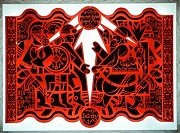
Screens flicker, reproductions of antique black-and-white photos (works by Andrey Boyarov) attract with their understatement, and here is the work “Capacities,” created in the “counter-form” genre by Nazar Bilyk from polyvinyl on plaster. Roman Minin’s striking black-white-red work “Believe First,” executed as a lightbox, illustrates the currently fashionable theme of confrontation (but the artist does not answer who is right and who is wrong).
Stepan Ryabchenko and his bizarre “The Fox Who Wants to Drink” show the viewer that a plot is created through directing; first, the environment emerged, and then a character was introduced into it.
In a separate small hall, draped with a mourning cloth, under a non-stop soundtrack, which is a funeral march to the tune of the song “By the Black Sea,” documentary video footage shot on May 2 near the burning House of Trade Unions in Odesa (work by Temporary Group) is shown. Opposite is Alina Gordienko’s project titled “Please.No.Drama,” which illustrates the role of women in modern society as oppressed and suppressed characters, figures are half-cut out, half-drawn, and the “white noise” in the background symbolizes, according to Alina, how modern man is mired in the media space. However, it is best to see each work with your own eyes, as “Screen Tests” are created for viewers to experience the authors and their works…











