

The artistic film “The Guide” by Oles Sanin, nominated in two competition programs — international and national full-length features — received enthusiastic audience approval with a standing ovation. Odesa had the honor of hosting the world premiere.
Film synopsis from Wikipedia: “The events take place in the Ukrainian SSR, during the times of industrialization, collectivization, Holodomor, and the extermination of the intelligentsia. American businessman Michael Shamrock, along with his ten-year-old son Peter, arrives in Kharkiv. Michael stays in Soviet Ukraine and becomes part of Soviet propaganda. Shamrock comes into possession of secret documents about planned repressions in Ukraine, which leads to his death. Michael’s son witnesses his father’s murder. Peter manages to escape his pursuers thanks to the blind bandura player Ivan Kocherha. The boy attaches himself to the blind man and becomes his guide. In the winter of 1934, Ivan Kocherha and other kobzars are executed. Peter remains the sole living witness to those tragic events.”
…To this day, not a single “living testimony” of the event has been recorded. Neither the execution of the “congress of kobzars,” nor even the fact of such a congress (were there “cultural figures” present?), convened in Kharkiv, according to sources, within the timeframe of 1927-1935. There are no references to archival documents; there are laments that the Chekists destroyed the documentation. The “executed congress of kobzars” remains a legend.
“Dzerkalo Tyzhnya” presents a testimony-story, also resembling a legend, about a boy named Oleksiy Bozhko from Ukraine, who attached himself to a blind kobzar and miraculously escaped arrest. Perhaps Oles Sanin is aware of this story, and his imagination transformed the Ukrainian boy into an American one…
Be that as it may, Oles Sanin has created an impressive, grand romantic ballad — or, if you will, a “duma” — on the eternal theme of “the singer and power.” In the film, each viewer will see what they are predisposed to see. As for me, I am cautious about attempts at fictionalization. I would have preferred a documentary-journalistic investigation in the spirit of the series “War: The Ukrainian Account.” Especially since Sanin, in his film, did not manage to avoid regrettable touches of propaganda. True, the actor Oleksandr Kobzar (what a coincidence), playing Volodymyr, managed to create a deep and ambiguous character, with a certain subtext — and this, I note, is somewhat beyond the schematic plot: perhaps the artist brought his own human significance and subtlety to the role. As for Olha, it is difficult to say anything definite about her, other than that she is exotically beautiful, as she is played by the singer Jamala (Susana Jamaladinova). The film’s retrospections, depicting how brutal Red Army soldiers, including the young machine gunner Volodymyr, execute noble heroes of the UNR, among whom is the young Ivan Kocherha (who will miraculously survive but be blinded), I will not comment on: let future historians sort out the pros and cons.
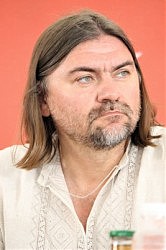
Ivan Kocherha, the “Ukrainian Homer,” played by Stanislav Boklan, is a typical romantic hero of a folk ballad, without fear or reproach. To prevent the character from appearing hollow, the director initially gives his hero an unappealing stubble and even sloppiness: the nobility and masculine charm of the blind wanderer gradually emerge as the plot unfolds.
The film is exquisitely beautiful, sophisticated in its color palettes, which is precisely what captivates the viewer, lending the plot’s conflicts additional emotional weight. We owe this to the artistry of the cinematographer-production designer Serhiy Mykhalchuk.
AT A PRESS CONFERENCE, the creative team discussed how the film “The Guide” was made.
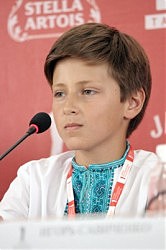
Anton Svyatoslav Hryn, who plays the young Peter: “When I received the offer, I was shocked: I had never acted in a film, was not even close to it, and didn’t dream of it. And now I want to become an actor.”
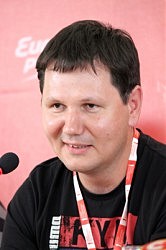
Oles Sanin, director and recipient of the A. Dovzhenko State Prize: “Anton turned out to be such a mystery! If I had known I would find him, I would have written the script differently. But now we are shooting a 4-part television version, in which we will reveal the biographies and relationships of the characters in detail. We wanted to show a fantastic, legendary Ukraine, the one we love. We shot the final scene at a military training ground near Lviv — there are the ruins of a church there, which had been a target for artillerymen for decades. This church became a symbol for us of the indestructibility of the spirit.
The place where we filmed the execution scene of the kobzars is the village of Bazaltove in the Rivne region. It was minus thirty degrees, snow had buried the film crew, we traveled there for two days in BTRs, people endured a lot to tell this story. We gathered over 170 visually impaired people from all over Ukraine. Among them were many musicians; they were eager to pay tribute to the memory of their fallen “brothers” and patiently endured the inconveniences and hardships. They felt they were suffering for the truth.
While we were filming the movie, the world around us changed. Odesa is the first city that saw this picture. Odesa is an honest city: if it’s good, it will kiss you, if it’s bad, it will spit in your face. I am not counting on festival awards, I am not claiming to be art-house, I have not resorted to popular genre techniques. I did what I could to convey the story to the people.”
Poet Oleksandr Irvanets, one of the four screenwriters: “This is Oles Sanin’s story. I simply told it in words. In Ukrainian.”
Actor Oleksandr Kobzar: “At night, I wrote on my Facebook page: ‘In 2012, I experienced four months of happiness, and I will tell my children about it.’ When they called me for the role, they said: ‘There’s no money. Are you with us?’ They all had very warm eyes. I replied: ‘I am with you.’ And at the end of the filming, Anton Hryn turned ten years old…”











