

On a June day in the urban-type settlement of Novi Bilary, Kominternivskyi district, provocative announcements appeared, the content of which made young and old gather on Teatralna Street on a weekend to participate in population evacuation training in case of an emergency.
“We specifically included the question in the announcements: ‘What will you do if a cloud of ammonia moves towards your home?’ so that people would think and gather for training. The task set for the employees of the Main Directorate of the State Emergency Service of Ukraine in Odesa Oblast and the workers of the Odesa Port Plant to train the population in correct actions during an emergency situation must be fulfilled. Considering the proximity of such an enterprise as the Odesa Port Plant, we must always be prepared,” said Oleksandr Nalysnyk, head of the temporary control deputy commission on the technological impact of the enterprise on the settlement of the Novi Bilary village council.
Near the village council, the residents of Novi Bilary were met by representatives of 4 units responsible for safety at the OPP enterprise: the state fire and rescue squad, the paramilitary security, the medical service, and the paramilitary gas squad.
Special equipment and specialized specialists, instead of lectures, prepared practical visual training for the population to develop an evacuation algorithm in case of an emergency at the plant.
Sirens sounded the alarm, and text messages were displayed on television and from loudspeakers.
Oleksandr Shamaryn, assistant director of OPP, assured that the enterprise has a number of warning devices, as well as automatic environmental monitoring systems that monitor the content of harmful substances in the air every minute and control the environment according to 8 criteria. “We are conducting training of this scale for the first time together with the Main Directorate of the State Emergency Service of Ukraine in Odesa Oblast. Novi Bilary is located in the sanitary zone of the Odesa Port Plant, and in case of threat and with a southern wind, this settlement can be covered by a cloud of harmful substances. Residents must know where evacuation transport will pick them up and what actions rescuers will take,” said the assistant director.
Residents of the urban-type settlement gladly learned to put on personal protective equipment and use improvised items and materials to protect their respiratory organs.
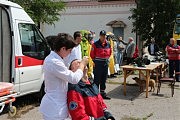
For many, the use of simple mustard plasters to relieve laryngeal muscle spasms became a discovery. Rescuers also gave children and adults the opportunity to get measured and find out their gas mask number. Protective equipment is stored centrally and will be promptly distributed to the residents of Novi Bilary in case of trouble.
Four training stations were set up on the square in front of the village council, where people were gradually introduced to the equipment of special vehicles and the actions of specialists in various emergency situations. Adults and children could try on filtering gas masks, hold gas analyzers and dosimeters, and see in action the use of chemical protection suits of different modifications.
About 2,000 people live in Novi Bilary, more than half of the adult population works at the plant and understands preventive measures and this type of training.
“We know all the intricacies and dangers of our production. Despite all our knowledge, it’s always scary when it starts to hum at night: the urea stops, and noise begins, but given our experience and today’s training, we now clearly know where to run and where the evacuation buses will be waiting for us. Such a ‘school’ is necessary, we all have children. Today they showed us how to provide assistance to a victim. Such exercises should be conducted regularly, and the equipment should be shown. You watch how the rescuers work, and you don’t worry: after all, you are protected by professionals and great equipment,” shared her opinion Irina Periatkevych, a resident of the urban-type settlement of Novi Bilary.
The residents were impressed by the fire truck based on a Scania chassis, which vividly demonstrated its capabilities thanks to the coordinated work of the employees of the state fire and rescue squad for facility protection, led by its head Vadym Fedorovskyi.
To the enthusiastic shouts of the spectators, the powerful machine “stood” on its “legs,” raised the articulated boom, and supplied water from a monitor nozzle.
Vadym Fedorovskyi told the residents of Novi Bilary about the features of this unique vehicle: “This machine was custom-made and is the only one of its kind in Ukraine. The telescopic boom can extend up to 20 meters, the pump delivers 65 liters of water per second, and it also has a foam generator, a carbon dioxide extinguishing system, various special suits, and equipment for cutting metal structures. The machine carries 4.5 tons of water.”
In addition to demonstrating the capabilities of the equipment, rescuers distributed leaflets to the public and allowed people to practically learn how to operate different types of fire extinguishers.
The training lasted several hours during a general gathering of the residents of Novi Bilary. Some took notes on the sequence of actions, some filmed the practical exercises on their mobile phones, and some actively participated in the training events themselves. The main goal of the training was achieved: the population received an understanding of the procedure for action in case of possible contamination of the territory with dangerous colorless ammonia, which is so necessary in various spheres of human activity.











