

The musical “Fiddler on the Roof” is back on the Odessa stage! The premiere of Vladimir Podgorodinsky’s production at the M. Vodyanoy Odessa State Academic Theater of Musical Comedy was a great success. The next premiere performance is scheduled for April 11.
There’s a big gap between performances: the theater has only paid the copyright holders for 15 shows so far. So, hurry to see and hear it. We, in turn, wish the musical a long stage life in Odessa: it’s worth it. The long pause between premieres will undoubtedly benefit it: many small but important details can still be fine-tuned and adjusted in its powerful and complex construction. It’s hard to write a review based on the impression of the first premiere, because any review sounds like a verdict, and that’s not what we want in this case. Our “Fiddler on the Roof” now resembles a mighty ship just launched from the slipway. This behemoth must reach its depth and gain momentum to soar over the abyss like a sea swallow!
Yes, the production is monumental, mass-oriented in the best sense of the word, and executed with a high level of acting discipline. The director’s framework was clearly visible at the first performance, which is always a good indicator of whether a play is successful. After all, the living flesh of a stage story can only grow on a properly constructed and strong skeleton.
On the foundation laid by Podgorodinsky, the actors can embark on countless improvisations. I don’t want to say that the artists were still constrained at the premiere – they were good, they were organic, they were so characteristic that they looked unrecognizable. But the acting potential is deep. Our little ship will still plow these depths. It will still test all kinds of stage “weather,” from a breeze to a storm. I think both the director and the troupe need to constantly seek new nuances, not allowing the play to become stagnant in its monumentality. After all, the audience has material for comparison – how many versions of the story of Tevye the milkman have been seen, both musical and dramatic!
Based on the first impression of the premiere, I would like to articulate what, essentially, Vladimir Podgorodinsky has brought to the familiar story that we haven’t read or seen before. And how his play differs from the usual interpretations.
About ten years ago, I had the chance to see the famous Hollywood film adaptation of “Fiddler on the Roof,” from 1971: Norman Jewison’s film version with the striking Israeli Chaim Topol as Tevye, with Jerry Bock’s music adapted by composer John Williams. It’s a great adaptation. Since we are talking about the musical genre – musicals do not belong to the “deep drilling” genres, and it’s fortunate when its literary basis is a classic, as, for example, in “My Fair Lady” – what motive will be fundamental for us? That’s right: love! Everything else, however significant it may be in the literary basis, is still a pretext and background for love’s entanglements in a musical. In Jewison’s film, Love’s adventures consisted in its self-affirmation, in the struggle against the tyranny of Tradition. Tevye’s young daughters dared to manage their own feminine essence and destiny, daring to love and choose.
For Tevye in the film, this meant the end of the world, a world turned upside down. Well, of course, as a wise man and a local philosopher, Tevye managed to understand modern youth and rebuild his own consciousness. One of the film’s most powerful scenes was the duet between Tevye and Golde, which revealed that they had lived a life together, had children, but they didn’t know this feeling – love. Habit, attachment, respect, duty – yes: that’s what family is for. But love: what is it at all?… The philosopher Tevye and the worldly-wise Golde are lost, shocked – they turn out to be like congenital invalids, something vitally important in their psychophysics has atrophied…
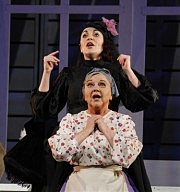
In the film adaptation, this idea was one of the main leitmotifs. In Vladimir Podgorodinsky’s production, which, like Jewison’s film, opens with an assertive chorus with a formidable refrain: “Tradition!”, – this aforementioned “red thread” is weakly discernible so far. The reason for this is the intonation of the duet between Golde and Tevye (Honored Artist of Ukraine Victoria Frolova and People’s Artist of Ukraine Vladimir Frolov): it’s too idyllic, as if a pair of doves are cooing. One might think they cherish the memories of their wedding, which their parents arranged without asking their wishes, but blindly obeying the age-old dictate of Tradition. But what kind of idyll is there! “Will it pass and become love?” Respect and attachment are still not Love. I would advise working on this key duet scene, radically reconsidering its intonation.
Why? Because, firstly, psychological accuracy is needed, and the reality is this: the spouses do not know love, like the Russian Snegurochka. And secondly, and this is very important, this psychological line is a strong support for revealing the main idea of the play: the affirmation of Freedom. True freedom is inner freedom, and where can it be most reliably affirmed than in the most intimate and unregulated sphere: love?
Here we come to the through line that the director has drawn clearly and powerfully: the theme of Freedom. Moreover… I don’t know how Podgorodinsky conceived his interpretation of Tevye’s character, but life during rehearsals offered a plot to which the director reacted sensitively and wittily. He delivered a most relevant, striking paradox. Namely, he told us what Revolution is. Which, due to Tradition, is usually considered the twin sister of Freedom…
After all, Tevye’s character has been interpreted in countless ways. A kind of matrix, which everyone is free to fill with their preferred content and meaning. There are Sholem Aleichem’s stories. There is Grigory Gorin’s play based on them, from which we actually know Tevye best from stage productions; there is Joseph Stein’s play-libretto. One can interpret it in terms of revolution, because the humble milkman Tevye happened to have a revolutionary son-in-law. One can be indignant about anti-Semitism and other intolerance; Tevye’s story contains such material. One can observe the break with the age-old way of life, the rebellion against the commandments of ancestors. Anything is possible.
Vladimir Podgorodinsky managed to fuse all these motifs together – they are dashed in the musical, due to the specifics of the genre, and when else is there time to sing and dance?! – and reveal the amazing, paradoxical transformation of the human soul, show the path of its self-discovery and ascent.
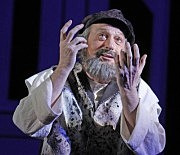
Tevye, performed by Vladimir Frolov, appears before us as a genius of conformity. He is the true pillar of Tradition. He is the guardian of the commandments passed down from generation to generation. But this adherence to tradition is driven, paradoxically, not by stupidity, but by a natural gift of empathy – the ability to empathize with the feelings of another person. In this case, a distant ancestor. A parent. And therefore, one’s own child. And a neighbor. And the Lord God, who chose the Jews, but, it seems, often as scapegoats…
And therefore, Tevye always compromises. He always finds some rightness in the actions and reasoning of others, no matter how much they may offend him at first glance. Vladimir Frolov convincingly, touchingly, and humorously portrays these qualities of his character. And so, Tevye the compromiser, usually considering his own tragic situation “from the other side,” comes up with an unheard-of heresy: “And what is a Jew and a non-Jew? And why did God create Jews and non-Jews? And if he created both, then why should they be divided?”
This thought, you must admit, is deeply revolutionary, considering the time and place, and also the terrible circumstance that his own daughter fell in love with an outsider, a “goy,” and broke with the religion of her ancestors! And when such a thought entered the mind of the most devout of the devout, then, you could say, he is already free. Free from tradition, from opinions. From desires and attachments. He has freed himself from fear. And he who knows no fear, to him all people are brothers and the whole world is home. Even when evil people in their blindness expel you from your native village, from the land of your ancestors. The eternal wanderer Tevye, leaving for the wide world with his cart in the final scene of the play, looks not tragic, but life-affirming: “As long as there is a soul in the body, as long as at least one vein is still beating, one must not lose hope.” Tevye is a victor. He has accomplished a Revolution. Not an external one. But in his own consciousness. That truly divine revolution, which is expressed in the simple phrase: “Start with yourself.”











