

Interesting Facts You Didn’t Know About Pelmeni
Initially, the name of this dish consisted of two Udmurt words – “ear” (pel) and “bread” (nyan). A piece of meat wrapped in dough indeed resembled a human ear. Well, “pel-nyan” eventually turned into pelmeni.
Europeans call pelmeni their invention from the Middle Ages, the Chinese call them theirs. But the universally recognized, ideal pelmeni are Siberian. Loved by the Udmurts, they were also liked by the Komi-Permyak peoples and Russian Siberians. And from about the 14th century, the spread of this delicacy throughout Russia began. The invention was liked because the meat could be stored for a long time in the frost before cooking, and being wrapped in dough, it masked the smell that attracted predators.
Pelmeni had ritual significance, associated with animal sacrifices to the gods. Therefore, classic Ural pelmeni are a mixture of three types of minced meat: beef (450 g per 1 kg), lamb (350 g), and pork (200 g). A very small amount of pepper is added to them, finely chopped onion – in moderate quantities, a little fresh cabbage, grated radish, and finely chopped herbs. Due to the vegetable additives, the tender filling does not turn into a monolithic hard lump during cooking, threatening to tear the dough casing.
The dough for pelmeni is prepared with the addition of eggs, which allows it to be rolled out quite thinly during preparation. The thinner it is, the tastier the pelmeni. Their shell strength does not decrease during cooking. Interestingly, at first, eggs not from domestic chickens, but from partridges, quails, or bustards were added to the dough.
It is believed that if a pelmen floats to the surface during cooking, it is ready. This is not entirely true if you want to cook pelmeni correctly. The fact is that Siberians added ice water to the filling before shaping, and after shaping, they were placed in the harsh Siberian frost. The freezing water guaranteed the tenderness and juiciness of the meat during cooking. But – surprise! – such an “icy” pelmen would float to the surface twice during cooking!
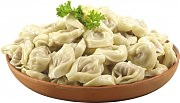
There is a tradition: the last pelmen prepared for consumption is made with an unusual symbolic filling. Greens symbolized joy, pepper – love, sugar – a successful and carefree year, a coin – wealth. Well, if the pelmen turned out to be completely without filling, made entirely of dough, you will be happy. By the way, if the host serves you pelmeni not only in a large dish but also with a generous “heap,” it means he is clearly well-disposed towards you and friendly.
There are also traditions associated with Chinese dumplings, but their peculiarity is that to fulfill wishes, you need to eat a certain number of “bread ears.” If you want double joy, eat two pieces; happiness is brought by 3, 6, and 9 dumplings; a rich and bountiful harvest year – 4 or 5. Those who wished for a successful year, good health, and lasting happiness had to eat a dozen at once.
The most expensive pelmeni are made at the Golden Gates restaurant in the Bronx, New York. If you want to try them, prepare your money: a portion of eight dumplings will cost $2400 (!!!). Of course, if you are not put off by the blue-green color of the dumplings that phosphoresce in the dark. The reason is that the filling contains iron from a deep-sea lanternfish.
It would be strange if such a popular dish did not deserve a monument, at least in its “historical homeland.” And for ten years now, a monument to pelmeni has graced Izhevsk, attracting all tourists like a magnet. It is claimed that it is here that the geographical point where the world’s first pelmeni were prepared is located.
According to dream books, if you dream of making pelmeni, it means you lack family coziness. One can good-naturedly laugh at dream books, of course, but the tradition of making pelmeni as a family is a kind ritual of the family hearth. A number of experts in spiritual practices even call this process family meditation.











