

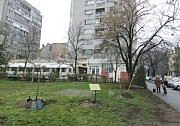
On the initiative of the Odessa Literary Museum and the “Mir Paustovskogo” Literary Society, supported by the historical and toponymic commission of the city council, on November 22, a memorial sign was installed and two cherry trees were planted at the intersection of Zhvanetsky Square and Torgovaya Street, on the site that served as the prototype for Anton Chekhov’s play “The Cherry Orchard”.
According to local historians, in the play “The Cherry Orchard,” written in 1903, Chekhov depicted the real story of the sale of the Odessa estate of Olga Rodionovna Vasilyeva, the adopted daughter of the wealthy landowner Zherebtsova. In 1900, Vasilyeva inherited all of Zherebtsova’s fortune, including the estate with a cherry orchard at Torgovaya Street, 1. A few years earlier, Olga Vasilyeva met and befriended Chekhov in Nice, and translated his stories into English. During his visit to Odessa in 1901, Chekhov visited the cherry orchard on Torgovaya Street and met with the brokers involved in selling the orchard. Vasilyeva wanted to use the money from the sale of the estate to build a tuberculosis sanatorium in Odessa. Anton Pavlovich, who suffered from this disease, took an active part in this.
Nevertheless, the estate was only sold in 1909, after Chekhov’s death. According to theater critics, Anton Pavlovich based the character of Anya, Ranevskaya’s daughter, in the play “The Cherry Orchard” on Olga Vasilyeva, and her old manager Lukashov on Firs. As for the cherry orchard itself on Torgovaya Street, 1, according to eyewitness accounts and documents, after 1917, both it and the estate fell into disrepair. The garden, house, outbuildings, stables, and all structures became dilapidated and were destroyed. And after 1945, the estate was demolished altogether.











