

At the time of writing these notes, the most striking performance in the festival program appears to be “Morphine” – a production by Vladimir Pankov based on the novella of the same name by M. Bulgakov, presented by the Moscow theater “Et cetera” of Alexander Kalyagin…
Some viewers could barely endure the thundering and mind-boggling (literally) spectacle. Others couldn’t sit through it, and these were seasoned theatergoers. But overall, the hall was delighted. The Odessa directors I asked, however, comically winced, swore: “I will never shoot up!” – or asked, but what is all this… circus acrobatics for?! I want to answer to the best of my understanding, assessing the merits of the play and noting its weaknesses.
V. Pankov’s play is indeed full of merits. Impeccable plastic training, flawless live singing of operatic parts – by dramatic actors. The jeweler’s precision of the director’s drawing and the flexible pliability of the actor – an ideal puppet, which, in fact, is needed for the theater of representation. Before us is a theater of representation, a theater of plastic metaphor, a theater of carnival grotesque, this is undeniable. In this case, the creative result is adequate to the claim, the idea finds optimal embodiment, talent is evident in the director. A dangerous talent of a showman director with an overabundance of imagination. Such performances – they are like the Baroque style in architecture: at first glance – it delights, at second – it tires, at third – it irritates, and you begin to look for a spiritual component, the presence of which, for example, in the exquisite angel of Lorenzo Bernini is somewhat doubtful…
So, after the first viewing – I watched it twice – I had the feeling that the lush, restless, convulsive embellishments of the Baroque were placed on a building without a foundation. After the second viewing, I understood: there is a base, the question is: how solid is it?
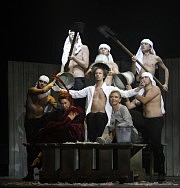
After all, the very first plastic statement – with a claim to shock: Doctor Polyakov (Anton Pakhomov), sent to work in the Russian backwoods in early 1917, is tightly surrounded by a crowd – symbolic people, and these people are all in Gulag padded jackets, rough boots, and ushankas. If this is a claim to the future, then what does the zemstvo doctor Sergei Polyakov have to do with it?..
The kinship of the intellectual Polyakov with the suffering people is declared, however, directly: the doctor, abandoned by his mistress, drowns his soul’s wound with vodka, and the people pour it for him, crowding him so much that the subtle intellectual barely breaks through the mass. This is one of the many unobtrusive plastic allegories in the play. Not as striking as, for example, another: the orchestra constantly present on stage… by the way, why is it here? to accompany Polyakov’s visions, in which his mistress, an opera star, appears? or is it like an ancient choir? or maybe… this: “listen to the music of the revolution with all your heart, with all your consciousness”? – well, the orchestra once forms a procession, carrying a double bass over their heads like a lacquered coffin, and we understand: since Polyakov resorted to a morphine injection – his death is not far off. Or: over the head of the opera diva, the folk extras wave their shovels like fans, reminding us of the “proletariat-gravedigger”…
…Polyakov is tormented by neuralgic pains, and the nurse Anna Kirillovna (People’s Artist of the Russian Federation Tatyana Vladimirova) – oh, this Russian female pity – injects the sufferer with morphine. Having tasted euphoric oblivion, the young doctor seeks it again to drive the treacherous diva, the opera Amneris, from his imagination. She, however, relentlessly pursues him with her arias, if not in memory, then in drug hallucinations, and the people sing along with her.
But how this dark people transforms before our eyes, revealing multiplicity of hypostases! Suddenly it sheds its padded jackets, baring its torsos: machismo under the rough cloth, irrepressible riot, aggression of the flesh, fraught with the lawlessness of Stenka and Emelka! And now it ties white shirts on its heads, tucking the sleeves into the back of its neck, and before us are soldiers of a colonial army in hot countries – should we decipher the allusion? By the end of the narrative, the people, speaking in parts from “Aida,” will generally transform into ancient Egyptians – this is justified by Polyakov’s hallucinations, the visions of Amneris-the-beloved – and the last transformation will bring Polyakov’s story into timeless parameters, hinting that this personal tragedy is universal, independent of any revolutions and authorities, and that all that we call “culture” and “eternal values” is actually quite relative and does not save man from demonic possession…
How the demon of morphinism possesses Polyakov and how it relates to the demons that simultaneously seized Russia, this, it seems to me, is the pathos of the play “Morphine.” Is not “world revolution” and “education of a new person” at any cost the same diabolical narcotic stupor?
“Physician, heal thyself”! The main connecting stroke: Polyakov is a doctor. A doctor: a savior, a giver of hope. And if he is morally ill, then what can be said about society? And here is the nail in the rough boot of this bright play. Let’s figure out what is so annoying…
Maxim Obrezkov’s scenography is deadly accurate, capacious to the infinite capacity of meanings. The stage is enclosed by a wooden fence around the perimeter, from which heavy benches are broken out – all according to Bulgakov: “Rus’ is a wooden, poor and… dangerous country…” – well, that is, according to Dostoevsky, whispering to Bulgakov’s characters in their nightmares. The benches can become bunk beds, an operating table (worn enamel buckets are placed on the proscenium – and the village hospital is evident), a cage, a triumphal platform, a bathtub…
The scenes of Polyakov’s degradation are plastically developed astonishingly. And try to object that it’s not according to Bulgakov: “In a word, the person is gone. He is switched off. A corpse moves, grieves, suffers,” – thus the hero of the novella notes his drug withdrawal, and Anton Pakhomov’s character, more than once – perhaps even excessively, – brilliantly translates this wording into the language of the body, running around the stage with his pants down, drooping, writhing, and rising after an injection, like a revived Frankenstein or a coded zombie. It is so impressive that you truly vow: “I will never shoot up.” And these melodeclamations, breaking into grotesque rap!..
The picture of human degeneration is unfolded in the emanations of “culture” sitting in the intellectual consciousness: arias and choruses from “Aida” are performed with the grace of hidden irony, with a slight hint of commenting sarcasm. And let’s give credit to Irina Ryndina’s excellent mezzo – Amneris. As well as to Tatyana Vladimirova’s excellent performance – the awkward, aging, rough (all contrary to Bulgakov) Anna, with whom Polyakov cohabits for a dose…
…When dealing with such a show theater, I like to observe the mathematics of directing in it – like one of Bulgakov’s heroines, I am delighted by everything that is done brilliantly. Here is a scene where Polyakov burns a newspaper with an announcement of “Aida” in a bucket – I watch it for the second time: not a iota of deviation, the gesture and pause are calculated to the nanosecond. The actor lights a match in the same way, it burns in his hands for the same amount of time… they at “Et cetera” seem to have even the matches trained! Such are the subtleties of the theater of representation: thus, I once observed with what impeccably worked-out organic rhythm Carmen’s leg twitched from evening to evening in Zholdak’s play, being dragged away by a rapist…
Yes, but what is the point of all the “circus”? What is disturbing about it? And here’s what. In Bulgakov, Doctor Polyakov tells us the story of his illness through an intermediary, a narrator – Doctor Bomgard, into whose hands the diary of the deceased fell, and who decided to publish the notes for universal edification. Bomgard emerged from “A Country Doctor’s Notebook,” he carries within him the best that was in the Russian intelligentsia – duty and honor: his life was a “combat post, where I alone, without any support, fought diseases, with my own strength, like a Fenimore Cooper hero, getting out of the most bizarre situations”…
In Vladimir Pankov’s production, such a beginning is not contrasted with the central hero – also a doctor. Sergei Polyakov here is the center of the universe, and he is weak-willed, he is susceptible to vice, he is devoid of masculine principle, he is not self-sufficient, he, in the end, does not command respect. And it occurs to me, when comparing Polyakov with the Gulag padded jacket, to formulate the play’s ultimate goal: all this revolution with the subsequent GULAG became possible precisely because the Russian intelligentsia is shit, as V. I. Lenin formulated…
Whether this is true, discuss it yourselves. In any case, withdrawal pains torment us to this day. And our surgeon-saviors have turned into marauders. Who can explain – why?..











