

The name Russov is well-known to Odesans. Unfortunately, this is not because grateful descendants honor the memory of a fellow countryman, honorary citizen, millionaire, philanthropist, and vice-president of the Odessa Society of Fine Arts, Alexander Petrovich Russov.
In his not-too-long life (Russov died in 1908 at the age of 61), he built a number of magnificent buildings in Odessa that became the adornment of the city. And, being a great lover of fine art, he assembled a unique collection (850 paintings), which was housed at the very beginning of Torgovaya Street, in a specially built gallery with an area of 3150 sq. meters.
The gallery was open to all residents of Odessa at the time. The words of Alexander Petrovich Russov, spoken at the opening, have been preserved in newspapers of that time: “…I tirelessly collected everything I found best and outstanding among the works of Russian artists, and assembled a collection of paintings that was quite large in quantity (over 850 canvases) and very valuable in quality. Deciding to utilize my art collection for educational purposes, presenting it for free viewing to all who are interested in art, I, at the same time, arranged it in such a way that for young aspiring artists it would undoubtedly serve as a visual school of native art in its best and rarest examples.”
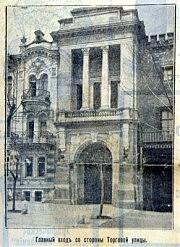
Unfortunately, all this magnificent heritage can already be considered lost. The days of the Russov house on Sobornaya Square are clearly numbered, and there is no doubt that the hour is not far off when, instead of a unique example of early 20th-century architecture, a multi-story “something” will appear here – like a shopping center.
As for A. P. Russov’s painting collection, after the 1917 revolution, the gallery on Torgovaya Street found itself in the epicenter of the civil war. The Red Guard headquarters was located there, which was repeatedly shelled. Paintings were destroyed and stolen. Starting in 1920, everything that remained of A. P. Russov’s collection was nationalized. Some paintings were sold abroad, and some were distributed among various Soviet institutions. Only in 1923, 119 surviving paintings (out of 850 canvases) were transferred to the collection of the Odessa Art Museum on Sofievskaya Street, where they have been preserved to this day.
The fate of the gallery building itself, which housed A. P. Russov’s painting collection and was a cutting-edge exhibition complex in the south of the Russian Empire in 1903, also turned out to be tragic. The gallery on Torgovaya Street, 2, which survived the civil war, was turned into the House of Nationalities. Then the building was handed over to the military sailors, and the headquarters of the Odessa Naval Base was located there. In July 1941, when the active bombing of Odessa began, the headquarters building was destroyed.
Now, in its place is a public garden with a bust of twice Hero of the Soviet Union A. E. Nudelman. Behind the public garden is house No. 2 on Torgovaya Street, where artists live and the exhibition hall of the Odessa branch of the Union of Artists of Ukraine is located. So, it can be said that continuity has been maintained.
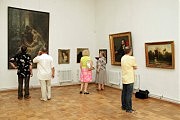
On the occasion of the 110th anniversary of the founding of Alexander Russov’s art gallery, an exhibition “A. P. Russov. Wishing to provide all possible assistance to native art” opened on June 27 in the exhibition hall of the Odessa Art Museum (Sofievskaya Street, 5A), which presented all 119 works preserved in the museum. Among them are works by such great artists as I. Aivazovsky, I. Shishkin, I. Levitan, A. Vasnetsov, I. Repin, L. O. Pasternak. As well as less famous ones, such as I. Asknaziy, Ya. Brovar, A. Egornov, P. Kovalevsky, S. Krivolutsky, A. Popov, V. Simov, I. Tikhomirov, K. Shershevsky, which clearly demonstrate the diverse palette of the artistic development process of domestic art of the late 19th – early 20th centuries.
I sincerely hope that the opened exhibition will not only be an event in the cultural life of Odessa but will also serve to awaken historical memory. And that the examples of selfless service to one’s city and country, which our past is so rich in, will find their continuation in our days.











