

On Saturday, the festival of the Moscow magazine “Oktyabr” and the Odessa Literary Museum will already be open at Batumi University. In Batumi, a “landing party” of writers will disembark from the ferry “Greifswald,” provided by the company “Ukferry.” The Moscow — Odessa — Batumi route is undertaken in memory of Vladimir Mayakovsky’s similar journey, which he made twice, in 1914 and 1924. The editor-in-chief of the magazine “Oktyabr,” Irina Barmetova, will give poetry lovers in Batumi the opportunity to familiarize themselves with the exhibition “Mayakovsky, 20 Years” in the format of a video project.
This video material, under the motto “Mayakovsky Forever,” was presented as part of the festival in Odessa. It is based on a historical exhibition that lay dormant in the storage of the State Museum of Literature in Moscow for many years. As is known, in January-February 1930, Mayakovsky organized a personal exhibition – a creative report dedicated to his literary, artistic, and lecture work over twenty years. It is also known that neither his “brothers in literature” nor official figures paid attention to the exhibition…
The film was shown against the backdrop of works by ROSTA Window artists. The exhibition was prepared by the Historical and Local Lore Museum and the Literary Museum of Odessa. The exhibition dedicated to Mayakovsky, featuring lifetime editions of his works, photo documents, and other materials, was organized by Anna Bozhko, a leading researcher at the Literary Museum. The original drawings from life are curious: for example, the album sketch “Reading Mayakovsky” by artist G. Furse, dated 1912. A unique exhibit is presented – the original portrait (cardboard, oil) of Maria Denisova – Mayakovsky’s great love in Odessa, who inspired him to write the poem “A Cloud in Trousers.” The portrait was painted in 1909 by E. Bukovetsky, a member of the Society of Traveling Art Exhibitions. The girl was beautiful! For such a one, one could compose passionate poems.
“I am a Cossack by birth, a Zaporozhian by upbringing, and a Georgian by birth,” wrote the Poet. So the traditional route of the festival was very fitting for the 120th anniversary of the birth of Vladimir Vladimirovich. Moreover, “Modern Georgian poets were discovered for Moscow and the CIS thanks to the ‘Silk Road of Poetry’ festival held in Odessa in 2004,” notes Irina Barmetova. “Now Georgian poets are participants in Ukrainian festivals, particularly ‘Kyiv Lavra.’ We have prepared a substantial book of translations of contemporary Georgian authors in Moscow.”
Before the departure of the festival participants, many events and creative meetings took place at the Odessa Literary Museum. One of the festival’s highlights was a meeting with Boris Asafovich Messerer on May 20. This year, the renowned stage designer, People’s Artist of Russia, corresponding member of the Russian Academy of Arts, and laureate of the State Prize of the Russian Federation, Boris Messerer, turned 80, but who would have thought it, looking at him and listening to him?! The meeting in the Sculpture Garden felt like a heartfelt gathering in an intellectual kitchen of bygone days. Boris Asafovich is a magnificent, sincere, very informal storyteller. He vividly depicted his friendship, and that of his wife Bella Akhmadulina, with Vladimir Vysotsky and Marina Vladi, recreating the atmosphere of those years and places. The artist presented his memories in the book “The Flash of Bella,” excerpts from which were published by the magazine “Znamya” in 2011. The meeting with the people of Odessa was held “based on” this book…
Currently, Boris Messerer, the husband, comrade-in-arms of the Poet (I deliberately do not write “poetess”), a meticulous collector of Bella Akhatovna’s archive, is concerned with one task: to worthily immortalize the memory of his outstanding wife. He created a monument on which Bella Akhmadulina appears as she was seen by poetry lovers: head thrown back, arms extended as if about to take flight – this is how she usually read her poems. The author wanted to erect the monument in Tarusa, a town Bella loved to visit and to which she dedicated many lines. Alas, the Tarusa authorities showed no interest in the project. Then Boris Messerer established contacts with the authorities of Kazan – it was from Kazan that he came to us for the festival…
There were interesting “round tables.” The staff of the Literary Museum were particularly pleased with the discussion “The Three Fat Men and The Twelve Chairs,” dedicated to the 85th anniversary of the publication of the legendary works by I. Ilf and E. Petrov and Yu. Olesha. Participants in the discussion included Alexandra Ilf, Alena Yavorskaya, Igor Volgin, Valery Khait, and many others.
A debate, based on publications in the magazine “Oktyabr,” on the topic “Contemporary Literature on the Verge of a Nervous Breakdown (Is Literature Capable of Responding to the Challenges of the Time)” turned into a “Freudian slip” by one of the participants, Alexander Dmitriev: “Russia is on the verge of a nervous breakdown.” This is because “the country has no clear concept of development, no common, whether approved or condemned, vector – a look into the future. Many writers are floundering in the superficial mainstream.” But can this only be said about Russia?! Isn’t the same true in our independent homeland?..
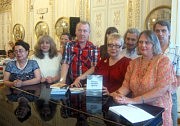
In this context, Irina Barmetova’s remarks were very interesting. Traveling through the CIS countries and regions of Russia with compact ethnic populations, Barmetova discovered a pattern: culture is “between Scylla and Charybdis” – on the one hand, it experiences pressure from nationalists, and on the other, it is panic-stricken by provincialism, “ghettos,” and “reservations.” Because of this fear, culture loses its originality, color fades from works, local realities are eradicated, and averaging and sterility of creativity are observed. If, as the discussion participants noted, Marquez had been ashamed of the local flavor and the provincial status of his country in the world, the world would not have seen his masterpieces!
And are the definitions “Moscow writer,” “provincial writer” even correct? It’s about the quality of the text. As I noticed (if, of course, we are comparing truly literary texts, because the festival microphone was generously provided to poets both good and varied), the quality of texts by Muscovites and Odesans was often on the same level…
What kind of festival without presentations? Firstly, the project “Poet of Ukraine. Poet of Russia” by the Kyiv publishing house “Laurus,” headed by Polina Lavrova from St. Petersburg, with the participation of A. Dmitriev, I. Barmetova, P. Midianko, and A. Zarakhovich, was presented. A significant event for Odessa was the release of the book by the Kyiv publishing house Dmitry Burago “Verbs of Our Time”: poems by twenty Odessa poets who, 20 years ago, were part of the literary studio “The Circle.” The compiler of the book was Yuri Mikhailik, the head of “The Circle,” an Odesan poet now living in Australia.
Eight pupils of “The Circle” remain in Odessa: Anna Son, Olga Ilnytskaya, Olga Kovalenko, Mark Epstein, Slava Kitik, Anna Streminskaya, Valery Sukharev, Alexander Molchanov. At the presentation, they read poems – for themselves and for those who are overseas…
“I remember the presentation of the first book of ‘The Circle’ – ‘Free City’,” said the vice-president of the World Club of Odesans, Evgeny Golubovsky: “The Club owns the publishing project. Ruslan Bodela, Evgeny Demenok, and Dmitry Burago helped us financially with the publication of ‘Verbs of Our Time.’ And this second book is even better: simply, during the time of the first, the ‘breath of freedom’ was felt more acutely.”
“Odessa is spread everywhere, and wherever it is, which is all over the world, the release of the book will be an event,” said Olga Ilnytskaya. “Our stretching ‘for the entire length of separation’ has now been shortened,” with these words, Valentina Golubovskaya read a poem by Yu. Mikhailik…
“Not to divide writers into Moscow and Odessa, but to create a unified literary space” – this goal, formulated by Irina Barmetova, is served by the 53rd issue of the almanac “Deribasovskaya — Richelievskaya,” presented in the Golden Hall. In this issue, writers from Odessa and authors from the magazine “Oktyabr” – I. Volgin, Yu. Arabov, B. Messerer, A. Arkhangelsky – are featured equally. The almanac is part of the literary project “Odessa Library” by the company “Plaske.” “We want the almanac, which is gaining popularity, to be sold: in Odessa and abroad in Ukraine,” noted Ivan Liptuga, vice-president of the company. “The publication owes its substance to the productive work of the editor-in-chief Felix Kokhricht and his colleagues Evgeny Golubovsky and Oleg Gubary.” The historical and local lore section of the almanac is worthy of Moscow publications, believes Irina Barmetova.











