

Poland’s closest European neighbor, Poland, invited journalists this autumn by the Polish Tourism Organisation. On average, Poland receives 2.5 million Ukrainian tourists a year, presenting itself as beautiful, well-maintained, respectful of its history, hospitable, polite, delicious, finally. I had the personal opportunity to see this for myself by visiting the third largest voivodeship, Lublin — this region was chosen by the trip organizers to host the third “Ukraine — Poland” journalistic forum.
Tourist Product
There is much talk about the need to create and promote it in Ukraine, and in Odesa in particular. But, unfortunately, little is being done. How seriously our Polish neighbors are engaged in this is evidenced by the figures alone: the Polish Tourism Organisation — a professional state organization responsible for promoting the country as a tourist destination on the foreign market — has its own line in the state budget, and today it has representative offices in 14 countries around the world. The representative office in Kyiv opened at the end of 2007 and has been successfully operating under the leadership of Mr. Włodzimierz Szczurek. In Poland itself, regional tourism organizations have been created in each of the 16 voivodeships, and there are also local tourist information centers. An industry that brings income to many, many countries does not deserve to be “in the shadows,” and the fact that Ukraine today has not a single tourist representative office abroad is very regrettable. Relatively recently, a tourist information center opened in Odesa as a communal enterprise at Pushkinskaya Street, 2. It is still gaining momentum, and in this regard, here is some information about how tourist information centers are organized in Poland. During the trip, we visited many of them. They are present in every touristically attractive area, always in the city center, near train stations and airports. Here you will be provided with guidebooks, maps, directories in various languages, helped to plan the most advantageous route and organize accommodation, and advised on prices. Here you can leave your luggage for a while, you can rent a bicycle and go on an excursion. In short, the desire to be useful to visitors in all respects is immediately felt. The care for tourists with special needs is particularly impressive. In particular, the “Tourism for All” project has been implemented — for 10 months, work was carried out in all voivodeships to create an online database on the accessibility of tourist infrastructure for tourists with special needs. Thanks to this work, it has been confirmed that there are 5017 objects on the territory of Poland accessible to people with various physical disabilities. The list includes places to stay, shops, parks, cultural objects, etc. Moreover, with detailed information — whether there are ramps for wheelchairs, elevators, whether the doorways are wide enough, and what the staff’s qualifications are.
Cities and Towns
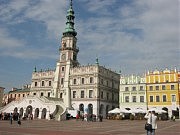
Zamość is the first city on our route, a UNESCO World Heritage site. Built in 1600 at the wish and design of one person — Crown Chancellor Jan Zamoyski. He liked Italian cities and commissioned an Italian architect, Bernardo Morando, to realize his idea, who designed the city based on the model of Padua. The beautiful Town Hall with a tower, houses with arcades surrounding the Market Square — an ideal city built on the principle of a pentagon. Zamość is considered extremely calm and comfortable for living. Although in the distant past it was a fortress city, part of the fortress has been preserved and now serves quite peaceful purposes — performances, concerts, shops. An interesting detail: the current mayor, Marcin Zamoyski, is a descendant of the city’s founder. He is elected for the third time. In addition to the pearl of the Renaissance, as Zamość is called, tourists are attracted by the nearby Roztocze National Park — a true kingdom of thermophilic plants of Southeastern Europe and Polish horses — descendants of the famous wild tarpan breed that lived here for centuries.
Chełm is another ancient city. The former capital city of King Danylo Halytskyi, until 1770 — the main city of the Chełm Land of the Ruthenian Voivodeship of the Polish-Lithuanian Commonwealth. From Cathedral Hill, where the Basilica of the Nativity of the Blessed Virgin Mary is located, the view is simply magnificent! For several centuries, Chełm was famous for the miracles of the icon of the Blessed Virgin Mary, which is now kept in the city of Lutsk. People from all over Ukraine come to venerate the shrine. In Chełm, we were shown a house on Sienkiewicza Street with a memorial plaque: “Mikhailo Hrushevsky, Ukrainian historian, first president of the Ukrainian Republic, was born here in 1866.” Ancient churches and chapels are actively visited by tourists from different countries in Chełm. No less interesting to them are the chalk caves — chalk was mined for centuries under the old town, resulting in a multi-kilometer labyrinth of winding passages, adits, tunnels, and wells. And this attraction of Chełm has been turned into a high-quality tourist product — about 2 kilometers of chalk workings have been turned into a tourist route, with a depth of 2 to 8 meters, all existing myths and legends about the underground have been collected, including those about the spirit Belyukh, the guardian of supposedly hidden treasures. Well, when the “spirit of Belyukh” unexpectedly appears in the narrow space of the caves — tourists are also provided with plenty of thrills…
In Kozłówka, the luxurious palace and park complex of the Zamoyski family is noteworthy. The lavishly furnished palace, the Italian garden and the English-style landscape park, the carriage yard. After the war, the remaining family members emigrated to Canada. The ancestral home became a museum. As the guides told us, the heirs at one time made claims and eventually agreed that the state would pay them some compensation and allow them to live in specially designated apartments for two months a year. Interestingly, Kozłówka is known not so much for its palace (there are many such in Poland!), but for the… gallery of socialist realism located here. As we were told, during the Polish People’s Republic, warehouses of the Ministry of Culture were located in this territory. When they started clearing out the piles of paintings depicting Stalin, Dzerzhinsky, Gorky, sculptures and busts, slogans and posters, they decided to exhibit everything. And it turned out that they had created a gallery of socialist realism, the first in Poland and perhaps the only one in Europe.
The capital of the voivodeship is Lublin, which entered history textbooks as a city of Magdeburg Law and the Union of Lublin, will soon celebrate its 700th anniversary. But if you look at it from the height of the Trinitarian Tower, you can see how wonderful it looks for its venerable age. The old defensive tower, the Cathedral, the Dominican basilica… The most impressive is the Chapel of the Holy Trinity, which is considered one of the most valuable monuments of medieval art in both Poland and Europe. Its global uniqueness lies in the combination of Byzantine-Russian painting with Gothic architecture. The frescoes, depicting scenes from the Old and New Testaments, could have been lost forever — in the early 19th century, the inner walls of the chapel were covered with plaster, but fortunately, people were found who undertook many years of difficult restoration work.
The charming town of Kazimierz Dolny captures the heart at first sight. As the mayor, Grzegorz Duna, told us at a meeting, the town, with only 2,000 inhabitants, is visited by up to a million tourists annually! Artists and painters love it — there is no better place than this town on the Vistula for plein air painting and various festivals. It is also known as the town of lovers — it somehow creates a romantic mood.
Revitalization, Polish Style
The concept characterizing the processes of restoration and reconstruction is interpreted more broadly in Poland: revitalization means bringing back to life while preserving the old, historical. The state spends considerable funds on the reconstruction of ancient buildings in large cities and small towns. True, everywhere we visited, representatives of local authorities said: the scale of such work has significantly increased since Poland joined the European Union in 2005. For example, the small town of Zamość has already spent 100 million euros since then, 43 percent of this amount went to the reconstruction of the old town. And the small Kazimierz Dolny received 10 million zlotys for the restoration of historical monuments, which is more than the town’s annual budget. According to the mayor, the appearance of the city is zealously monitored by the state, local authorities, and the public. In the capital of the Lublin Voivodeship, the historical part of the city is reconstructed according to a plan, adhering to strict rules. And no one living in an old house is allowed to rebuild anything at their own discretion. We have already seen vacated old houses prepared for restoration. If there are frescoes on the exterior walls, they will certainly be preserved as much as possible. In one of the quarters of Lublin, where work is about to begin, the posters in the window openings were striking — faces of people from a bygone era. It turned out that after the resettlement, about two hundred old photographs were found. Whose? Who are these people? A creative idea emerged to make posters the size of the windows and hang them up — perhaps some descendants would recognize them? Alas, they told us, only two townswomen have recognized their ancestors so far. But the search continues, and the media are involved in this.
The careful attitude of Poles towards their heritage cannot fail to be noted by everyone who visits the country. Such is the nature of tourist interest — we are primarily attracted by antiquity.
Dora Dukova.











