

November 24 — Day of Remembrance of the Victims of the Holodomor
The fourth Saturday of November is a day of mourning for Ukraine. In 1998, by decree of President Leonid Kuchma, the Day of Remembrance of the Victims of Holodomors was established for the first time. Eight years later, the Law “On the Holodomor as Genocide of the Ukrainian People” was adopted.
A few years ago, the Kyiv Court of Appeal, which considered the materials of the criminal case on the commission of genocide in Ukraine in 1932-1933, named the final number of human losses from the Holodomor in our country — more than 10 million people. Almost 4 million died directly from starvation, and 6 million are unborn. Anyone can honor the memory of the innocent victims — light a candle in the window at 4 p.m. on this day.
This unquenchable candle unites all Ukrainians, wherever they live. The idea to make it a symbol was proposed by the famous American scientist James Mace (he is called the historian of Ukraine of the 20th century), speaking in 2003 to the deputies of the Verkhovna Rada and talking about the American commission on the Holodomor. He believed that a candle in the window is an act of confirmation that national memory exists.
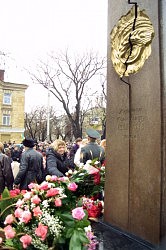
In the morning of November 24, a ceremony of laying flowers and compositions of rye and wheat ears will be held at the memorial sign on Lidersivsky Boulevard. The leadership of the city and region, representatives of public, youth, veteran, and religious organizations will take part in it. Memorial services for the victims of the Holodomor will be held in the churches of Odesa, and thematic lessons, lectures, and discussions will be held in schools and libraries, designed to remind of the terrible tragedy in the history of our people, which was hushed up for many years.
Today, dozens of books have been published that tell about what the Ukrainian people had to endure in 1932-1933, and the memoirs of thousands of witnesses of the Holodomor have been published. As regrettable as it is, even now, after the revealed truth, one can still hear the opinion of some people, saying that this topic is too politicized for the benefit of certain politicians, and the scale of the tragedy is greatly exaggerated. And was there even a famine in the breadbasket of a mighty power?
It was necessary to turn not even to the memories of people who survived the Holodomor, but to the dry archival documents of that time. Silent historical references sometimes sound more convincing and eloquent. Here are just a few from the vast number of documents stored in the archives.
A “Secret” report to the Odesa Regional Control Commission of the Workers’ and Peasants’ Inspectorate on cases of cannibalism in the Krivoozersky district: “Collective farmers O. Romanchyshyna, P. Ishchenko, I. Bondar in the early days of March 1932 dug up the buried corpse of citizen Matrona Mondrina in the cemetery, divided it among themselves, boiled and ate it.
Poor Daniil Golovatyuk buried his deceased mother in the cemetery and that same evening dug her up, brought her home, boiled and ate her… Middle peasant Anton Masnyuk brutally killed his 2 children — girls aged 4 and 3. During the search, corpses and part of boiled meat were found. Poor woman Evdokia Ridka killed 2 children — a boy aged 3 and a girl aged 1.5 years, whose meat she ate. Her husband Yevgeny Ridka is in prison, arrested for stealing and killing a collective farm horse. In the village of Sekretarka, 12 people who ate human flesh were identified and detained.”
Summary of the Odesa Regional CC WPI on the state of the starving population of the city of Zinovievsk and Zinovievsky district of Odesa region: “From January 13 to February 17, 1933, 12 people were treated in the local Adzham hospital due to severe exhaustion. Such patients are provided with limited assistance due to the lack of food products. 18 people died from exhaustion, mostly children. However, there is no accurate record of mortality, especially in cases of death on the outskirts of the village. The starving are provided with assistance on the spot by issuing weed — panic grass, and many collective farmers are so weakened that they are unable to grind panic grass seeds.
The family of Yefrem Kovalenko, 38 years old, his wife 35 years old, four children aged 1 to 6 years. The whole family lies on the stove. The adults are swollen, the children are all severely emaciated. When asked “What are you sick with?”, Kovalenko’s wife answers with tears and a plea to save the family from hunger, they haven’t eaten anything for 4 days…
Nazar Zashlyakhovsky, a family of 5. Four children aged 8 months to 8 years. His wife recently froze to death on the way to Zinovievsk. The children and father are swollen. There is absolutely nothing in the house — everything has been sold. It’s cold, unheated. The family ate their dog. Zashlyakhovsky asks to take his children away somewhere and save them, because he knows he will die… The widow Natalia Andrianovskaya asks to take her three children so that they do not die before her eyes…”
Certificate of the responsible instructor of the Odesa Regional CC WPI on cases of death due to malnutrition in the Pervomaisky district: “As of March 14, 1933, the following deaths from malnutrition were registered in the villages of the district: Kryshka — 4 people, Dolgaya Pristan — 4 people, Dorozhniki — 15 people, Vitoldov Brod — 7 people, in Konets-Pole — 60 cases of swelling. In addition, cases of death were registered at the Goltyan section railway station — 9 people died in 13 days of March, 17 in February. In the first days of March, 2 people threw themselves under a train. In February, 40 children were abandoned. According to the GPU agent, all these cases were due to malnutrition.”
From the report of the secretary of the Klintsovsky village council of the Zinovievsky district: “I personally checked several families who are in a difficult financial situation, there is nothing to eat. Ivan Okolyushny has 5 children. When I entered the hut, I saw that he and his wife were crying like small children, begging for salvation. The children were also crying, they had lees from kvass on the stove, they were drying them and then eating them… Currently, there is a large influx of collective farmers to the collective farm board for help, from early morning until late at night they ask for help, many collective farmers are asking for certificates to leave Ukraine altogether. Schools are 50% empty. It’s a pity to look at the schoolchildren, the children are pale, yellow.”
…Light a candle in memory of the millions who died of hunger.











