

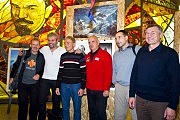
The assembly hall of the Polytechnic Museum in Moscow was packed. People were standing, their palms sore from applause. They weren’t honoring popular poets, beloved bards, or pop idols. The “birthday celebrants” were 68 people, not too well-known in general. Each of them had fulfilled their dream – conquered the highest peak in the world.
The congress of Everest conquerors from the former USSR countries gathered climbers from Azerbaijan, Belarus, Georgia, Kazakhstan, Kyrgyzstan, Latvia, Lithuania, Moldova, Russia, Uzbekistan, and Ukraine.
Our city was represented by Honored Master of Sports Mstislav Gorbenko. He was awarded the Honorary Badge “Everest Climber” number 14. If a similar award had been established in Ukraine, the certificate issued to the Odessa resident would have borne the number 3, and if in Odessa itself, the Badge would have proudly displayed the number one. Because among the Odessa residents, he was the first to conquer Everest, the third in Ukraine, and the fourteenth in the USSR.
— Was there an opportunity to join the first Soviet Himalayan expedition in 1982, Mstislav Mstislavovich?
— Not a single chance. Odessa residents weren’t even allowed to participate in the selection back then. It’s a bit disappointing, but what can you do? It’s like with cosmonauts: someone flies first, and the rest follow. But we weren’t envious; we were happy for our friends, because the mountaineering brotherhood is not an empty phrase. And in Moscow, I was happy to meet Sergey Bershov from Kharkiv – the first Ukrainian to set foot on Everest, Kazbek Valiev from Kazakhstan – he is also from the cohort of first ascenders, the coach of that team Anatoly Ovchinnikov, our team leader in 1990, Honored Coach of the USSR Vladimir Shatayev, and many others.
— Was the celebration a success?
— Absolutely. We watched film and video chronicles, a slideshow “The History of Everest Conquest,” a photo exhibition generated great interest, and we were shown unique exhibits from the Sports Museum. The Ambassador of Nepal to Russia participated in the congress. For the first time, the newly elected president of UIAA (International Union of Alpine Associations) Fritz Vrijsland attended; he, by the way, deservedly received the “Everest Climber” badge, as he had also been there. But the most vivid impression, of course, was from the communication.
— Did you manage to see Andrey Tselishchev, with whom you worked in the Himalayas as a climbing pair?
— Unfortunately, for some reason, Andrey didn’t come from Ust-Kamenogorsk. But I know he is alive and well. Mountaineering is a way of life associated with risk. Of the eight Soviet climbers who participated in the “World Ascent of Everest” in 1990, four are no longer with us. Katya Ivanova from Irkutsk – the first woman in the USSR to ascend Chomolungma, died during an ascent of Kangchenjunga; Sergey Arsentiev from Leningrad and his wife found their final resting place in the Himalayas; Grigory Lunyakov from Almaty completed his earthly journey on Makalu; Anatoly Moshnikov from Leningrad died in the Altai. To conclude this sad topic, I’ll say that of the three Odessa residents who have been to Everest, I am the only one left alive. The country’s only conqueror of all fourteen eight-thousanders, Vladislav Terzyul, and Vasily Kopitko are no longer with us. The most poignant moments at the congress in Moscow were, of course, the minute of silence in honor of the fallen. Each of us chose our own destiny, each knew what we were getting into.
— Do you often recall the ascent of Everest?
— For me, it means much more than just a sporting achievement. I’ll explain now. The idea and the entire project belonged to the famous American climbers Jim Whittaker and Warren Thompson. They conceived the “World Ascent of Everest.” Their grand idea was for representatives of three great powers – China, the USSR, and the USA – to ascend the world’s highest peak simultaneously. In our country, the selection system was extremely strict. There were over two hundred applicants! Can you imagine how difficult it was to select eight from them? Finally, the final roster was determined: Sergey Arsentiev, Viktor Volodin, Mstislav Gorbenko, Ekaterina Ivanova, Grigory Lunyakov, Anatoly Moshnikov, Alexander Tokarev, Andrey Tselishchev. We arrived in the Himalayas in March, and in May, a telegram arrived at the USSR State Committee for Sports, signed by the head of the Soviet delegation Vladimir Shatayev: “On May 8, around 11 o’clock, Mstislav Gorbenko and Andrey Tselishchev reached the summit.” I managed to make a summit push from the north from an altitude of only 8300 meters – it was a record achievement. I left the coat of arms of our city, pennants of the “Odessa” alpine club, and the Odessa Mountaineering Federation on the summit. “Vechernaya Odessa” was also with me on the trek.
But it’s not by chance that our project was called “World Ascent.” Over several months of joint work, a true friendship developed, the test of which did not take long to arrive. On April 23, it turned out that the American Laverne Woods was ill. Our American friends asked Sasha Tokarev and me to help her return to the base camp, located at an altitude of 5150 meters. Soon, it became clear that the situation was much more serious than our colleagues thought. Laverne had weakened so much that she couldn’t even dress herself. At such an altitude, such an illness can be fatal. We gave her oxygen, which she breathed for an hour and a half, and began the arduous slow descent from the saddle to the glacier. We managed to get her to the doctors, and everything ended well. Now, at the Woods’ home, we are welcomed like family.
And my wife and I had our own sorrow. Our son Rustem was born with four heart defects. He had a very rare condition – tetralogy of Fallot. A month after birth, Rusik underwent his first surgery, which was brilliantly performed in Moscow by Vladimir Vladimirovich Aleksi-Meskhishvili. But three defects remained. The next surgery in the USSR had to wait for a whole six years. My new American friends learned about this during our conversations in the Himalayas. And after the expedition, they became very active in America. As a result, they found the organization “Children’s Treatment,” which took on the responsibility of saving the child, provided funds to cover the expenses associated with accompanying our son to Spokane, where the clinic was located, and paid for the air tickets… On August 9 of the same year, Rustem’s heart surgery was successfully performed. This is the mountaineering brotherhood. This is the Everest of human relations.
— How is Rustem doing today?
— Everything is fine. He also suffered from “mountain sickness.” He achieved the 3rd rank in mountaineering. But then he switched… to chess. He works as a coach, teaching children.
— Do you manage to see your climbing colleagues from the 1990 expedition?
— We do. We are active athletes, we meet in the mountains. Once we even crossed paths with the Chinese in Nepal. I suspect we look the same to them, but we recognized each other – we hugged joyfully, then drank tea together, did something else, took photos. It was a heartfelt meeting. And we are always welcome at the homes of Americans; we taught them not to be shy about hosting guests.
— You were fortunate enough to participate most directly in an ascent of Everest once again.
— In 1999, under the leadership of Honored Coach of Ukraine, President of the Ukrainian Mountaineering Federation Valentin Konstantinovich Simonenko, the 1st National Ukrainian expedition to Everest was undertaken. I served as the chief coach. I reached an altitude of 7,000 meters, and from there, I was involved in the tactics of the ascent and its organization. And believe me, the day when Vladislav Terzyul, Vasily Kopitko, and Vladimir Gorbach from Kyiv reached the summit is no less memorable for me than May 8, 1990.
— What is more difficult: climbing yourself or leading an ascent?
— Leading, of course. It’s one thing to battle the mountain and yourself, and quite another to be responsible for the safety of others. It’s impossible to control every step at such altitudes; God grant that communication appears at least three times a day. You’ll go gray, you’ll go bald – extremely high nervous tension. The last expedition with Simonenko was two years ago on Makalu. That’s the fourth highest peak in the world – 8500 meters. But it’s not even about the altitude, but about the route up the West Face. Everything ended with colossal success – three people reached the summit, all descended safely. But I decided for myself: “That’s it, enough, it’s time to quit.”
— How many expeditions have you been on, Mstislav Mstislavovich?
— Many, I haven’t counted; it’s not just the Himalayas, but also the Karakoram, the Tian Shan, and the Pamirs. And there are about one hundred and fifty ascents. Not that many by today’s standards. But I am happy and proud that I received all my sports titles during the Soviet era. In 1980 – Master of Sports, in 1987 – Master of Sports of International Class, in 1990 – Honored. Now the significance of these titles has been considerably diluted.
— And do you still go to the mountains today?
— Of course! Only before, I derived satisfaction from difficult ascents, from overcoming very challenging walls or high peaks, and now I’ve learned to enjoy life from relatively simple mountain hikes. To Kazbek, for example, or to Goverla in winter, you can go on skis. Mountaineering is for a lifetime. Anatoly Ovchinnikov, who led the first Soviet expedition to Everest in 1982, is already 85, and he still hasn’t calmed down. At the congress in Moscow, he invited me to join him on an ascent. Now I need to prepare so as not to disappoint the veteran.











