

Cardinal changes are coming to the Ukrainian maritime trade union movement. There are two reasons for this. Firstly, over two decades of independence, the country has practically lost its national merchant fleet. Maritime specialists are leaving abroad in large numbers, becoming in demand on vessels under flags of convenience. But the vast majority of maritime trade unions still operate in the old, Soviet way. For them, the main thing is that sailors pay their membership dues on time. And after that, they don’t care.
However, in the global maritime labor market, trade unions play a completely different role. The most striking example is the Philippines. The rights of “flag of convenience” seafarers from this country are protected by such strong national trade unions that all shipowners, from the British to the Greeks, reckon with them.
And the second reason for the upcoming reformatting of the maritime trade union movement in Ukraine is the entry into force on August 20 next year of the ILO Maritime Labour Convention, 2006. This document not only grants trade unions very broad rights to protect the legitimate rights and interests of seafarers but also imposes serious responsibilities. To comply with it, a trade union public organization must meet a number of conditions. Perhaps the most important of them is to achieve genuine independence from foreign employers. Only in this case will it be possible to truly fight for the rights of seafarers.
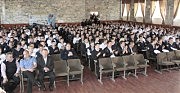
The upcoming changes in the work of maritime trade unions were discussed at a meeting of cadets and teachers of the Solyanik Odessa Maritime College of the Fishing Industry. Guests of the renowned educational institution, which will celebrate its sixtieth anniversary in two years, were the Deputy Chairman of the Odessa Regional Council Oleksiy Honcharenko, the Chairman of the All-Ukrainian Trade Union Organization of Labor Migrants “Svyataya Sofia,” Captain of the long-distance trade, Yuriy Bychkovsky, the Executive Director of the charitable organization “Assol Seafarers’ Assistance Fund,” Nataliya Klamm, and the Chairman of the Society of Greek-Russian-Ukrainian Friendship, Captain of the long-distance trade, Georgiy Grishko-Kiriakidis.
The meeting was opened by the Deputy Director of the college, Head of the Practice Department, Volodymyr Nezavitin. He reminded that the educational institution trains specialists not only for the fishing industry but also for the transport and auxiliary fleets. Annually, more than 2300 cadets study in full-time and part-time departments, of which almost 1200 are full-time students, and 70% are contract students.
They have to find work on their own. And they find it – on the vessels of foreign shipowners. Graduates of “rybka” (as the maritime college of the fishing industry is affectionately called in Odessa) are gladly taken under the “flag.” As representatives of intermediary enterprises note, the college provides very good theoretical knowledge and ensures high-quality practical training.
There’s just one snag. The college is currently under the management of the State Agency for Fisheries of Ukraine, which is subordinate to the Ministry of Agrarian Policy of Ukraine. Therefore, cadets are formally covered by trade union protection, but it is absolutely ineffective in today’s realities of the international maritime labor market. This circumstance led the college director, V. Mozolev, to invite representatives of a new generation trade union to hear firsthand about what kind of assistance cadets going to sea on “flag of convenience” vessels can count on.
— The name of our trade union organization, “Svyataya Sofia,” was not chosen by chance, — noted Yuriy Bychkovsky. — If you remember, that was the name of the vessel where a Ukrainian crew worked. A foreign shipowner abandoned “Svyataya Sofia” off the coast of Egypt. The sailors were left without food, drinking water, fuel, and with large wage arrears. But the trade union, of which the crew members were members, completely distanced itself. Then the “Assol” fund saved the sailors, which resolved the difficult situation on its own, effectively acting as a trade union. But that’s not right! That’s why the idea came to create a trade union that would protect Ukrainian sailors working abroad not with words, but with deeds.
Yuriy Bychkovsky knows the maritime college of the fishing industry not by hearsay. After working for a quarter of a century at sea in senior command positions, he taught there for a long time. Senior students remember him and treat their former teacher with great respect. After the meeting, they didn’t want to let him go for a long time, asking one question after another about their maritime future.
— The times demand completely different approaches to work from trade unions, — emphasized the Chairman of the All-Ukrainian Trade Union Organization of Labor Migrants “Svyataya Sofia.” — For example, the entry into force of the so-called Manila Amendments has introduced very serious adjustments to the maritime education system. Therefore, our trade union is ready to take on the provision of modern simulators for the college, and will also participate in organizing the practical training necessary for cadets to obtain working diplomas as navigators and engineers.
— The reason why the “Assol” fund initiated the creation of a new type of trade union organization is dictated by the situation in the maritime labor market, — says Nataliya Klamm. — As it turned out, in the so-called third-world countries, whose citizens are the main competitors of Ukrainian sailors, the trade union movement is very strong. Foreign shipowners are forced to reckon with them. As a result, Ukrainian sailors suffer, as they are gradually squeezed out of the market because there is no one to stand up for them. Ukraine also needs to learn to defend the rights of its citizens abroad.
— A strong trade union organization is also needed to help in situations where authoritative advocacy can save from great trouble, — emphasized the Chairman of the Society of Greek-Russian-Ukrainian Friendship, Captain of the long-distance trade, Georgiy Grishko-Kiriakidis. — Today, more than a hundred Ukrainian sailors are in Greek prisons, many of whom ended up behind bars on charges of serious crimes, such as transporting illegal migrants, simply because they did not receive timely help, advice, or consultation. But this is the direct responsibility of the trade union, which collects membership dues under the obligation to protect the seafarer…











