

On October 4, the Museum of Western and Eastern Art opened a solo exhibition of the painter, member of the National Union of Artists of Ukraine, Vadim Tselousov, dedicated to the artist’s anniversary.
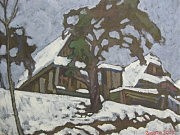
It seems that the canvas itself reflects the serene autumn sun, just as a pond reflects the pre-sunset sky. This painting is built on trembling nuances – “on subtle relationships,” as painting teachers used to tell their students. They mean the relationships between shades, but Vadim Tselousov truly has subtle relationships with nature! Every unpretentious corner of it – a clump of reeds and a boat, modest huts – he sees as a semblance of some fairy-tale kingdom.
The paintings testify that the artist does not get stuck in a once-developed winning style. He is in constant search, experimenting with textures, colors, and the manner of presenting the subject. Thus, many of Tselousov’s landscape canvases, an artist of a predominantly chamber style, have not only acquired impressive dimensions but also demonstrate techniques of monumental painting, approaches characteristic of theater and film artists.
We witness firsthand the mystery of the transformation of the visible world under the brush – I would say “magical,” but “magic” does not fit with “mystery,” the concept of which relates to high religion, not shamanism. It is precisely an enlightened religious principle that is felt in Vadim Tselousov’s canvases.
I believe that this is precisely what the director of the Museum of Western and Eastern Art, V. I. Ostrovsky, who opened the exhibition, felt. In his speech, he referred to the theory of the Ukrainian modernist Mykhailo Boychuk, who believed that the path of visual art would be determined by the synthesis of European avant-garde trends with a reinterpreted ancient Byzantine tradition. This synthesis of Greek icon monumentalism, sublime representativeness with Western impressionistic color perception can, according to Vladimir Ostrovsky, be perceived in Tselousov’s work.
…By the way, the museum director also served as a model for this artist: his portrait with a guitar, titled “Song. Vladimir Ostrovsky,” attracts attention with its luminosity. The simple white relief paste blends so well with the subtly modeled ochres that the white strokes scattered across the canvas background work like “prabelas” in icon painting. In this case, they create an airy environment, trembling with sun glare.
I will not say anything new by noting that Tselousov, an artist by inclination a realist, is an excellent psychological portraitist. The person in the portrait “Song” is caught off guard at the climax of an emotional experience. His facial expressions are full of expression, and it doesn’t even matter that the artist seemingly paid no attention to the most striking element of the portrait: the eyes, the “mirror of the soul.”
Tselousov’s NUDE genre is also “light-sensitive”: female nude models dissolve in radiance, corporeality is purified, striving to become transparent – perhaps so that the soul can shine through. The painting is no longer a specific person of a certain build and facial features – it is an “image,” in the Greek sense, stemming from antiquity: we often tend to forget that the naked marble Aphrodites, whose harmonious corporeality we admire, were goddesses and objects of reverent worship…
Here is a duplicated, mutually inverted image of a boat on a golden background. The painting is “Vilkove.” And I thought – Charon’s boat: the shimmer of these colors in the golden expanse of either sky or water is so mysterious. Gold signifies infinity. The boat is eerie, yet alluring. Is this not a symbolic depiction of the first moment of afterlife: not a “tunnel” at all, but a boat gliding in a gentle radiance? The ancient Greeks also glimpsed something – it was from them that early Christianity drew its ideas.
And the “Vase in the Window” with a vulgar houseplant aloe, it turns out, can contain all the exoticism of the savannas with all their prides – you just need to find the right colors, this stunning combination of ochre, terracotta, emerald, and turquoise.
The apotheosis of Tselousov’s poetic realism is the non-objective composition “Old Hafiyka’s Stove,” where in softly layered and floating spots – like falling asleep under grandma’s patchwork quilt, spots float before closed eyelids – the stove embers seem to smolder. Perhaps these are flashes of childhood memory?..
…The exhibition has the character of a complex triptych: the works, concentrated in three halls, are gathered in each based on a unifying principle. The first hall, landscape-portrait, is the very sunny joy of being, gratitude for the priceless gift of life. The second hall is the mystical twilight of ancestral memory, “shadows of forgotten ancestors.” Here, ethno-motifs, fascination with pysanky, rugs, decorative approaches, Christmas brightness and sonority prevail. “Morning Roosters,” painted with intensely deep, anxious colors, are truly Gogolian, and the grandmothers in the compositions are exactly like ours. The third hall features semi-abstractions: it is a poetic text expressed not in words, but in lines and spots. Each painting here is a hint of a subject, a suggestion of an event, and by event, we mean being as such, a special sense of human participation: co-communion.











