

The premiere of the one-act play “Menu” by Alexander Mardanyan took place at the Odessa Jewish Cultural Center “Beit Grand” (Nezhinskaya, 77).
The plot for a short story: an elderly gentleman reads the menu of expensive restaurants, where he cannot afford to dine, and recalls a life that has passed without much purpose… Staging plays by the Odessa playwright Alexander Mardanyan “head-on,” so to speak, is a thankless task. It requires some brilliant directorial move to elevate the everyday material of daily life collisions, grounded dialogues to some generalization, a flight above the vanity in which we all exist here and now. And the studio “Theater on Nezhinskaya” took on not a play, but the story “Menu,” and tried to “present” the material as festively as possible. The first staging of the story “Menu” was done in 2008 by the Moscow theater “Comedian” (the play “Two Stories for Food” was a participant in the Third International Festival “Meetings in Odessa”), and now work on a production based on the same material is underway at the Kharkiv theater “Lanzheron.” Odessans will likely have to evaluate the work of the Kharkiv residents, and the Muscovites were not as inventive in terms of staging effects as our compatriots.
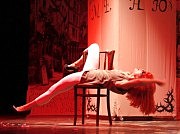
Director Sergey Kurkaev, along with artist Sergey Deyneka-Morentzov and choreographer Oleg Gusarenko, created a special world. On the backdrop is the cozy street of Marseille, which the hero dreams of, and on a screen with slits, the inscription “Menu” – from time to time it becomes a screen behind which shadows dance, peeking through these very slits. The hero’s monologue, recalling the Soviet past from a gastronomic perspective, was divided between two characters, without adding or subtracting from the author’s text. Honored Artist of Ukraine Igor Gerashchenko plays Konstantin Sergeevich, and the role of Karina Shragina is designated in the program as “Soul.” He is a star of Ukrainian theater, a brilliant actor of the “school of representation,” while she is the literary manager of a puppet theater and, at the same time, a sought-after actress on chamber stages, bright, plastic, and emotional.
From the stage, the hero speaks in the first person, and his Soul (she is sometimes picky, just like a wife or a strict mother) adds: “Konstantin Sergeevich did not like to be treated… Konstantin Sergeevich also did not like umbrellas.” And she’ll even look like that… Condescendingly. Well, only mothers and wives can look like that. And he has a completely different look, defenseless, wounded, the look of someone who is not protected by the love of either mother or wife. Venomous sarcasm will not protect anyone from anything…
The set designer’s invention balances between the earthly and the heavenly. When Konstantin Sergeevich recalls his brief Crimean happiness with his beloved in connection with rapana in sour cream (he was already married at the time, raising a son, and could not decide to change his fate), the screen-menu turns into a tent where two people, the hero and his Soul-beloved, frolic and laugh. And in the finale, quite, it must be said, rushed and unexpected, the Soul in a deathly white mask runs-flies towards the audience, and behind her, the wings-shutters of the same menu clap. Unfortunately, the action ends with a beautiful mise-en-scène, but the poignant ending of the story is completely absent here.
At the beginning of the play, after the words about the hero’s dislike for umbrellas, the text sounds: “The black hat, matching the scarf, had fewer flaws. Of course, it couldn’t keep hair dry for long in the pouring rain, but it had another advantage for evening walks. Pulled down over his eyebrows, it gave the intelligent Konstantin Sergeevich the look of a liberated thug from a gangster series… It performed a deterrent function, like poisonous coloration in insects.”
Both actors put on hats, pulling them down over their eyebrows, make faces, and then… take them off and don’t remember them anymore. But as Chekhov’s gun hanging on the wall must fire in the finale, so Mardanyan’s black hat should have marked a tragic finale with a bold dot, because Konstantin Sergeevich did not manage to put it on at the right moment, and his encounter with thugs on the street ended badly for him. Very badly.: “Another Japanese restaurant was planned for today, located not far from the port entrance. Late, maybe go home, for yogurt? Although I’m really hungry today, and I can cook a tasty mushroom soup from concentrate, Konstantin Sergeevich thought, but his feet were already walking down the slope. Raw fish, rice, seaweed, and such popularity. There were already five Japanese restaurants in the city, and all were full of visitors. It’s interesting that each had its own menu with colorful pictures of the dishes offered. Konstantin Sergeevich used to come to the port “Japanese” every two weeks. Usually, the restaurant and the sidewalk in front of it were brightly lit, but today only reflections from the candles on the tables shone from within. Perhaps the electricity in the building was turned off, Konstantin Sergeevich thought. Yes, with such lighting, you can’t make out the shrimp in the pictures, and you can’t read the composition of the “Kamikaze” cocktail, I came for nothing. Dark. Late. I’m going to drink yogurt.
Konstantin Sergeevich turned towards home. Two short-haired men were walking towards him.
“Dad, can you break a hundred?” one of them asked, blocking his way. Konstantin Sergeevich’s hand reached for his pocket, for the black hat, but it was too late. Really too late… Completely.”
And it’s a pity that nothing remains of the ending written by the author (of course, staging it convincingly is difficult, but that’s what directing skill is for, given by God and teachers), except for the poetic clapping of wings. Just as you can’t remove the “Desserts” or “Hot Drinks” section from a menu, so the climactic moment could not be removed from our “Menu” without detriment to the play as a whole. The author did not interfere with the theater’s work, waited for the premiere, and perhaps was not entirely right in this. But in any case, it is worth following the posters of “Theater on Nezhinskaya,” and delving into “Menu” even more so. Little people live and die not only in Chekhov’s stories, but also in our days, in our memory, without having tasted everything that beckoned from various menus, without having seen the desired Marseille (Paris, New York – depending on who you are), without having fully experienced the taste of life and consoling themselves only with the fact that they did not do evil and did not devour other people’s lives – however, this is not so little…











