

The Association of Hotels Knows How to Promote the North
Halkidiki is another remarkable place on the map of Greece, quite interestingly “constructed.” It consists of three “fingers” – the peninsulas of Kassandra, Sithonia, and Athos. Two of them are very accessible, which we took advantage of, having visited, in particular, the famous resort of Porto Carras and inspected its highlight – “Villa Galini.” Located on a hilltop among pine, almond, and citrus trees, designed by the famous Greek architect Kapsambelis and decorated with the participation of Salvador Dali and Yves Saint Laurent, the villa is listed as a historical hotel in Europe.
As for Athos, tourists are only allowed a cruise along the peninsula. The autonomous monastic republic is closed to idle visits, and a woman’s foot has never set foot on the land of Athos. But the cruise is also impressive – twenty male monasteries in the rocks of the peninsula seem to hang between heaven and earth. Between God and people. A story about the Holy Mountain and its inhabitants is broadcast on the boat via loudspeaker in several languages, including Russian.

On the Sithonia peninsula, at the “Eagles Palace” restaurant, there was an unexpected encounter of the “our people in Greece” kind. Ruslan, the waiter serving us at lunch, turned out to be a student at the Kyiv National University of Trade and Economics. He explained that under a university agreement with the hotel, he undergoes practical training here for five months annually. A mandatory requirement is knowledge of English, and the intern also arranges a visa and buys tickets to Greece at his own expense. However, the hotel provides free accommodation and meals, and a salary of 400 euros per month. Improving professional skills and foreign language, earning money, and of course, sea-sun-beach on weekends – Ruslan is very satisfied with all of this.
The kaleidoscope of hotels and the demonstration of everything that the tourism industry can offer visiting guests concludes with a press conference by the president of the Halkidiki Hoteliers Association, Grigoris Tassios.
As he explained, the association includes owners of 200 hotels from one to five stars (40,000 hotel places), as well as individuals who rent out rooms and houses to vacationers – that’s another 30,000 places. They united to jointly promote the tourist product. We were interested in the results of these joint efforts regarding Ukraine, and Grigoris provided figures: in 2010, Halkidiki was visited by 9,000 Ukrainian tourists during the resort season, last year – 18,000, and an increase in visits is expected this year as well. Although, he noted, 110,000 tourists come from Russia annually. The association hopes that the influx of Ukrainians will significantly increase, facilitated by circumstances such as a simplified visa application process and charter flights to Thessaloniki, which are now operated not only from Kyiv but also from Kharkiv, Donetsk, Odesa, and Lviv. What class of vacation do our compatriots choose? As it turned out, three-star mid-range hotels are the most popular. Regarding the cost of such a budget vacation, Grigoris, who owns a three-star hotel himself, says: on average, a room for two with breakfast will cost 40-45 euros per day, and more in the high season. How much has the tourism business been affected by the economic crisis?
— In season, we usually receive from 800,000 to 1 million tourists. Currently, these numbers are a bit lower, due to the German market, although German tourists have been vacationing on the peninsula for over 30 years… Greeks themselves are also not vacationing at the moment due to low purchasing power.
The association decided to rectify the situation by taking the only correct path – improving service and developing new types of tourism.
— The peninsula has 35 Blue Flag beaches; only Rhodes surpasses Halkidiki in this regard, — says the president of the association. — We offer safe holidays, impressive excursions, and very interesting cuisine. We intend to develop types of tourism such as medical, green, wine, and even winter tourism. I have been to the Lavra and know that religious tourism will be of interest to believers – Athos attracts Orthodox Christians.
Gastronomic Chapter
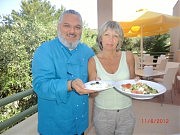
To omit Greek cuisine in a travel report would be a crime. It’s impossible to try everything it offers in such a short time. But I have acquired some new gastronomic knowledge and will share it (don’t read if you’re hungry!). There are many taverns on the coast in Greece, and they usually have a relaxed atmosphere. Greeks, as I noticed, know how to enjoy life under any circumstances and somehow infect those around them with it. They also love to feed well. The top national dishes include: moussaka – a casserole of potatoes, eggplant, minced meat with a cheese crust, souvlaki – something like shawarma, saganaki – fried feta cheese in batter. I haven’t forgotten about Greek salad, and I couldn’t – the chef of the “Royal Paradise” hotel restaurant, Leonidas, conducted a master class on preparing Greek cuisine for journalists. I offered to help him to remember better. Greek salad, well-known to Odesa housewives, he prepared as follows: onion, tomato, cucumber, olives (black or green), bell pepper, feta, olive oil. Since my help was limited to chopping vegetables, I noted the following features – oregano should be torn into the salad, and all components should be cut very coarsely. Leonidas also gave a lecture on the side: Greek salad is a perfectly balanced dish, as vegetables give their vitamins to olive oil. It’s no accident, he said, that the Mediterranean diet is recognized as one of the most effective; Crete has preserved traditions in nutrition more than others – fish, vegetables, herbs, and little meat. “In restaurants, of course, we prepare a diverse menu, but we always advise making a choice: a lot of meat or eating right,” said Leonidas. Together with him, we prepared another interesting dish – tzatziki. In a bowl with yogurt, you need to add finely chopped fresh cucumber and dill, squeeze in garlic, and mix everything thoroughly.
Among the Greeks’ alcoholic preferences, I noted dry wine, retsina with a pine needle aftertaste, and ouzo anise vodka, which is diluted with water. Ouzo is considered an elixir of youth and health here.
Oh, how right Grigoris Tassios is when he talks about the prospects of such a type of tourism as gastronomic!
Good, but not enough
Take my word for it, you can find a better country for a vacation, but it’s difficult. Everything here appeals to the heart – the white houses with red tiles clinging to the rocks, the oleander alleys with mixed white and pink bushes, the abundance of artifacts from ancient, Byzantine, and Ottoman times, the noisy, friendly Greeks, and even the sea, which I personally am not deprived of. The first counselor for economic and trade affairs of the Consulate General of Greece in Odesa, Dimitrios Ziogas, told me before my departure that the country would definitely be liked. The short Greek journey has ended, but the desire to return here remains. In Thessaloniki, on the day of departure, the sun shone as usual in a completely cloudless sky. If only it had rained – it would have been less painful to part with this amazing country…











