

Extracted the image of the seven deadly sins from the reflection in the eyes of the face on the fragment of the “Altar of Nations” – the Ghent Altarpiece by the van Eyck brothers, laid out in a mosaic of wooden elements
On July 4, artist Oksana Mas with her assistants extracted the egg-shaped wooden elements depicting human sins, placed in the pupils of the face on the fragment of the “Altar of Nations,” which is exhibited in Odessa on Grecheskaya Square. Thus, the artist fulfilled her promise given during the meeting of the commission on internal policy of the Odessa City Council on June 28.
Recall that earlier a group of religious monarchists spread false information and manipulated public opinion about the true content of this secular work, making provocative statements in the press and during rallies in front of the “Altar of Nations” pavilion in Odessa.
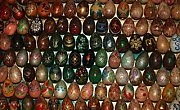
Oksana Mas’s art installation “Altar of Nations” is made of egg-shaped wooden elements – the most ancient sacred symbol of life. All willing participants took part in painting the 250,000 wooden elements that make up the mosaic of the “Altar”: from prisoners to monks, from the very young to the elderly residents of 42 countries of the world. They depicted their understanding of good and evil, sins and vices, passions and aspirations that have displaced bright images from the soul of modern man and are tearing the world and society apart. According to the artist, everyone who feels and tries to understand this work will experience a transformation of soul and worldview.
The fact that the work is created not only from bright images, but also from depictions of human weaknesses and vices, gives rise to disputes and misinterpretations. “Only the progenitors of the human race, Adam and Eve, as well as gold jewelry, are depicted from sins,” emphasizes Oksana Mas. However, even in these images, there is a so-called “grid of good,” which, like a foundation, holds the entire “weight of negativity.” The Holy Spirit, the Lamb, and the Virgin Mary are depicted only from eggs of virtue.
Specifically for the installation in Odessa, Oksana took an unprecedented step and removed from the pupils of the central face of the art installation egg-shaped fragments that represented the reflection of the seven human sins in the eyes of the Almighty, looking into the soul of each of us.
“Representatives of 133 nationalities live in Odessa. Representatives of almost all world religions participated in the creation of the ‘Altar of Nations’: Catholics, Protestants, Orthodox, Muslims, Buddhists, Krishnaites, Jews, and others. This project at the Venice Biennale was accepted and highly appreciated by believers from 89 countries of the world, who saw the same fragments of the Ghent Altarpiece by the van Eyck brothers, recreated from painted wooden fragments, as are installed in Odessa.
This project is designed to unite the world, which is why I agreed to make changes – art should not divide people. With my step, I want to resolve the conflict; it is very important for me that peace, tranquility, and respect prevail in Odessa.
We talked with Father Oleg, who opposed the installation, about how there are always different paths: both the artist who creates a work of art learns from the viewers, and the viewer learns from the artist. We came to a common opinion that such a step would be a wise solution to this complex issue. Confrontation has two sides, but I choose the path not of confrontation, but of civilized dialogue, which respects the interests of representatives of all denominations, and places art and soul above dogma,” says Oksana Mas.
Head of the Department of Culture and Tourism of the Odessa City Council, Tatyana Yurievna Markova: “We receive many appeals daily from people demanding to stop the persecution of the artist. Both sinful people and innocent children, depicting beautiful emotions and positivity, painted the eggs. This is a secular work, not religious.”
The Ghent Altarpiece, which Oksana Mas recreates with her creation, is the first work of the Renaissance, it is non-canonical and is neither an icon, nor an iconostasis, nor an altar in the Orthodox sense. The image of God Sabaoth on the altarpiece by the van Eyck brothers is also non-canonical, therefore it is improper to “apply” Orthodox dogmas to a secular work based on a 14th-century Catholic altarpiece. At the same time, the artist approached the depiction of saints with great respect and piety – all of them are “woven” from images of flowers and bright images.
“In November 2011, Ecumenical Patriarch Bartholomew blessed the ‘Altar of Nations’ project as very timely, contributing to the unification of humanity. During the audience, the Patriarch also said that I could turn to him for support in case of any misunderstanding or confrontation,” Oksana Mas said in her address to believers.
Even at the conceptual stage of the project, His Beatitude Metropolitan Vladimir of Kyiv and All Ukraine not only blessed it but also provided support by sending a delegation of priests to the Venice Biennale, where the first fragments of the “Altar of Nations” were presented. Representatives of all denominations were present at the opening of the installation in Venice. The approval for the installation of the Altar in the church took place in the Vatican. The Patriarch of Venice, and now Archbishop of Milan, Angelo Scola, personally thanked the artist for her contribution not only to the opening of the San Fantin Cathedral – after 40 years, and thanks to the project, the collected funds went to the repair of the church – but also noted that the project is very timely and important, as it unites people in such a difficult time for our planet.
Odessa residents and city guests can visit the “Altar of Nations” exhibition pavilion on Grecheskaya Square throughout the summer. On July 6, the installation opened on the Ai-Petri plateau in Crimea.
As part of the exhibition tour, fragments of the art installation will be installed in the central squares of other cities of Ukraine: Dnepropetrovsk, Kharkiv, Donetsk, Lviv, Zaporizhzhia, as well as cities in other Eastern and Western European countries.
Since July 4, photographic images of the oldest artifacts of our history – Scythian gold from the famous “Platar” collection – have been exhibited in the “Altar of Nations” art installation pavilion in Odessa, on Grecheskaya Square.
Vera Gruzova.
PR&BTL agency “Formula of Success”.
OPINION
The work of artist Oksana Mas is aimed at attracting public attention to the spiritual problems of our time. Overcoming human flaws, according to the author, consists in repentance, striving to correct one’s life, and purification of the spirit.
The main idea of Oksana Mas’s creative projects “Sphere of Good and Revival” (Easter installations installed in the Kyiv-Pechersk Lavra), “Gaze into Eternity” (mosaic panel in St. Sophia Cathedral in Kyiv, depicting the Most Holy Theotokos), “Altar of Nations” is the transformation of the spirit through repentance for sins and crimes, awareness of one’s imperfection, and striving for God’s truth. Oksana Mas’s works are installed in various cities and countries: in Russia, America, Spain, Italy, Switzerland, etc. The Ministry of Culture of Ukraine chose her project “Altar of Nations” as a work worthy of presenting Ukrainian art at the Venice Biennale in 2011. The Ukrainian government allocated the corresponding funds for this. Presidents of several countries, religious figures, and representatives of creative circles from around the world attended the opening of the “Altar of Nations” in Venice.
The artist’s installations consist of hundreds of thousands of fragments – wooden eggs, painted by people of various denominations, nationalities, political views, and professions. Many elements were created by the hands of prisoners – men and women; individuals in rehabilitation centers where they undergo treatment for drug addiction and alcoholism. For them, the work process was accompanied by explanatory work by psychologists, and the transfer of many books of spiritual content, purchased in Orthodox churches, to prisons and hospitals.
The participation of people in the creation of installations is so massive that the need for spiritual censorship of the created elements arose, as not everyone realized the path to repentance. Some fragments had to be dismantled due to their excessive frankness. The artist’s selection has now become more thorough, as her task is to consolidate people, not divide them.
The Synodal Department “Church and Culture” is observing Oksana Mas’s creative endeavors with interest. We call on figures of contemporary culture to heed the voice of the Church as the keeper of universal human values: peace, good, love.
It is mutual understanding and mutual respect, not aggression and struggle, that can benefit society, which is struggling in search of truth.











