

This is how the main task of the complex of measures for the restoration and development of the Akkerman fortress was defined by the head of the regional department for the protection of cultural heritage sites, Natalia Shterbul, at a press conference held on July 14 directly at the fortress.
This structure is one of the largest and most valuable historical and architectural monuments of the 13th-15th centuries in Ukraine. Its uniqueness also lies in the fact that the fortress was built on the site of the ancient city of Tyras. For over two thousand years, people have lived here continuously, and therefore the materials that archaeologists and historians obtain during the research of the fortress are truly unique. In 1963, the fortress was granted the status of a monument of national significance. Nevertheless, its condition continued to deteriorate until it reached a critical point.
To take measures for its salvation, in February 2011, by a decision of the Odessa Regional Council, the regional communal enterprise “Fortetsya” was created, whose main task, as stated in the document, is: “Implementation of tasks and measures of state, regional and local programs concerning the protection, preservation, restoration, use and scientific research of structures and territories of the architectural and urban planning monument of national significance – the Akkerman fortress in the city of Belgorod-Dnestrovsky.” The most effective way to save the Akkerman (Belgorod-Dnestrovsky) fortress, according to the plan of the regional authorities, will be its development as a tourist attraction. This was explained in detail during the presentation of project documents for the restoration and development of the monument by Natalia Shterbul, as well as the authors of the projects and the specialists who will implement them.
“Our task is not only to save a monument of national significance, to carry out the necessary conservation, restoration, and bank protection work (and all of them must be preceded by archaeological research). We need to do everything to make the monument live,” believes N. Shterbul.
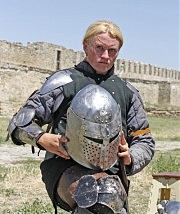
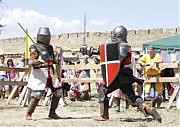
The same task was set when developing the fortress development project, noted its author Vladimir Golyshev. The specialist explained that the functional zoning scheme of the territory (not only within the fortress walls, but the entire allocated land) provides for several zones – recreation, excursion, and development. For example, the construction of a pier is planned, which will be used for docking ships, for sailing excursions on the Dniester Estuary, and in the future – for longer distances. “An interesting idea, from our point of view, is an amphitheater that will be integrated into the natural terrain, will not disrupt the overall appearance, and will create even greater attractiveness. It can be used for the same knightly battles that regularly take place in the fortress,” said V. Golyshev. “And in the citadel, for example, it is planned to create a City of Masters, that is, to arrange rows of artisans, so that blacksmiths, weavers, potters, and other craftsmen can both demonstrate their skills and introduce visitors to the secrets of ancient crafts.” The recreation area will also be developed.
The nearest plans, as emphasized by N. Shterbul, will be implemented by the end of this year. This includes the construction of a public toilet and an information pavilion (which will house an excursion bureau, ticket offices, and an ATM), as well as the most important thing – connecting the fortress to the sewage and water supply systems.
“We want to open these facilities this year. We could have started the work earlier, but we would like to see allies in the face of the Belgorod-Dnestrovsky City Council… Meanwhile, we have been trying to get technical specifications from the mayor’s office for two and a half months,” said the head of the department. And Nikita Petrakov, director of the “Fortetsya” CP, reported that the work on these facilities will cost 1 million 900 thousand UAH. The cost of project documentation was 19 thousand UAH. The work is financed by the “Fortetsya” CP.
REMINDER: archaeological research at a historical and architectural monument is a mandatory stage, which, according to Ukrainian legislation, must precede any work – landscaping, restoration, emergency prevention.
As candidate of historical sciences Tatyana Samoylova, head of the Department of Archaeology of the North-Western Black Sea Region of the Institute of Archaeology of the National Academy of Sciences of Ukraine, head of the Belgorod-Tyras Archaeological Expedition, explained, this principle is strictly observed in the fortress. Unlike the city, the specialist states with bitterness, where houses, garages, etc., are built in the protected zone – without any archaeological expertise and with the inaction of local authorities.
The focus of the latter (or rather, the epicenter of the conflict of interests) remains solely on the fortress. At least, this is the impression formed by journalists who came to the project presentation, during communication with several deputies of the Belgorod-Dnestrovsky City Council. The people’s representatives, who essentially tried to disrupt the presentation, obviously perceive the fact that a year ago the monument, which was previously under the formal management of the city, was transferred to the jurisdiction of the “Fortetsya” CP, very painfully.
And the main principle of the CP’s activity, determined by the decision of the regional council, is extremely simple: everything that the fortress earns is spent exclusively on its needs.
“With respect to the residents of Belgorod-Dnestrovsky, I want to say that this is not only their fortress… The city authorities have enough to do besides arguing about who should own the fortress,” stated Nikolai Salata, representative of the Ministry of Culture, during the presentation.
Tatyana Samoylova said that she had acquainted the director of the Institute of Archaeology of the National Academy of Sciences of Ukraine, academician Petr Tolochko, with the project. The recognized expert in medieval fortification, a specialist with a world reputation, highly appreciated the developers’ proposals, noting that this is “not just a competent, but also a very original solution to an emergency situation,” which, according to T. Samoylova, “has been tormenting us for many years.”
The plans of the archaeological expedition for the current season also include underwater research (at one time, part of the ancient city went under the waters of the Dniester Estuary). Nothing like this has been done for over half a century. The expedition’s work will also be carried out with the help of the “Fortetsya” CP, and purely scientific interest will be combined with measures to preserve the fortress.
The most urgent task now is to carry out anti-landslide measures, as the foundation of the Akkerman fortress is literally “hanging in the air,” as warned by the director and chief designer of the Odesa institute “StroyNIIproekt” Iosif Podolsky. He presented the project developed by the institute for priority emergency measures in the most vulnerable part of the monument facing the Dniester Estuary. The steep slope on which the fortress stands has been eroding for several years, threatening to “drag” the wall and towers with it. “The deformation process can take years, but it will collapse overnight, without warning anyone,” warns the director of “StroyNIIproekt.”
The fact that dangerous processes are not stopping is evidenced by the cracked, “torn” emergency “beacons” installed 4-5 years ago, and clear signs of destruction on the retaining buttresses built during the time when Bessarabia belonged to Romania. And characteristic collapses – fallen pieces of limestone, delaminated slabs – are visible even to a non-professional.
Specialists, before proposing a solution, found out the cause of the problem. “We conducted a fairly serious analysis, involved the Department of Geology of Odesa National University named after I. I. Mechnikov, because we understood that the task was not easy,” noted I. Podolsky.
“The specificity of the local slope is that the fortress stands on limestone with a thickness of only 4.5 – 5.5 m. Dense clays are located under the limestone. And the most unpleasant thing is that at the very bottom, in the zone of contact of clays with the lower edge, where water enters, there are layers of loess loams, which erode upon contact with water.
The second negative factor is suffosion (removal of fine mineral particles of rock by water filtering through it). We are no longer talking about estuary waves, but about atmospheric precipitation. “It would be enough to drill a few holes with a diameter of 100 mm in the wall, and this water would gradually drain, moreover – the space would be ventilated. We have done such things in Odesa, for example, on retaining walls that support Primorsky Boulevard,” said I. Podolsky. “They are also provided for in our project, but these are ‘drip’ measures that are easy to implement.”
“Holding” the entire slope is much more difficult… The developers divided this task into two parts. The first (and main) is to prevent the slope from being washed away. For this, it is necessary to carry out bank protection, expand the coastal strip by 17 meters, by dumping stone debris, so that the waves no longer approach the foundation of the fortress.” It is also necessary to create a system of anti-collapse structures that should seal this slope, support the fortress, and fix its condition,” noted I. Podolsky.
The work was carried out on the order of the regional department for the protection of cultural heritage sites and paid for from its special funds, clarified the head of the department, Natalia Shterbul. Commenting on the financial prospects of the project, she recalled that in 2004 the Cabinet of Ministers of Ukraine approved a program for the development and preservation of the Akkerman fortress. It was planned to allocate 80 million UAH for its implementation at that time. Meanwhile, although the program has expired by its deadlines, no more than 10% of this amount has been received from budgets at all levels. In the last three years, the fortress has not received any state funding at all.
In 2012, 1 million 143 thousand UAH from the regional budget is planned to be used for the implementation of “local sections” of the priority emergency measures project. “And for next year, we are preparing to participate in receiving a subvention from the State Budget. For this, we already have project documentation, approvals from the central authority, and the documents are undergoing expertise. These are the mandatory milestones without which the issues of allocating subventions are not considered,” emphasized N. Shterbul.
It remains to be hoped that the plans will become a reality: the unique monument will not only be preserved but will also come to life.











