

“Oh, how right the ancient gods were to choose Ancient Greece as their place of settlement!” — I exclaim, echoing the writer Tatiana Tolstaya. I “dreamed up” this trip to Greece for myself — the theory of visualizing desires works. Thanks to my profession, the Embassy of Greece in Ukraine, and the Greek National Tourism Organization, who invited journalists on a press tour with one simple request: see our country with your own eyes and tell your readers, who may now be judging Greece based on Western European propaganda slanders — that it’s restless here, with constant manifestations and armed people running through the streets. This could certainly harm the tourism industry, on which Greece, along with agriculture, depends.
The route proposed to us lay through Northern Greece; two regions — Central and Eastern Macedonia — Thrace have been actively promoting their tourism product in CIS countries and Ukraine, in particular, in recent years.
A Nature-Friendly Hotel
A few hours of flight, and we are in Thessaloniki, from where we immediately head to the city of Kavala. During dinner under the stars on the upper terrace of the restaurant, representatives of the local authorities immediately “load” us with information about the sights. The Vice-Governor of Eastern Macedonia-Thrace, Konstantinos Papakostmas, talks about the ancient city of Philippi, built by Alexander the Great’s father, Philip, about ancient theaters, and about the church of Saint Lydia — the place of baptism of the first Christian woman in Europe — in short, there is something to show tourists. Kavala, like Odesa, is part of the Black Sea Cities club.
Our hosts also arranged for us to get acquainted with the hotel business, which in Greece is mostly family-run. In a place called Krinides, the owner of the hotel “Philippio,” Panayiotis Germanidis, invited us. It was from him that I heard this definition — a nature-friendly hotel. Heating and hot water are provided by solar energy; solar panels, which are installed everywhere in Greece — in hotels and private homes — provide significant savings and do not harm nature. As Panayiotis explained, the hotel is completely autonomous and has its own water purification system. Local stone was used in its construction. Each room is heated separately. Economy plus ecology — the principle that the owner prioritized from the very beginning of construction. Many guests of “Philippio” choose this hotel precisely for the owners’ environmental consciousness. Where did such environmental awareness come from? As Panayiotis explained, he, a mathematician by education, spent five years designing his hotel, visiting exhibitions, and observing new technologies. He built it taking into account the local business support program — you build the facility with your own funds, and when you put it into operation, you can expect to get back half of the costs. Panayiotis is also counting on this, although the wait has already stretched to two and a half years — times are not good for the Greek economy.
I don’t know if this is an official status — friendliness to nature, rather, it’s a generally accepted vector of “green” policy in the country — as we could see, all resorts have triple-purification desalination plants, drinking water production facilities, sewage treatment plants with biological waste processing, and ecologically clean agricultural products are produced. But the “Blue Flag” is definitely an official international distinction for the cleanliness of the coast and sea. Greek beaches not only received this certificate of compliance but also successfully confirm it year after year. Every time the topic of the “Blue Flag” came up in conversations at various resorts, we were told: “We take great care of the sea.” “Is it really never, not once, not a single pollution of the sea?” — I tried to find out with cautious persistence. “But we don’t have industry!” — they replied. Odesa doesn’t have it anymore either, I thought with jealousy, and our beaches are as far from the “Blue Flag” as they are from the moon…
And the beaches in Greece are truly paradise-like, for every taste — sandy, pebbly, and countless coves. The color of the Aegean Sea — you have to see it! Selling plots of land on the coast into private ownership is prohibited by law. All beaches are municipal; rentals are practiced, but they only apply to services like sun loungers, daybeds, and umbrellas. But! Anyone can come with their own towel and lie down to sunbathe wherever they like — even on the beach adjacent to a five-star hotel, you can lie on the sand between the daybeds. These are “details” that have not been discussed in Greece for a long time, but remain relevant and conflict-prone for us…
Thassos Island
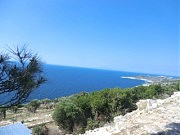
This northern gem of the Aegean Sea is less known to beach and cultural tourism enthusiasts than, say, islands like Rhodes, Crete, or Corfu. But this is for now, the island hoteliers assured us. A ferry runs from Kavala to there. When inquiring about the origin of the name of one of the greenest islands in Greece, I immediately found an Odesa monumental analogy — the sculptural composition “The Abduction of Europa,” dedicated to the love adventure of the god Zeus, at the 6th station of Bolshoy Fontan. According to Herodotus’ version, when Zeus, turning into a bull, abducted the daughter of the Phoenician king, royal sons were sent in search, one of whom — Thassos — stumbled upon the island, where he decided to stay, ceasing his unsuccessful attempts to find his sister.
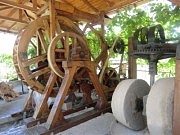
An extraordinarily beautiful place — mountains divide the island diagonally in half, pine trees, reflecting in the water, give the Aegean Sea a unique emerald color, and the beaches evoke only one desire — to lie on the perfect sand and look at the sky without a single cloud. The wooded island is tirelessly patrolled by the fire service, which has 12 vehicles, one of the most modern provided by the European Union. There is also a tourist police here. As they explained, they “are engaged in protecting the rights of tourists.” Any problem that arises for a person vacationing here, including restrictions on beach access, is a reason to call their number — the tourist police can revoke the license of an overzealous renter. An excellent road has been laid around the island, along which we traveled, visiting the island capital Limenas, and the women’s monastery of Archangel Michael in the village of Theologos. Thassos has seven ancient olive oil production plants. We visited one of them, in the village of Panagia. Its owner, Georgios (every other person in Greece is Georgios or Kostas), has preserved the olive oil production machinery that his family used four generations ago. We thought it was a museum, but it turned out to be a working one. A water wheel, millstones that grind olives with their pits into a paste, a press, filters — this is the only ancient workshop in the country in working condition. Georgios said that he continues the family business, gladly demonstrates to tourists the method of obtaining oil used by his ancestors, and advised: “healing oil is first cold-pressed; there is no point in using the pomace further, as there will be nothing beneficial left in that ‘oil’.”
Dora Dukova.











