

Usually, when writing about the Odessa artist Esfir Serpionova, they start from the end, that is, from the fact that she currently lives in the Holy Archangel Michael Women’s Monastery, leads nuns who skillfully create works of church art. That one fine day she drastically changed her life, withdrew from the world, found herself in serving the Lord, but continues to teach students and hold exhibitions, and spends her teacher’s salary on the needs of the monastery, on art supplies.
And we will not shy away from this topic, but everything in the fate of this great artist began differently. In this smiling, benevolent woman, radiating inner peace and harmony, the little girl Fira Varshavskaya is alive, who was born during the war in distant Nizhny Tagil. The three-year-old toddler suffered from “scrofula” and lost her sight. Her mother carried her in her arms, standing in a cattle car, to Odessa to show her to Academician Filatov. He decreed: the girl needed aloe injections. One hundred injections. But there were no medications. Mom had to go to an old woman living in Peresyp for plant leaves. On the ninety-ninth injection, the little one regained her sight and has since looked at the world with admiring eyes, knowing how to appreciate what, from a position of well-being, seems elementary to some. For her, healing was a miracle that determined her entire future fate, the fate of an artist.
In kindergarten, after touching the gray-green clay balls (at first glance they resembled semolina porridge), which the teachers brought for modeling classes, she felt the joy of creativity. By the age of eight, she could skillfully carve wood. And in the pioneer camp, where pencils and paints were abundantly provided for making wall newspapers and posters, she felt truly happy, and also learned to make luxurious carnival costumes out of paper.
— My mother was friends with artists, one of her friends suggested that I should be sent to art school, — recalls Esfir. — I went there, enrolled, and they took me straight into the second grade. General education school was paid from a certain grade then, but I remember that it was just canceled. And suddenly, at the art school, the monthly fee became a half-year fee, such luck… It was important for our family. At a children’s art competition in 1958, my Cinderella figurine, scrubbing a dish, won a prize. This figurine was molded from plasticine. And at the art college, I received a sculptor’s specialty, it was comprehensive, for example, we were taught the economics of ceramic art so that we understood the technology. We traveled to ceramic factories, now, alas, they are closing one after another. Already at the art and design faculty of the Leningrad Institute of Theater, Music and Cinematography, I received a theater artist specialty. It was incredibly interesting to study at the level of creating sketches. We studied architecture — I crumpled paper, and a “rose” for a Gothic church appeared. The sets for “Carmen Suite” were designed as a cage… In the theater, everything is so voluminous, any materials are used, even tin cans, such a scope for imagination! But the theater itself is not close to me. Although recently I accidentally ended up at the Youth Theater for the play “And the Month of May Will Come Again” about the war, it moved me to the depths of my soul! And once I designed more than thirty productions in theaters from Ukraine to the Caucasus and Siberia. I worked in Barnaul as the chief artist of the drama theater. At the Odessa Puppet Theater, I worked with the wonderful director Yuzef Gimmel фарб, a funny photo remains where we are both in identical checkered jackets and looking in the same direction, wrinkling our noses in the same way… The puppet theater attracted me with the opportunity to change the scale of the characters, to reveal their personalities in different ways. But then I was smoothly lured to the institute, and now I teach, I can’t do without it anymore…
Esfir has something to teach the young. Today she is a Candidate of Pedagogical Sciences, an associate professor at the K. D. Ushinsky South Ukrainian National Pedagogical University, and the author of several textbooks. A wonderful artist herself, she teaches students of the art and graphics faculty systematic exercises, the art of keeping a graphic diary, and not allowing gaps, because stopping is always a step back… She teaches the ability to find drama in the arrangement of chairs in a room, because behind each chair stands an invisible hero, the person who sat on it, moved it… She teaches to comprehend color theory, gives her students more than one key to the magic door into the world of art, and her experience with Odessa teachers helps her in this. One of them, Esfir recalls, worked at the legendary Bauhaus, another could do a somersault in class while talking about antiquity, a third described St. Petersburg so vividly that later, finding himself there, Ira (as she was called in her student days, sometimes clarifying: “the pale one who is always silent”) easily found her way to any building, any museum or palace. By the way, one of her uncles, Isaac Varshavsky, was also an artist, and was assigned to the Grekov studio; a photo of his diploma work, a battle scene with horses and riders, has been preserved. The uncle went missing in the war, and in another case, there would have been one more talented master in the family.
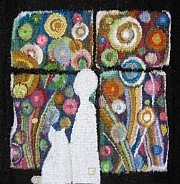
— An artist needs to be given confidence, so that their education system is well-established, so that there are no “broken windows” in it, — Esfir smiles. — When complexes disappear, the ability to quickly sketch twenty options appears, I tell my students: “Now you are mine!” In design classes, I encourage them to look for many options, for example, a sketch of fabric painted with umbrellas and balls can be used in decorating a children’s party, in curtains, tablecloths, costumes. We fit the options into squares — a whole cartoon comes out. Even before the institute, I wanted to make cartoons, one picture is not enough for me, I want development, that’s probably why I love creating triptychs so much.
Esfir Serpionova indulges in the search for variability in her unique tapestries (she learned the profession of a weaver in her youth), which she weaves not from threads, but literally from rags, torn into the finest strips. “Golden Net,” “Against the Current,” “Legion” — a school of fish swimming towards one fish, in different tones, in different lighting. And indeed, looking at these tapestries, you start to wonder if the majority is always right, maybe it’s actually struggling in the golden net of momentary gain, or simply mindlessly following a deceptively calm current, or acting as an aggressive army, without realizing what is happening? The first part of the triptych is drowned in gold and silver tones, the second — in azure, the third — gold mixed with purple colors… “Alien Holiday” — monochrome figures of a child and a cat by the window, beyond which a salute blooms in all colors… And the absolutely charming “Aesthete” with a figure of a cat watching a fish in an aquarium — there is something in Esfir’s tapestries from her favorite cartoons of the sixties. Her weaving is constantly desired to be seen at the textile biennale in Kherson.
— A large-scale exhibition and conference always takes place there, — says Esfir. — People come from Japan, Korea, Turkey. Recently, there was a project of twelve Ukrainian and twelve Japanese artists called “Peace in White: All or Nothing,” and my works participated in it. One of my tapestries is now in Tokyo. There are active people, they respond well, report on ratings, invite me to give lectures…
In her church art, she is, of course, different, but still recognizable. Leading the monastery workshops is not an easy task, because here they paint icons, embroider vestments, restore ancient church books, and create murals, sketches for carpentry and stone carving. And all this is done with respect for ancient canons, which must be observed.
Recently, with the abbess of the monastery, Abbess Seraphima, Esfir visited Kyiv for the exhibition “Stones of Ukraine,” it was necessary to order a stone cross, and she was even pleased with how many new tools modern sculptors have! She herself has not so much moved away from sculpture, but has stopped carving marble. Weaving, drawings, watercolors — this is what she shows from time to time at her solo exhibitions, and each area of her creativity has earned high recognition from professionals, has been included in prestigious collections and catalogs, although Esfir herself is hardly concerned with prestige, as you can understand. Many remember her watercolor exhibition “Inhabited Island,” which took place in the gallery of the World Club of Odesans, where scenes from monastic life, enlightened and joyfully embodied by the author, brought to the secular viewer an unfamiliar, but spiritual and in its own way beautiful world, where iconostases are painted, kulichi are baked, churches are decorated with flowers, and even laundry drying on ropes flutters with the sails of a higher hope, incomprehensible in the everyday worldly bustle.
— Artists often dig either broadly or deeply, but I am a border guard, I have the gift of walking the line, — the artist smiles. — And I also realized over the years: an artist combines a whole crew of a writer, an executor, and a critic. Of course, one of these three always limps. But in art, you can always put today’s date and start all over again with a smile!











