

After a long break, the name of the great Russian playwright Alexander Ostrovsky has returned to the repertoire poster of the Odessa Academic Russian Drama Theater – with the first spring premiere, which was his comedy “Blazh” (Folly). The artistic director of the production, People’s Artist of Russia Leonid Kheifets, and director Alexey Litvin managed to overcome, to some extent, the barrier of lack of attention to the playwright.
— The new era dictates a new interpretation of Ostrovsky’s plays due to the change in the concept of “money,” Leonid Kheifets told reporters before the premiere. — In the Soviet Union, there was no money, in essence; there were coupons for the distribution of material goods. And when you stage Ostrovsky anew today, you get an astonishing understanding of what money is and what it means when you don’t have it. “Blazh” is a play about something slightly different, but it also has a situation – people are cornered, looking for money, and for the sake of money, they commit many transgressions.
Looking ahead, it must be admitted that the theme of money is not fully revealed in this production; the characters’ relationships with it are only hinted at, not established. Alas, the concept of money remains something distant and abstract for our actors, perhaps that’s the reason? Leonid Efimovich also mentioned that the text of the play has been shortened, as it is simply impossible to stage classics today without some temporal corrections, given how little time modern people have. The cuts were made, as far as possible, by removing archaisms whose meaning is now lost on the audience and which do not play a significant role in understanding the plot.
It must be said that the creators of the play managed to avoid both clumsy old-fashioned speech and excessively topical intonations.
But, unfortunately, it must be admitted: it would be a regrettable misunderstanding to believe that “Blazh” is Ostrovsky. This play of very moderate artistic merit was written not by the brilliant Russian playwright at all, but by his much less talented student Pyotr Nevezhin. Ostrovsky’s co-authorship arose from the brilliant playwright’s desire to help a younger colleague whose work was rejected by the tsarist censorship under the pretext of undermining parental authority. Alexander Nikolaevich, an recognized authority of the imperial stage, invented the main character to be the mother’s elder sister from her first marriage and godmother (there was no longer any talk of disrespect for parents), added a couple of relatively lively scenes, and, most importantly, put his name on the title page. After that, it was awkward to refuse Nevezhin, and “Blazh” received a stage life, albeit a short and unenviable one. The premiere took place on December 26, 1880, on the stage of Moscow’s Maly Theater with the participation of the legendary Maria Yermolova, soon after – at the Alexandrinsky Theater, and before the 1917 revolution, it was staged on all provincial stages. Afterward, it was extremely rarely in demand by theaters, and rightly so, few people were blessed with such folly, pardon the pun…
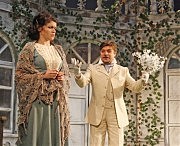
But then the action begins. On stage is a pavilion in the form of a dilapidated manor house (pavilions at the Odessa Russian Drama Theater are usually created by artist Grigory Faer in productions directed by Leonid Kheifets). A well-forgotten old scenographic technique in itself has a right to exist; what is alarming is something else: it turns out that a stone-faced house, if its plaster crumbles, reveals reed laths… The appearance of the caricatured, disheveled provincial matchmaker Guryevna (Valentina Prokofieva) does not foreshadow any shocks, but suddenly a man’s hand emerges from a first-floor window, grabs Guryevna by the scruff of her neck, and slowly, thoroughly pulls her into the house. Sounds of a struggle are heard, Guryevna’s vest, cap, and even skirt fly out of the window. The Maly Theater would have collectively fainted in horror at such a mise-en-scène, and this is simply showing us an event that happened before the action began: the manager takes a compromising letter from the matchmaker. But why the matchmaker will later justify herself to the young lady who wrote the letter, saying she was holding the envelope in her hand and it was taken away, is a mystery. This is reminiscent of how in another performance on the same stage, the red-haired heroine in the play was played by a brunette, who nevertheless called herself a “red-haired lady.” While showing boldness in some moments, one must also ensure consistency… However, this is where the directors’ audacity ends; from then on, everything proceeds very decorously and nobly. Perhaps to their detriment?
Amusing tricks could have enlivened the rather dreary love drama of the widowed landowner and the brutal young handsome man whose main goal is money. So, before us is the sultry widow Serafima Davydovna Sarytova – Honored Artist of Ukraine Yulia Skarga, for whom the role is clearly too small; this eccentric actress could clearly have frolicked on stage no worse than the performer of Guryevna’s role. Only in the final scene, when everyone leaves, and she cannot hold back tears of disappointment in her absurd, ruinous love, does Serafima touch the soul. In Ostrovsky’s time, a widow in her early forties was considered an old woman who should be thinking about her soul, but in reality, back then, forty-year-olds were even much healthier than they are now, with natural products and country air…
The object of the landowner’s passions is the young manager Stepan Barkalov (Mikhail Ignatov). He possesses not even brutality, but undisguised impudence, which he demonstrates without interruption to all the characters… He wouldn’t even be allowed into a respectable house even once, let alone the constantly unbuttoned shirt at the chest. The directors should help the talented young actor search for other colors for this character, otherwise the main heroine loses out significantly in the presence of such an “obzhe,” as they said in Ostrovsky’s time, meaning an object of desire. Perhaps it’s really not love, but folly…
The landowner couple Bondyrevs (Honored Artist of Ukraine Larisa Korshunova and Mikhail Drobotov) and one of Sarytova’s pupils, the mischievous Nastya (Olga Saltykova), are much more organic. The second one, Olga (Elena Yashchenko), despite her striking beauty, is so proper, dry, boring, and stiff in her interactions that it’s hard to understand the dandy, rich Lizgunov (Sergey Yurkov), who is in love with her.

Family disputes due to the impudent manager subside, relatives reconcile, and the landowner is left alone, shedding a tear. And yet, this is still not Ostrovsky, neither in terms of artistic impact nor in meaning. One can hope that the current “Blazh” will only be a rehearsal for a full production of the great playwright’s play, from whom Odessa has become too unaccustomed, so unaccustomed that they might well form a distorted impression of him, seeing a vague performance with a dull text and barely sketched characters. Why don’t Kheifets and Litvin stage, say, “Without a Dowry” in Odessa?
The Odessa theatrical spring this year is generally closely linked with Leonid Efimovich Kheifets, who will conduct a creative laboratory for chief directors of drama theaters in Russia at our theater from April 22 to 27. And from April 28 to 30, his students will show their training performances. It is worth recalling that the Kheifets-Litvin tandem has already staged two Chekhov plays in Odessa – “The Cherry Orchard” (2003) and “Uncle Vanya” (2008). “Blazh” is the third joint work of the directors, and as a fourth, we would like to see a production of an Ostrovsky play, but pure Ostrovsky, without co-authors who have not stood the test of time and the audience, with his melody, his vision of the national character, his typification, which is still relevant today. Finally, being a financier, he knew everything about money, almost as much as we do now…











