

An exhibition “Nude” has opened at the World Club of Odesans. Twenty-three works from the collection of Evgeny Demenok represent the work of twenty Odesan artists. These names are familiar to all connoisseurs of painting: Yuri Egorov, Valentin Khrushch, Alexander Roitburd, Alexander Freidin, Evgeny Rakhmanin, David Bekker, Stas Zhalobnyuk, Elena Shchekina, Evgeny Petrov, Andrey Gerasimyuk, Eduard Pavlov, Vladimir Krikhatsky, Olga Kotova, Anatoly Asaba, Gennady Garmider… The carefully selected and masterfully presented works not only give an idea of how nude female figures were depicted by representatives of several generations of Odesan painters, but also give a feeling of warmth and joy of life.
“Why is an artist needed? To share the feeling of beauty with the world!” – said **Evgeny Demenok** at the opening. – “My favorite artists are presented here, almost all of them are from the Odesan school, one work from each author, and in the work of some of them, the genre of “nude” is rare as such. The human body has always been considered the measure and standard of beauty, and woman embodied beauty. I hope the exhibition will please connoisseurs.”
Well-known journalists Evgeny Golubovsky and Felix Kokhricht, themselves long-time collectors of “Southern Russian” painting in all its national Odesan manifestations, added something important to the owner’s speech: keep in mind, the women in the paintings and sketches before you are Odesans!
Every era had its ideal of beauty, and here is a natural phenomenon: a bright, striking appearance, due to the multi-ethnic factor. Admire: the exhibition is a collective image of an Odesan woman in all her anatomical and psychophysical beauty… no, of course not in all of it, because the diversity of female beauty types in our city is inexhaustible.
Well, and if we project the subjective factor onto this circumstance, that is, the personality of the artist and his individual creative manner, then we will have all sorts of reprimands. For example, the “eternal revolutionary” Alexander Roitburd depicted a young lady from behind, leaving a provocative thong on her. As always with the creators of the “Roitburd circle,” the canvas impresses with its scale: the image significantly exceeds the size of the model, and the texture is assertive, bordering on aggressive: wow, the density of the brushwork! They say this is postmodernism, although it seems to have died somewhere in the mid-90s.
However, much more academic authors than Roitburd also indulged in postmodern quotation: the strict graphic artist Gennady Garmider directly reproduced “Nude Maha,” laying the model on a colorful rural Ukrainian blanket – apparently, the theatrical essence of the artist flared up, as he studied scenography at the Kyiv Art Institute and graduated under Daniil Lider. Igor Terekhov created a plastic sketch with a soft medium, placing the model in the pose of Van Gogh’s “Sorrow.” In short, there is an open playful element.
In Valentin Khrushch’s work, the female torso is depicted from behind: clear, accentually geometric construction. It’s not she who charmed him, it’s he, the demiurge, who is sculpting her right now, without even delving into details. But his magnificent idea has already illuminated this “blank” with iridescent pearlescent radiance: tenderness will be her essence.
Sharp expressive dynamics in Vladimir Strelnikov’s pencil sketch: imagine how the seasoned abstractionist-Mamay was captivated… no, not by specific female beauty, but by the living, ever-changing life manifested in it.
Stas Zhalobnyuk, again, resorted to postmodern tricks, in a narrative-literary aspect. In the foreground is a luxuriously reclining diva without a face, and her eyes are taped shut; in the background is a male figure without a head at all. Love is blind!
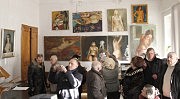
In this context, David Bekker’s nude stands out with the immediacy of both feeling and execution: a hot, literally, beauty. Burning! Because it is painted in an open Van Gogh technique of complementary contrast: golden ochres on a cold blue background. The sharpness of the silhouette and the dynamic impulse are conveyed by the outlining technique. Similarly Odesan, Mediterranean, sensual and romantically wild is the beauty of Grigory Palatnikov, depicted in black ink. And the “sitting” watercolor, in grisaille technique (shades of one color) by Viktor Khokhlenko, is tremulously chaste. And Anatoly Asaba’s graphic work, all ornamented, refers to an oriental fairy tale.
Evgeny Rakhmanin’s half-figure is a half-revealed dream. And Evgeny Petrov’s exquisite “lying” figure – here is a fusion of cultural influences that makes one lose their mind, where the Northern Renaissance, the Pre-Raphaelites, and Russian symbolism echo each other: the literary element also plays a significant role. The female figure, in whose Akhmatov-esque profile one can easily recognize our talented artist Lera Fokina, is not sensual or carnal, she is the embodiment of the cosmic principle, not of Eros, but of Sophia, in a cold, obliquely cast sunbeam, and her conditional bed is in some beyond.
It is interesting to see “nudes” at the exhibition performed by Yuri Egorov, Svetlana Krizhevskaya, and other artists of Odesan training – even if they are quite situational fleeting sketches, these works are instructive in their attempts to interpret the eternal theme – Eternal Femininity.
The exhibition runs until February 21.











