

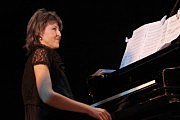
On December 1, the Philharmonic Hall hosted the premiere of the musical program “TANGO FEERIA,” created by Honored Artist of Ukraine Volodymyr Murza (bayan) in tandem with pianist, laureate of international competitions Tetyana Kravchenko. By the way: December 11 is celebrated as International Tango Day – on the birthday of the Argentine singer and film actor, the “King of Tango” Carlos Gardel (1887 or 1890–1935).
The season’s opening act was the orchestra “QuinTango”: Yevhen Pihulyak (violin), Volodymyr Grechuk (double bass), Serhiy Repchynsky (guitar), and Kristian Orozco (percussion). Bayan solo – Volodymyr Murza, concertmaster – Tetyana Kravchenko: both are artists of our Philharmonic, both teach at the Nezhdanova Music Academy, and the guys, as I was told in the concert department, were recruited from students. The Philharmonic has its eye on these guys – we’ll see what happens, they say, but at the moment they are thinking about promoting “QuinTango” throughout the Odesa region, in response to the public’s fervent interest.
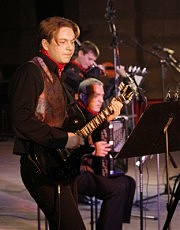
And the interest is indeed fervent – following the fervent and well-deserved delight, expressed in repeated ovations. Yes, you don’t need a special diploma to appreciate the refined performing academicism combined with the charming ease of the performing style. Very clear guys! The academic school has not dried them out, and the popular genre has not simplified them. Listening to them, you realize that humanity cannot live without pop music: you can create complex symphonies, but let’s wait three hundred years to see what remains of them – or you can compose a simple melody, and guess so intimately that it will last for centuries. This mystery is great! And it is present in the performance of “QuinTango.”
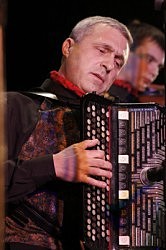
This is an ensemble of those who elevate the popular genre to the heavenly heights of irrefutable art. Like, for example, the orchestras of Paul Mauriat, Goran Bregović. It even occurred to me during the concert: why not give the guys a Balkan program now, since the bayan is perfect for this – or do we have to pay royalties “from abroad”?
Ah, tango!.. Thanks to the Internet, each of us can instantly become erudite in the history of the matter, so let’s not focus on the repertoire, but I can’t resist some references. Here, for example, is a classic of the genre, a case where the melody became folklore – “El Choclo” by Ángel Villoldo, written in 1903. The story is an adventurous novel! The composer’s sister, Irene, assured that the tango was written “in honor of one of the most malicious and fierce criminal authorities of Buenos Aires nicknamed El Choclo – Corn Cob.” And what a career the melody had: it was plagiarized, then ended up in the mouths of legendary singers – Yvette Guilbert, Isa Kremer (the latter heard the tango performed by the former in a cabaret in Montmartre)! In 1918, the film “The Last Tango” with Vera Kholodnaya, based on the plot of this very tango performed by Isa Kremer. The first recording of “Isa Kremer’s tango” on film, made in 1966 in Magadan by the exiled Vadim Kozin. And many more plot branches of the dizzying fate of the Argentine tango “El Choclo,” which even mentions the name Daniil Kharms. And Ostap Bender’s dance with a folder containing compromising material on Citizen Koreiko pressed to his chest. And that pub that “opened” either on Deribasovskaya or on Bolotyanovskaya…
Well, what can be added after this to the universal opus of the “father of tango” Ángel Villoldo, who worked as a musician in the restaurant “El Americano” in Buenos Aires?! But lo and behold – Volodymyr Murza and “QuinTango” performed “El Choclo” in such a way that it seemed like we were hearing it for the first time. In a most refined arrangement, developed simply masterfully, filigree. And at the same time – not boring: not “over-academicized.” It didn’t smell of “folk dances of Moiseyev and Virsky,” you understand? The color, the folk spirit, the mischievous soul – lived in the old melody, and it fluttered with butterfly wings, boldly soaring from the restaurant terrace, indeed, somewhere to church choirs with an organ.
This is just a detail, one number of the concert, and there were many melodies and authors. And Carlos Gardel, mentioned in the subtitle. And eight compositions by Astor Piazzolla, who merged tango, the fervent music of the backstreets, with the prim Philharmonic, which was initially booed, and later declared a classic. And all the concert tangos (in the original, this word is masculine, in Russian it became neuter, and it was announced as “Odesa tango” – following the “Odesa film” of the 20s, probably?) – all were performed… well, beyond all praise: you have to hear it.
And there was no shortage of a “world premiere”: the tango “Farewell, Friend” by Odessa native Yuriy Povolotsky, who now lives in Israel, was performed, and it sounded quite exquisite, although it seemed difficult to stay afloat in the “saturated solution” of the genre. And for an encore, after the ovations, the immortal “La Cumparsita” by Gerardo Hernán Matos Rodríguez was presented. About a year ago, while browsing the internet, I found, for example, versions of its bayan-accordion performance by Richard Clayderman and Petr Dranga, and that’s just “the tip of the iceberg,” so the competition in performing this opus is not weak – and Volodymyr Murza withstands it worthily, at a world level!
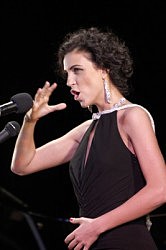
And now, although it’s a pity, I have to point out a not entirely successful aspect of the “Tango Feeria” program – the attempt to turn a Philharmonic concert into a show. They invited ballroom and sports dancers – masters of sports Anna Akimova and Oleksiy Serbatyuk, as well as young vocalist Angelina Statyeva. I have nothing against these dancers or the singer. But… they would have looked great at a republican review of club ensembles and in a television project like “Star Factory.” Next to the essentially Philharmonic ensemble, with its refined culture, they looked very out of place. Alas, in recent years, even certified professionals often cease to distinguish between art and amateur art – very decent, high-level, but still amateur art.
This eclecticism lowers the level of the program as such. Especially since “QuinTango” possesses such a happy charm, looks so effectively, expressively to the point of grotesque, against the black backdrop, is so plastic, that, honestly, it needs no vocal-dance “garnish.” And the choreography of the dance inserts, I must say, is weak, sometimes beyond good taste – what about the dancer’s languid stroking of a dress on a hanger and the “passionate” dance with a dress in his hands. To create a “tango atmosphere,” the empty garden bench on stage and a hanger with a lady’s hat would have been enough…
You will say: “But the audience likes it!” – and I will answer: the audience is tame, and how is your argument different from “the people eat it”? And, if in tango terms, who is the leader here, and who is the follower? After all, the Artist on stage sets the tone and the bar for the audience. And the bar for “QuinTango” is very high!











