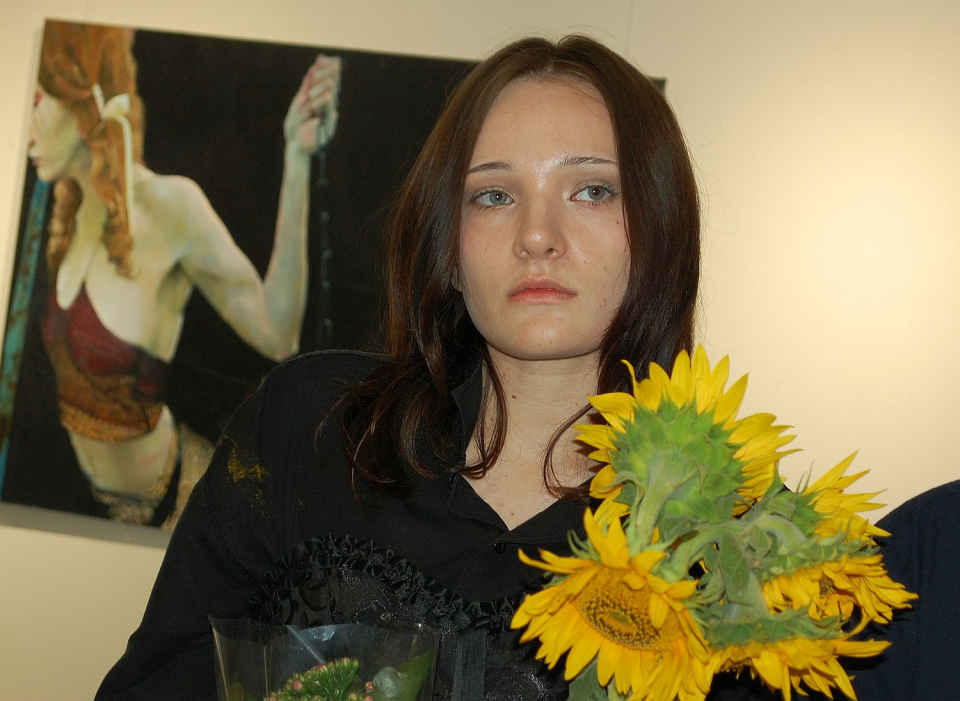
If you have already joined the charitable cultural and educational event “Golden Autumn of the World-2011” and visit the concert and exhibition hall of the “Medical Center ‘Hope, Goodness and Welfare'” on Frantsuzsky Boulevard, 32, pay attention to two paintings from the exhibition by the president of the Union of Marine Artists, the author of the “Art Tourism” project, Galina Lekareva-Nikitina — “Kuris Palace. South Side” and “Kuris Palace. North Side”…
Perhaps it was artists who were the first to appreciate the dying beauty of the castle in the village of Petrivka, Kominternivsky district, and realized that it, along with the charm of the surrounding nature, could be a very sought-after object of tourist curiosity. Artists, in essence, blazed the first trail to these places, which was also facilitated by their plein air painting exhibition. Then small groups of restless citizens began to flock there under the “leadership” of “Veselka of Tourism.” Later, after a reconnaissance trip to the Bilhorod-Dnistrovsky district
(“Oh, how many wonderful discoveries this blessed land is ready to give us,” “Evening Odesa,” August 18), a group of proponents of green tourism development, led by the president of the ecological center “Sustainable Development of Ukraine,” Yuriy Gerashchenko, also set off for the castle. Among them were American guests, experts in ecotourism and national park management, Melissa Prager, Barbara Gutman, and John Jost. The purpose of the trip was to draw the attention of authorities and the public to the fate of this unique building.
The sight was shocking. Americans were probably more shocked than us: how can one indifferently watch the destruction of a beautiful creation?! It’s not just the castle’s self-destruction. In 1990, a fire started due to a lightning strike. Local residents, convinced of the building’s abandonment, have been gradually dismantling it for their own needs.
The head of the Petrivka village council, Gennadiy Melnichenko, and the deputy district state administration, Serhiy Dorokhin, who came to meet the delegation, understand the castle’s value, but there is no money in the budget for its restoration. The eternal problem. Yuriy Gerashchenko suggested that charitable telethons or, for example, descendants of the Kuris family living in Greece and Poland, interested in preserving their ancestral nest, could help. The church in Odesa was restored through joint efforts…
The history of its creation and the fate of the castle are as interesting and dramatic as the life of a person who has survived revolution, war, post-war devastation, and the struggle against the “relics of capitalism.”
…The head of the office of the Russian commander-in-chief Alexander Suvorov, Ivan Onufriyevich Kuris, a Greek by origin, fought bravely in battles, for which he received the Orders of Saint Vladimir and Saint George. Not only an efficient “clerk” but also an resourceful and brave warrior, in one of the battles with the Turks, he saved Suvorov by giving him his horse. And the commander rewarded the brave man by granting him as much land as he could cover on that horse in a day.
Initially, the guide explained, the Kuris family lived in Odesa, but a summer residence was needed, primarily because the city house could no longer accommodate a huge number of books, paintings, and manuscripts… The castle was built in 1820. And it was rebuilt by Ivan Onufriyevich’s grandson, Ivan Irakliyevich Kuris. An art historian, he was also an honorary member of the Odesa Archaeological Society. The architect of the future castle was Odesa architect Mykola Tolkvinsky.
The architectural discoveries are captivating even today, so imagine what the castle was like in the time of its caring owners… Then the “owners” changed. During the revolution, they spared neither the library, nor the paintings, nor the manuscripts, nor even the remains in the Kuris family crypt — they were simply thrown out. The remnants of the luxurious library (not publicly accessible) are kept in our “Gorkovka,” and some are in the Hermitage. During the Great Patriotic War, the castle housed the Romanian commandant’s office, and looting continued. After the war, until the fire, it housed the Petrivka Agricultural College. Then came oblivion.
And it would be worth remembering that it was under Ivan Irakliyevich and his wife Lyubov Ivanivna, a Pole by the way, that a school, a hospital, a post office, and even the first kindergarten in the history of Russia were opened in the village, then called Pokrovske. There are buildings built by the Kuris family in Odesa as well, for example, maternity hospital № 2. It is also worth remembering that the forest they planted is the basis of the Tiligul Landscape Park, which includes the only ornithological reserve in the region, home to 281 (!) species of birds, 49 of which are listed in the Red Book.
And not far from the Kuris castle is the house-museum of the famous Peredvizhniki artist Mykola Kuznetsov, which was visited by Pasternak, Tretyakov, Chaliapin, Serov, Kostandi… This modest building also requires attention, but it seems only one person has shown sympathy for it; at least, the guide mentioned only one name — Serhiy Sedykh. He tries to support the museum’s life as best he can.
The Kuris motto is: “Let there be truth!” It would be good for us to follow it too: to indifferently observe the destruction of the castle means not only to miss the opportunity to develop new interesting tourist routes but also to simply disrespect the work of those who left us such a wonderful heritage.