

Judge L. Grabovan of the Commercial Court of Odesa Region issued a ruling on July 26 to suspend proceedings in the case of recognizing PJSC “Pressmash” as bankrupt.
The basis for this was an appeal filed by the Odesa regional organization of the Union of Machine Builders and Instrument Makers of Ukraine. It was filed against the ruling of the same court instance, dated July 15, 2011, which declared the aforementioned, recently renowned, enterprise bankrupt.
Thus, everything now depends on the Odesa Commercial Court of Appeal. Whatever it decides, so it will be. If the union’s complaint is satisfied, PJSC “Pressmash” will get a chance to return to life. If the court rejects it, the bankruptcy and ruthless liquidation procedure will gain momentum with doubled energy.
In its issue of July 23, “Vechernaya Odesa” reported on what happened at the enterprise after the court’s ruling on bankruptcy. A. Shevchenko, chairman of the Odesa regional organization of the Union of Machine Builders and Instrument Makers of Ukraine, received a call from Kyiv, from the Central Council of the Union, and was anxiously asked: what is happening at “Pressmash”? Is it true that equipment is being cut up and taken out of the factory gates as scrap metal?
The desire to preserve the enterprise, which will celebrate its 60th anniversary next year, as well as suspicions that it was deliberately driven to bankruptcy (proceedings in the case were opened by the commercial court at the end of November last year), led to the union filing an appeal.
Interestingly, four years ago, there was hope that PJSC “Pressmash,” one of Ukraine’s leading enterprises in the production of presses for various purposes, whose products were supplied to all union republics and 50 countries worldwide during the Soviet era, would finally be able to adapt to the harsh conditions of the market economy.
According to the newspaper “Delovaya Stolitsa,” in 2007, the State Property Fund of Ukraine sold a block of shares (50 percent plus one) of PJSC “Pressmash,” valued at 10.5 million hryvnias, to the little-known Odesa private enterprise “Technopark.” The buyer managed to outmaneuver clearly stronger — financially — contenders for the acquisition of the enterprise. However, it later turned out that “Technopark” did not act on its own behalf but in the interests of the well-known Odesa entrepreneur Borys Kaufman, the main shareholder of “Finbank.”
After PJSC “Pressmash” came into private hands, the joint-stock company continued its core business of producing hydraulic presses, as this product was in demand abroad, primarily in Russia. However, there were no Ukrainian customers at the plant, as told by chief engineer Oleksandr Topchiy… The main investment obligation undertaken by the buyer of PJSC “Pressmash” was to ensure the growth of the enterprise’s income within five years.
But the economic crisis disrupted the plans. In December 2008, PJSC “Pressmash” effectively stopped operating. Occasional orders helped to save a small part of the workforce. If 20 years ago, 1,500 people worked at PJSC “Pressmash,” today, according to Mikhail Kagan, chairman of the enterprise’s trade union committee, there are just over a hundred employees in the workshops. The average wage arrears are two months. Some are owed for a month or a month and a half, while others are owed for three months or more.
Today, the enterprise is de-energized — “Odesoblenergo” disconnected the power due to debts. This happened three months ago. The lack of electricity prevents the fulfillment of a large order for which the enterprise received an advance payment. In the last two years, instead of revenue growth, PJSC “Pressmash” has been rapidly increasing its losses.
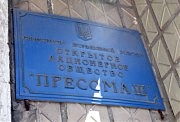
The buyer’s failure to fulfill the investment obligations of PJSC “Pressmash” makes it quite realistic to file a lawsuit to declare the enterprise sale agreement invalid, transferring the controlling stake to the former owner — the State Property Fund.
However, it is unclear what property will be transferred to the SPF in case of restitution. After all, according to “Delovaya Stolitsa,” in August 2009, “Finbank” allegedly issued a loan to PJSC “Pressmash” in the amount of 16 million hryvnias at 30 percent per annum. The enterprise naturally did not return the money. Through court, “Finbank” seized the real estate belonging to PJSC “Pressmash,” which served as collateral for the loan. The enterprise has become, as stock market specialists put it, a dummy: there are shares, but they are not backed by any assets.
However, whether a lawsuit will be filed to declare the investment obligations unfulfilled is still a question. But the fact that resistance to the bankruptcy procedure of PJSC “Pressmash” is increasing every day is already a reality. “Vechernaya Odesa” continues to monitor the developments around the enterprise.











