

The Odessa Jewish Chamber Theater “Geval Gevolim” (“Vanity of Vanities”) at the Festival “14th Week of Jewish Music and Theater” in Dresden
As we walked through the evening streets of Dresden, returning from the festival’s opening ceremony, and had barely stepped onto the Carol Bridge, which firmly connected the banks of the dark, shimmering river, a childlike question involuntarily escaped our lips: “So this is the Elbe?” Yes, it was the Elbe. Long-held associations, born from an old Soviet film, sank into these gentle and deep waters, which seemed to flow only to reflect the stunning magnificence of Dresden’s palaces.
It was an encounter with the river.
Festival Encounters
The festival director, Mr. Michael Rockstroh, who for half a year was associated only with a signature in concise business letters of an organizational nature, suddenly materialized as a tall, lean, smiling man in his forties with hair sticking out in different directions – and for some reason, it immediately became clear that he was “one of us,” a “theater person.” The foyer of the Jewish community center was filled with the usual festival buzz: many people, acquaintances, smiles, friendly staff of the festival bureau handing out brochures and programs, and on the tables – “a traditional glass of champagne and orange cake.”
Majestic and calm Dresden dreams of music: many music festivals are held there annually; even the city’s symbol is considered to be a little angel with a saxophone – such souvenirs often looked at us through shop windows. Therefore, it was quite organic that after the welcoming speeches by the Commissioner for Foreigners in Saxony, Dr. Martin Gillo, and the already familiar Michael Rockstroh, a concert began performed by four excellent jazz musicians from Berlin and one English rabbi with the simple Jewish surname Rothschild. The rabbi, in a rhythmic recitation, told and acted out all sorts of parables, and even sang.
Interestingly, the founder of the Week of Jewish Music and Theater was not the Jewish community of Dresden, but “Rocktheater,” which has no national affiliation – they simply cooperate closely during the festival. Later, Michael told us how the idea for such a festival arose 14 years ago: the musical “The Megile” based on Itzik Manger’s famous poem was staged at “Rocktheater,” and the production was a great success, which became the starting point for the future festival. Alas! Neither we nor most residents of the CIS know the name Itzik Manger: he was never translated in the Soviet Union, and this name was not mentioned anywhere. Meanwhile, Itzik Manger is an outstanding Jewish poet who wrote in Yiddish, born in Chernivtsi, a compatriot and contemporary of the great Paul Celan; his plays are still in demand in many theaters around the world. And – a striking coincidence! – it turned out that the lullaby that sounds in the new scene “Hershele’s Dream” in our play (we prepared this scene and two others specifically for the trip to Dresden) – a lullaby about a boy who dreams of becoming a bird to sing songs to a lonely tree, and which we considered a Jewish folk song – this lullaby is written to the lyrics of Itzik Manger! Our intuition for good poetry did not fail us.
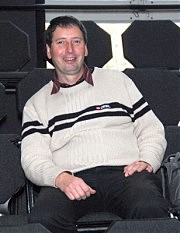
There was another amusing coincidence: among the many festival venues where concerts, exhibitions, lectures, and film screenings took place, we were to perform at the Rudi Theater, i.e., my “namesake.” The explanation turned out to be simple: “Rudi” is a common German name, and at one time this theater was built by someone named Rudi, whose surname has since been lost. Nevertheless, this gave us a reason to immediately consider the theater “ours,” but most importantly – it was made ours by the working atmosphere that we immersed ourselves in the day after the festival opening, during a large preparatory rehearsal.
More precisely, it was a series of rehearsals – an orientation, a sound check, a lighting check, a rehearsal for the so-called “overtitling” (parallel text translation displayed above the stage), a general run-through of the play – from morning till evening. Michael was with us almost all day – both as a translator (he speaks Russian quite well) and as an organizer; our friend Holger Kretschmar was with us all day (more precisely, he was with us all week, but we’ll talk about that later). And all day long with us were – or rather, “worked for us” – the reliable, businesslike, and friendly staff of the Rudi Theater: the calm Welfer, the smiling Helmut, who resembled Ole Lukøje, and Valeria, who grasped everything instantly and was in charge of the overtitling. By the end of the day, everyone was exhausted, especially Oleg Fendura – not only because he was the main actor but also because he took responsibility for setting up the lighting, partitions, and decorations to adapt the new hall to the play as much as possible.
And so, on October 19th, the final rehearsal and the first performance. Sold out, the “Geval Gevolim” theater is presented to the audience by Michael Rockstroh, Holger Kretschmar, and our musical director Evgenia Ermakova. The performance is full of energy, with concentrated tension; all “technical” aspects – changed staging due to the new hall conditions – go smoothly, the audience reacts lively and reservedly at the same time (more lively – the Russian speakers, who make up about a third of the hall, more reserved – the German speakers, such is the style of this audience), and at the finale, what is called “stormy applause.” The main indicator of success for us was that for the second performance, on October 20th, an additional row and chairs had to be set up in the hall for the audience.
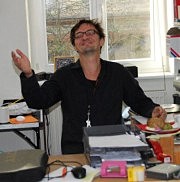
And, of course, the reviews. After the first performance, Michael invited us, along with the staff of the Rudi Theater and the festival organizers, to a small cafe right there in the theater. It was then that he told us about the history of the festival and shared his impressions of our play. Moreover, he spoke not so much as a festival director but as a theater person, which is more valuable to us. According to him, he was struck by the level of professionalism of the performers and the entire production. And also: “Here in our theater, we sometimes take a large piece of text – and it seems there’s nothing to do but speak that text; but you take a very small piece – and it turns into such a large scene, and so much life in it, everything is very alive…” Michael also said wonderful words about Holger, whom he met in person only at the festival: “Everywhere and always there are people who believe in something, are convinced of something, and simply do it – and start again and again, and this leads to what Holger has done. There are hundreds of theaters, thousands of music groups, and we can only invite a few. It’s not always a matter of quality and fairness – it’s a matter of these convictions, and it’s very beautiful. And I am grateful to him and to you for being here now.”
Encounter with Dresden
This encounter began in the morning, on the first day of the festival, when we went on foot to tour the three-hundred-year-old Old Jewish Cemetery, then further, to the very heart of Dresden – the golden monument to the powerful ruler of Saxony, Augustus the Strong, and the panorama of Theater Square opening behind it. And this encounter continued uninterruptedly throughout the week: even when we spent whole days at the theater, Dresden was tangibly present beyond its walls, setting a high and beautiful standard of calm dignity; our sets seemed to become part of the huge and most beautiful set imaginable.
I will not attempt to verbally describe what even photographs cannot fully convey. Dresden has half the population of Odessa but is twice as large in area – the city does not strive upwards, and it is amazing. There is no dissonance between new buildings and the old city. Very beautiful, very long, and very modern trams run through the city: close your eyes – and you’ll never guess it, because they are completely silent, as if they are not running on rails but on butter. They say the old city was restored for 40 years, stone by stone, after the infamous bombing. And when you see this magical, ornate baroque ornamentation, these elegant masses of palaces – you cannot help but admire the meticulous and active love of the citizens for their Dresden and the essentially rapid restoration. The city breathes history, but not heavily; the city breathes modernity, but without strain.
And throughout the city, the festival posters, now familiar to us, are hung – they are an equal part of its multifaceted life. As if Dresden itself has become our spectator and participant.
Encounters with Friends
As soon as our bus arrived at Neustadt station in Dresden after a day and a half of tiring travel, I saw Holger: he was meeting us with his friends (and now ours) – Connie, Christian, and Lyuba. Right there at the station, they treated us to hot tea from a thermos and warm buns prepared for us by Holger’s mother. Who would then talk about different “mentalities”? There are simply people and… there are wonderful people.
The wonderful Ines, who speaks Russian with a slight accent but absolutely correctly and with a huge vocabulary, gave us an unforgettable tour of Dresden, walking half the city (despite a recently operated knee).
The tireless Sveta and her husband Ulrich. Sveta not only translated for us but also offered to film the play herself, and when there were camera problems during the first performance, she came the next day and re-filmed everything. Holger’s father, who is almost 80 years old, came to the performance with his wife and then spoke to us warmly and seriously about his impressions – Holger translated, and when his father was called to the phone, he continued his emotional speech anyway. Connie, who, along with others, drove us from the station to the hotel, brought her class (she teaches Russian at a school) to our performance… It’s impossible to list everyone.
What can be said about Holger, thanks to whom we got to this festival, as “Vechernaya Odessa” wrote (“The Saturday of Consolation” is going to Dresden,” October 14, 2010) – he surpassed himself: he specifically took leave from work and dedicated all his time to us, taking care of every small and large problem that arose hourly in a foreign, unfamiliar city. He acted as an ideal theater manager, suggesting new ways to advertise our play. He – like a magician from a sleeve – pulled out new surprises for us: for example, a free visit to the Dresden Art Gallery (he later admitted that negotiations for this took him at least two weeks)… He was very tired, but when we mentioned it, he objected: “It’s nothing, I myself enjoy doing all this…” And he watched our play at least three times, counting the rehearsal, and each time he was more and more delighted, calling our theater unique: “It’s two or three times better than I expected!”
It’s an amazing feeling when adults are cared for so much, when literally all conditions are created for the theater – just play. Holger and his friends became the living, beautiful face of Dresden and the festival for us.
A lot of time has passed, and we have already performed our play in Odessa, as they say, “to a large audience” – but the encounters on the Elbe still nourish our hearts, still give impetus to our creative and human energy.











