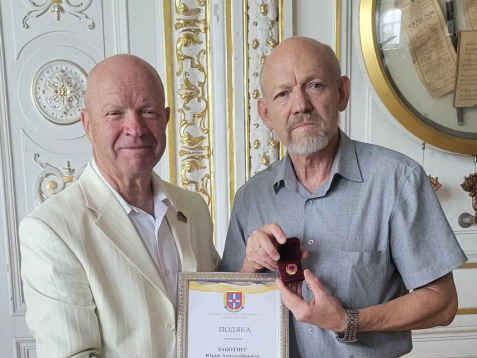
Recently, the director of the centralized system of city children’s libraries, laureate of our newspaper’s “People of Business” competition, Galina Yakovlevna Lazareva, received a print run of a book that she and her “team” had been working on for two years: “Princess Mary. A Creative Miscarriage.” The research is dedicated to the history of the non-creation of a film adaptation by film director Kira Muratova of M. Lermontov’s novella “Princess Mary”…
The provocative subtitle appeared as a result of joint creativity. “With the direct participation of Kira Muratova and Evgeny Golubenko,” the authorship of the book is specified on the title page spread. Initially, Evgeny Golubenko, the production designer for Muratova’s films, came up with the subtitle idea “forced abortion,” but later they agreed on the term “miscarriage.” This is where the purely feminine associations end. A strict and consistent presentation of the situation in documents begins: protocols and transcripts of meetings of the party committee, the directorate, the script editorial board of the Odessa Film Studio, official letters, conclusions of high authorities, orders, reviews, audit reports, and accounting statements. The book has 397 pages.
What is remarkable is that the book includes the literary and directorial scripts for “Princess Mary” created by Kira Muratova. They are, in themselves, artistic works of high caliber and allow a glimpse into the “laboratory” of a film director belonging to the cohort of so-called auteur cinema. Until now, these scripts have not been published in this form anywhere.

The directorial script for the film “Princess Mary” was accepted (i.e., approved) by the Main Script Editorial Board for Feature Films of the USSR State Committee for Cinematography on May 14, 1975. The deadlines for directorial development were liberally extended until May 22, 1975, by order of the director of the Odessa Film Studio, Gennady Zbandut (and such “extensions” were costly in all respects). The film was launched into production by order of the Odessa Film Studio on May 20, 1975 (“to commence preparatory work on a full-length, color, widescreen film”…), with work scheduled to begin on August 6. And… this film was shut down, removed from production by order of the State Committee for Cinematography of the Ukrainian SSR dated August 20, 1975, signed by the acting chairman of the State Committee for Cinematography of the Ukrainian SSR, D. S. Sivolap.
Because the film… stalled. And the meetings continued. The finance department informed the film studio director that “in the absence of an act of launch,” the bank would charge the film studio 40,000 rubles (a ruble in 1975 was equivalent to 60 cents). As a result, the salaries of the entire film studio for half of August would have been affected. D. S. Sivolap’s order credited the money spent on “Princess Mary” to the film studio’s losses. The budget for the preparatory period of the film was 60.3 thousand rubles.
Galina Lazareva notes that no other film in the history of the Odessa Film Studio has left behind so many protocols of various meetings and discussions. What happened?
“No one wanted to close the picture,” insists Galina Yakovlevna. “It was a trauma for everyone. For the Odessa Film Studio. For Kyiv. For Moscow. Sergei Gerasimov strongly supported his student Kira Muratova.” And yet…
“One cannot,” insists Galina Lazareva, “approach events unequivocally, without considering the environment, the economic and legislative components. The film studio was on a cost-accounting basis: the state allocated money for a specific film, not for the maintenance of the film studio. In case of a film’s box office failure, and even more so in case of its rejection at the State Committee for Cinematography level or its closure during the production period, the losses fell on all film crews and the entire staff of the film studio.” But thanks to this strict law, emphasizes G. Ya. Lazareva, cinema in the USSR generated “crazy” profits.
It was precisely this economic risk that “high authorities” feared, believes Galina Lazareva. Because the stumbling block became the directorial interpretation of “Princess Mary” at the casting stage. The results of the screen tests, according to reviews, showed a significant shift in the emphasis of the directorial concept, and some of the actors chosen for the roles caused sharp rejection from the script and editorial boards at all levels. At the Odessa Film Studio, recalls Galina Yakovlevna, supporters and opponents of the directorial interpretation of the characters of “Princess Mary” turned out to be “fifty-fifty”…
There were other subtleties: who is Pechorin? The director translated the hero’s diary entries, i.e., his reflections, into direct dialogical speech – and this revealed open cynicism in the “hero of our time.” This circumstance displeased many, including Lermontov scholars.
“There was a conflict of perception and attitude,” states G. Lazareva. “The screen tests made a shocking impression on many. The requirements for adapting classics were strict and fixed in the normative documents of the State Committee for Cinematography. Such an adaptation was very difficult to achieve, and the fact that Kira Muratova was entrusted with it showed the degree of Moscow’s respect for her talent.” This was despite the devastating reaction that Muratova’s film “The Long Farewell” caused “at the top,” condemned at the instigation of the “working people”…
Stereotypes of perception also played a role, notes Galina Yakovlevna: “Pechorin was a ‘positive hero’ who was ‘eaten up by Nicholas’s reaction,’ this viewpoint was imposed by the Bolsheviks, and they invariably recalled the Senate Square. And Kira broke away from the schoolboy canons. And “at the top,” there was no confidence that she would make a film that the audience would receive well.” However, the director made no compromises and did not even pretend to be ready to compromise, and did not even understand what “the bosses” were so afraid of…

The theatrical release fate of her film “The Long Farewell” was a precedent for the dictation of audience preferences: the film was shelved after a special cultural trip of “ordinary viewers” was organized for it. “Did the ‘hegemon’ himself think of writing reviews, or were they inspired by someone more literate?” I wondered. “No one was prompted to write denunciations,” G. Lazareva firmly objects. “It’s hard to understand what the ‘hegemon’ saw as ‘slander,’ but he had his own arguments. There was demagoguery, but the demagoguery came from below. And whether it was demagoguery, I cannot say unequivocally today. I myself, being a party worker, organized free cultural trips to the theater and observed how literally ordinary people understood the stage action, filtering it through their life experience. The ability for aesthetically detached perception is, after all, a result of upbringing.”
When the “signal from below” went through the party echelons, measures were supposed to be taken…
…By the way, notes Galina Yakovlevna, the book “Princess Mary. A Creative Miscarriage” was compiled by her with such comments so that even the generation that does not know what a “party committee meeting” means would grasp the described conflict.
“And yet, no one has convinced me to this day that a film can be made without considering the audience that will watch it. And that the film’s author and the film studio have the right to work on a box-office failure. Workers – even today – are not Muratova’s audience. And audience success was needed then and is needed now economically.”
“Cinema is 90% technology and production problems – and 10% creativity,” says Galina Yakovlevna. “These are not my words – eminent directors say this. ‘The world has recognized her films!’… But the world did not give her money!”
Kira Muratova did not leave for the West. And the situation, which in the USSR was veiled by the “totalitarian regime,” has now appeared before us in all its cynical glory: cinema is openly positioned as a commodity. “It’s not by chance,” says G. Lazareva, “that I included a dialogue with Kira about her plans in the afterword. Today she is in the same position as in the USSR: money!”
All of this is in the book, which, moreover, clearly shows from the meeting protocols “who was who.” The passions around “Princess Mary” were quite heated, the names of the figures involved are still well-known, and far from always were people guided in their reviews and oral statements by vulgar envy or “sovok” ideological idiocy, although there was no shortage of precautionary “ideological” phraseology.
Galina Lazareva tracked down some of the participants of the discussion at that time during the preparation of the book. For example, 92-year-old Evgenia Vasilyevna Vladimirova, who wrote a review of the literary script for the film “Princess Mary” in 1975 as a candidate of sciences and associate professor at the Department of Russian Literature of ONU.

…The “team” that worked excellently on the book consists of the author – Galina Lazareva; Alexander Balamsa – a master of Photoshop and collage; Raisa Sukhanova – technical editor; Vasily Maslenko – layout designer. The book is published by SPD “Karpenkov O. I.” with a print run of 1000 copies. Its design, as well as its manufacturing quality, is magnificent.
In search of visual material for the film “Princess Mary” that could illustrate the book, G. Ya. Lazareva approached the production designer of “Princess Mary,” Yuri Bogatyrenko. It was not customary to publish sketches for feature films. Storyboards, sketches, and even four sheets of the production design were found, one of which the artist had already used… as a palette for mixing gouache. This stained sheet was transformed, combined with a collage of portrait sketches of the film’s characters, into an elegant endpaper!
The portrait “heads” on the endpaper, as well as the drawing of a female profile on the cover, belong to the costume designer of “Princess Mary” – Rustam Khamdamov. A series of “costume” drawings by R. Khamdamov, included in the book, was provided to the author by Kira Muratova. These are exquisite drawings, truly museum-quality, in the vein of L. Bakst’s theatrical aesthetics.
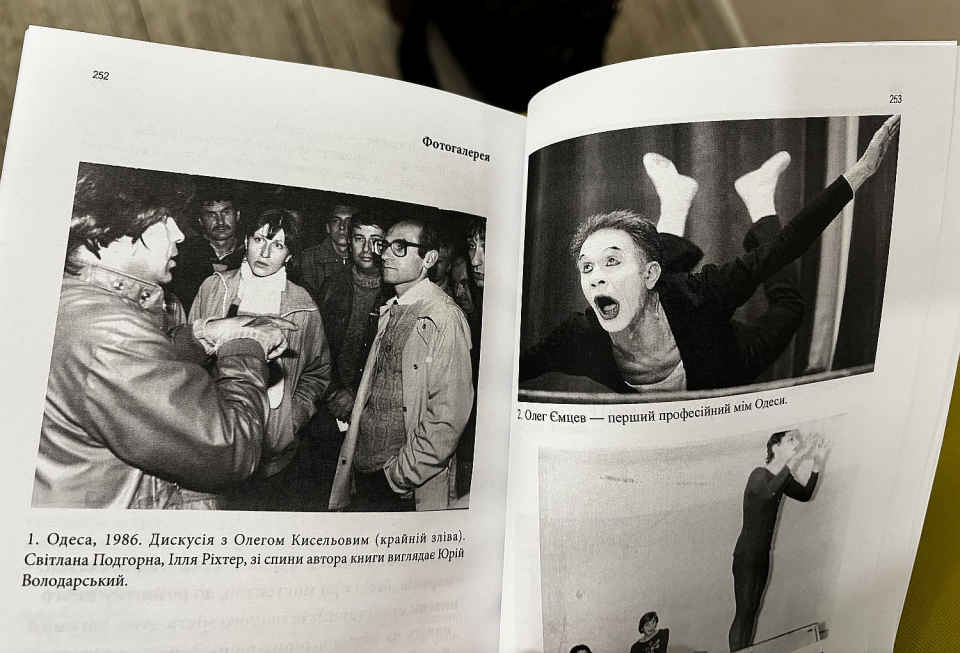
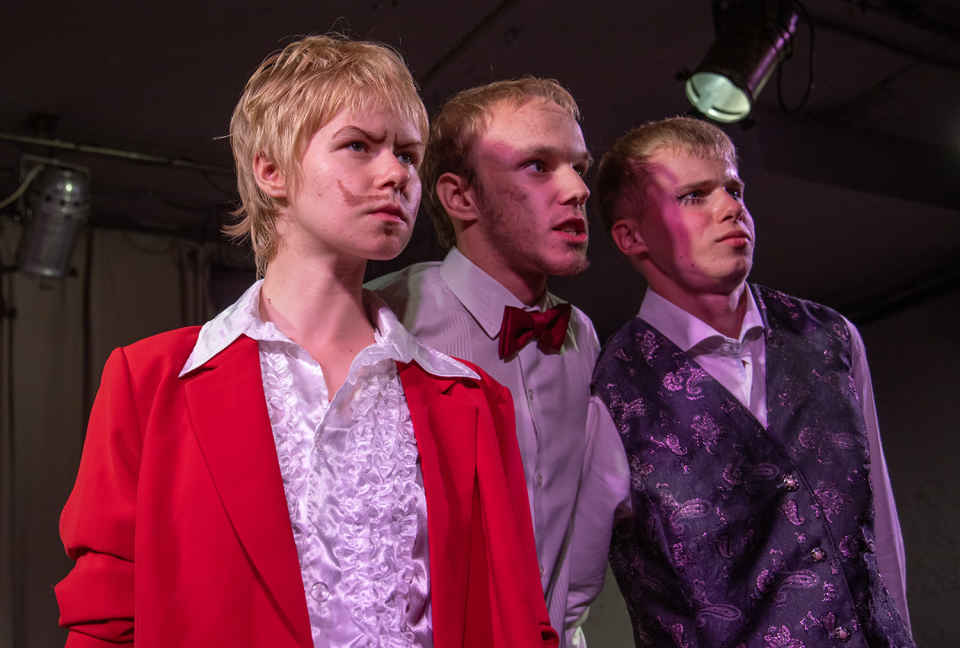
The pages of the book are decorated with “ribbons” of storyboard sketches and series of photos – photo and screen tests of actors for roles in “Princess Mary.” And whom do you not recognize here!.. The sections of the book are preceded by photo portraits of Kira Muratova – sometimes it is a portrait in a role, in “Brief Encounters.” The mood of these portraits, notes G. Lazareva, is chosen according to the content of the respective chapter of the book. Below Kira’s portraits are quotes from her statements corresponding to a certain period of work on “Princess Mary.” An illustrated filmography of Kira Muratova is also provided. The chapters-parts of the book are “Agitated,” “To Grieve-to Sympathize,” “The Man is Killed,” “King Kong Lives,” “One of Many.” Further – a terminological dictionary, biographical data, author’s comments, bibliography. Evgeny Golubenko also wrote his own small essay-opinion for the book.
“Poor ‘Princess Mary.’ Poor Lermontov.” “I have closed this topic.” These are Kira Muratova’s words. However, Kira Georgievna, as far as I have learned, not only responded favorably to G. Ya. Lazareva’s work; she was not only amazed by many things in the book – after all, she had already forgotten some words and details. Today she believes that in the distant 1975, she was indeed not yet fully ready to embody Lermontov’s immortal novella on screen, and the Odessa Film Studio was also not ready: the production would have been too costly to be worthy of such an original source. Even the “closed topic” of the Artist is a lesson. But does a “closed” topic die easily?… Sponsor!!!