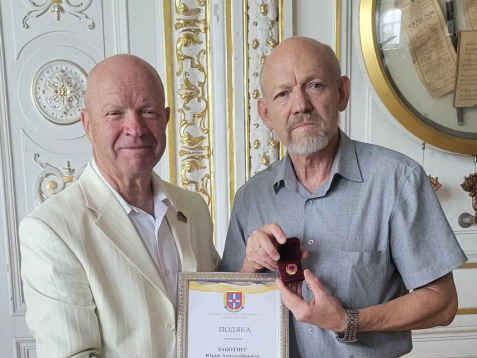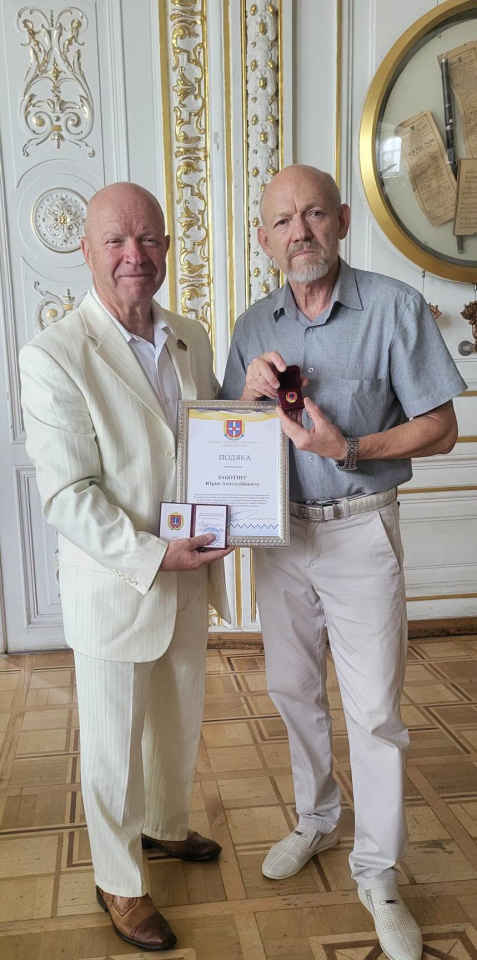
Lutheran Lane — St. Paul’s Church — Conservatory: a memorial musical “knot” tied to the name “Richter”. The revival of these memorable places, the perpetuation of glorious names, is dedicated to a long-term musical program initiated by the head of the S. Richter and D. Oistrakh Mission, pianist, professor Yuri Diky, together with the bishop of the German Evangelical Lutheran Church in Odessa, Uland Spälinger, and the president of the Synod of the NELC of Ukraine, pastor of the Odessa community of St. Paul, Andreas Hamburg. This project was discussed at a press conference on May 25.
A cycle of charity concerts is planned in St. Paul’s Lutheran Church. The initial goal is to raise funds for the creation and installation of a bust monument to the cantor of St. Paul’s Church, a talented organist who initiated the traditions of organ music in Odessa, pianist Teofil Richter, the father of the brilliant pianist Sviatoslav Richter.
The initiative for the event will be a performance in the church by the Kirovohrad Municipal Chamber Choir, led by laureate of international competitions, Honored Artist of Ukraine Yuriy Lyubovych. The concert will take place on May 30 at 6:00 PM. The mayor of Kirovohrad, Volodymyr Puzakov, will come with the musicians. The ensemble will not only give a concert free of charge but will also travel at their own expense.
As Yuriy Diky explained, Kirovohrad was not chosen by chance. Sviatoslav Richter was a student of the outstanding pianist Heinrich Neuhaus, who was born in Kirovohrad. The S. Richter and D. Oistrakh Mission of Odesa has had ten years of joint festival work with musicians from Kirovohrad.
“Not everyone knows detailed information about Teofil Richter,” said Yuriy Diky. “In 1916, he became the organist of St. Paul’s Church in Odessa. In the same year, the first graduating class of the Odesa Conservatory took place. Music critics’ reviews of this graduating class were very skeptical, and the first rector of the conservatory, Witold Maliszewski, was concerned about attracting high-class specialists to teach. Thus, Professor Teofil Richter was invited to the conservatory. However, the conservatory professors did not develop a fondness for their new colleague, although they did not refuse to use his knowledge and experience. He was undeservedly belittled, and in 1926, Teofil Richter left the university and became the organist of the Odesa Opera and Ballet Theater.”
The NKVD repressed Teofil Richter; he was shot on October 3, 1941. Where he was buried is still unknown.
“Remembering Teofil Richter in Odessa, we remember our Lutheran liturgical tradition,” says Bishop Uland Spälinger. “Its foundation is the Word of God, and music is second, as Martin Luther taught. With singing, supported by the sounds of the organ, parishioners glorify the Lord. This tradition gave the world the great Johann Sebastian Bach and has developed from that time to the present day. Our Christian community feels greatly indebted to Teofil Richter and is closely connected with his name. Organist Teofil Richter, like Pastor Karl Vogel of St. Paul’s Church, who was shot slightly earlier in 1937, fell as martyrs for the Christian faith.”
Odessans, the bishop noted, love music, and the church shares their desire for high musical experiences. The church is open for both worship and concert activities, for cultural events. The temple has excellent acoustics: the echo lasts for 4 seconds, which is an excellent indicator for an organ and choir, and it would be an unforgivable mistake to keep such a space closed to the world of culture.
On May 23, an organ concert by laureate of international festivals Veronika Struk took place with great success in the rebuilt, restored church. Almost 1000 listeners gathered — far more than St. Paul’s Church seemed to be able to accommodate at all! (About the concert — “Triumph of Music”).
“I left my job at the Odesa Music Academy,” Yuriy Diky remarked during the press conference, “but if its teachers and students expressed a desire to participate in our project, we would be sincerely happy about it.”
…Finally, journalists were shown a memorial to the victims of Stalinist repressions in the narthex of St. Paul’s Cathedral — a large cross on a memorial plaque with names, sheltered by two angels. On the glass doors leading into the cathedral, the inscription “Peace be with you” is repeated in eight languages.