

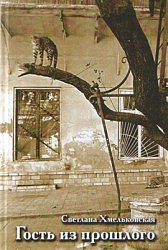
Svetlana Khmelkovskaya. «GUEST FROM THE PAST». Odessa. BMW. 2009
A little over two years have passed since Svetlana Khmelkovskaya’s literary debut. Her first book, “The Scent of Evening,” introduced us to a “journey of the soul” in an opening world, a woman’s soul, young, but already with a certain experience of survival, self-affirmation, and adaptation to such a tempting, such a close world in imagination, drawn from literature, and yet so alien… This world makes her free, but any freedom obliges one to choose. Where to live? How to live? What compromises are possible? What to do with one’s own destiny?… Svetlana Khmelkovskaya’s second book, to some extent, continues the theme of the first.
But if the heroine of the first book could be called a “lyrical heroine,” so clearly were her thoughts and emotions “authorized,” then the heroine of the new book gains greater independence, and the narrative itself becomes more pronounced in its plot. And yet, they have much in common, and above all, it is Odessa, their native city, which has become for both not just the city of their childhood and youth, but their destiny, largely determining their character, their attitude to the rest of the world. And, I think, I will not be mistaken in saying that this is a component of the author’s personality, which she gifted to both Lilya in the first book and Olya in the second. Because one can imagine any number of love adventures, but it is impossible to invent such a love for a city – it can only be embodied in words in one way or another, if it exists in the soul. Svetlana Khmelkovskaya embodies it with talent. The city, in her writing, warms with its breath, caresses and does not let go, blesses and patiently waits, hiding its native corners behind renovated facades, miraculously preserving them for a meeting with her…
Khmelkovskaya does not engage in detached description: everything is conveyed through the heroine’s feelings, sensations, and reactions. Whether it’s a description of the alleys of her youth running towards the sea, a favorite cafe in Berlin, or the streets of Paris… That’s why reading her is so easy and engaging – these “landscapes” cannot be skipped (as many did in childhood when reading classic novels); they participate in the plot on equal footing with the characters. The urban environment surrounding the heroine is so important to her that her perception of men in her life is clearly linked to their attitude towards the city – Berlin, Paris, Odessa…
This is, in essence, a novel about female happiness, or rather, about the search for female happiness in this turbulent world. The eternal striving of a woman (an extraordinary woman) for something impossible, which reality and the man living in this reality (according to its laws) cannot offer her. And the more “advanced” our world becomes, the more its acceleration, the fewer chances there are to meet a man in it who even remotely corresponds to romantic female aspirations.
And she, Olya, what about her – does she live in another world? No, she hasn’t fallen behind the times either. She is clearly endowed with outstanding abilities for learning, career, and survival in new conditions. A successful lady, categorically unable to return to her former life in Odessa, to give up the accustomed Western comfort. But at the same time, young feelings miraculously continue to live within her – for her mother, who left life too early, for her friends, for her “native hearth”… And most importantly – for him, her first, unique, irreplaceable love. A love experienced early, in school years (a love “you can only dream of!”), which shattered against new reality, did not burn out her soul, but remained in it, living as a deeply hidden, but not extinguished hope for an extraordinary, most important meeting in life.
In this novel, the heroine seemingly has no conflicts with the external world. The new world, on the contrary, has opened up to her, offering everything most convenient, most beautiful, and sometimes even most kind. A mother sympathizes with a ninth-grader in love, who spends evenings with her beloved at an empty dacha; no one condemns her, no one obstructs her… And even his parents agree to take her with them “for permanent residence” to a foreign country… But she firmly knows – it’s impossible! For her, it’s impossible to leave her native city, to part with her mother, her friends. She doesn’t yet know that the time will come – and she will leave, and she will part. And life in a foreign country will become possible, and some cities, some streets far from the Black Sea slopes will become beloved. And compromises, without which there is no well-being, no success in life, will become possible.
She knows that one can “wake up from loneliness,” and one can “wake up from the fullness of life”… Only where is this fullness?
And she lives in pursuit of a phantom happiness, from one disappointment to another, eventually agreeing to accept the love and care of an unloved man, resigning herself to the boredom of a comfortable German life. She lives this way not only until the call “from the past” rings out, but will continue to live this way even after her meeting with the “guest from the past.”
A paradox or a regularity? A woman craving an ideal feeling, seemingly ready to rush headlong at the call of a dream, in reality will not agree to any self-sacrifice or self-denial characteristic of heroines of past centuries. Who is to blame: the diminished men, incapable of “living with passions,” for whom the concept of “life’s work” has been replaced by the sacred – “business”? Or the hypertrophied personality of a woman who has elevated independence, self-sufficiency, and ultimately, the comfort of her existence to the rank of inviolable values?
The author demonstrates ruthlessness towards her heroine in the finale, describing her behavior and feelings when she suspected she was pregnant: “…How can I even entertain such a thought? Towards myself? It could change my life, in which I have already organized everything and everything has its place… But what are you talking about, children? This is crying, diapers, and snot in this holy sanctuary, where they don’t even keep a cat, so that its quiet steps don’t disturb the dead peace…” With sparse details, yet very vividly, Khmelkovskaya describes this world, where things have become more important than life.
The plot is not the main thing in this book, although it contains many sharp turns. The main thing in it is the description of feelings and sensations, the captivating depiction of extreme states of the female soul. A soul that is both contradictory and rich in high emotions, and with a subtle perception of the world. A special emotional intensity is given by the seemingly strange narrative style: it is conducted sometimes by the author, sometimes seemingly from the heroine’s point of view, sometimes with direct address to her. “She,” “I,” “You” – these coexist and do not interfere with each other.
Apparently, Svetlana Khmelkovskaya wrote her first books “in one breath.” They contain her emotional, spiritual experience. I think the time will come when the talented writer’s work will be increasingly influenced by a scrupulous analytical mind, the presence of which is evident. But for some reason, I am sure that her given gift to feel and convey feelings with words will remain in her work forever.











