

As part of the project “Month Before Christmas,” a solo exhibition by Vadim Kucher-Kutsan has opened at the Museum of Modern Art. The new exhibition, titled “And He Appeared in the World…”, is programmatic. Vladimir Ostrovsky, in particular, noted that the works presented are an interpretation of biblical stories by a 21st-century person who has managed to avoid banality.
An artist must be very confident in their abilities to dare to present freshly made works to the viewer’s judgment without delay, works that, in the overall concept, with a few exceptions, are most likely transitional. One must be very harsh with oneself, able to distance oneself from one’s own creativity and passionately strive for perfection, to dare to… destroy (!) a completely finished work.
This is not an un-dramatic introduction – about an artist with a “very complex character,” a graduate of the Odessa and St. Petersburg schools of painting (a student of the President of the St. Petersburg Academy of Arts, Boris Ugarov). Vadim Kucher-Kutsan is also known for his participation in the revived “Russian Seasons” in Lyon and Paris. Not long ago, his solo exhibition was successfully held at the Odessa Museum of Western and Eastern Art, whose director, Vladimir Ostrovsky, is a great admirer of Vadim’s work. He fully demonstrated this in his emotional and exhaustive performance during the opening of the vernissage at the Odessa Museum of Modern Art (OMMA).
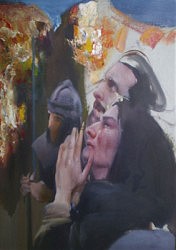
Why turn to the Bible specifically? Is it solely the ambition of a young artist possessing the full arsenal of academic expressive means? I think Vadim has been approaching this theme for many years. In this regard, I recall the work of the outstanding Odessa graphic artist Ambrose Zhda (1855-1927), who was inspired to illustrate the Gospel by the discovery of the Shroud of Turin. Zhda devoted about ten years of his life to this work but never fully realized his project. The Gospel itself is imbued with great pathos, immense power of grief and passion, and each biblical episode is metaphorical, multi-layered, and touches upon eternal moral problems. Today, after a century of atheism, interest in the Bible is quite high, as evidenced by the magnificently filmed movies of the last decade, for example, Mel Gibson’s famous film “The Passion of the Christ.” By the way, in Vadim’s works, the influence of cinema is involuntarily felt, especially in the scene “And Carrying His Cross.”
It is obvious that the work on this grandiose theme has so captivated the Odessa artist that, I venture to guess, the new year, 2010, will also pass for him under the “Star of Bethlehem.” This is indicated by a number of purely sketch-like variants presented, a large number of graphic sheets, where we see in the author a magnificent master of composition. It should be noted that the artist completed several dozen works dedicated to this theme, including three finished large-format canvases, in just three months, destroying one of them in a fit of dissatisfaction. This is an indicator of Vadim Kucher’s high work capacity and his perfect mastery and demanding nature, which cannot but inspire admiration. It is striking how easily and concisely the painter outlines the shape of a head with a single brushstroke, yet the psychological expression is not lost. This quality favorably distinguishes his canvases from earlier ones, which we could see at the previous exhibition.
Perhaps it is premature to make assessments, but let us ask ourselves: what is new in the interpretation of the Bible that the artist demonstrates? Kucher continues the tradition of interpreting the coming of the Messiah from a historical perspective, but it is perceived as a kind of celebration. The director of OMMA, Semen Kantor, emphasized this feature of the Odessa artist’s biblical series. The coming of Christ is an event that does not fit into the concepts of ordinary consciousness, and every seventh day of the week is meant to remind us of this. The paintings, most of which are signed with quotes from the New Testament, depict a misunderstood messiah surrounded by a blind crowd with base instincts. Let us ask ourselves the questions that Vladimir Ostrovsky, mentioned earlier, posed to himself and the audience: why did Christianity as a worldview, as a religious concept, manage to displace folk paganism? Why did the cult of the “weak,” the “turn the other cheek” (which Nietzsche so hated), replace the cult of strength? The scope of the article does not allow for developing this theme, but the very posing of the question indicates the possibility of filling the religious-scientific consciousness of 21st-century people with new meaning.
The joy of realizing one’s participation in the most perfect spiritual and moral phenomenon, such as Christ, contrasts with our perception of him, people of the 21st century, with the perception of him by Jews. They are depicted by the artist grotesquely, on the verge of caricature, and the image of Christ illustrates a certain concept rather than conveying a psychologically complete and uniform personality. Where the type of Christ is more specific, we see, above all, a stoic who has accepted the trials. It should be noted that the depiction of Jesus Christ is one of the most complex artistic tasks in world painting, which the genius Leonardo da Vinci “failed” to cope with in his time. Perhaps this ambiguity of the Savior’s image explains the author’s search for “his own” Christ. Perhaps an icon, rather than a painting, is still more adequately capable of conveying this image? A debatable question.
The feeling of festivity is enhanced by the depiction of flowers, the splendor of spectacular atmospheric glows and mirages, which are metaphorical in nature. This is a kind of antithesis: tragic events unfold against the backdrop of life’s rejoicing – a completely anti-romantic concept. Perhaps Vadim Kucher-Kutsan is closest to the Russian artist Vasily Polenov, although in some cases we see a certain influence of the Art Nouveau masters, especially in “Wreath of Christian Sonnets.”
The word “illumination” suits some of the works in the series (“Opening his mouth, he taught them”), others are reportage (“On the Way to Egypt,” “Into the Mountain Country”), or poetic (“And He Appeared in the World”). In the latter, Mary is overflowing with pride and maternal happiness. This canvas is a kind of hymn to life. Parallels with Vrubel’s “Lilac” come to mind, but despite the compositional similarity, Kucher lacks the mystical mystery characteristic of the Russian symbolist. Such “pieces of nature” bring a lyrical note to the artist’s works, ground the subjects, and in this case enhance the moment of intimacy, the feeling of quiet joy and fullness of life.
Other episodes from the Gospel allow Vadim Kucher to demonstrate his advantages as a painter inclined to elegant effectiveness (“When they saw the star, they rejoiced exceedingly”).
The question of succession does not diminish the merits of this artist’s works, but rather points to his general culture, gives a sense of solidity, especially when the fashion for avant-garde is cultivated. This is also evidenced by reinterpretations of classical themes, examples of Byzantinism (“Bringing Him Gifts”) or Mannerism (“Madonna of Parmigianino”). And it must be said that in his retrospections, the painter does not descend to kitsch, like, for example, the sensational Safronov (before whom the Odessa elite bowed so inappropriately).
It is symptomatic that the opening of the exhibition took place on the eve of the Christian holiday of the Presentation of the Lord in the Temple – a circumstance noticed by few and not publicly announced, but which in this case has its hidden meaning: after all, without this event in the biography of the Virgin Mary, He might have appeared in the world in another place and at another time… again misunderstood.











