

While browsing a newspaper archive with clippings of my publications, I came across an article in the newspaper “Moryak” about Cuba. And I immediately remembered…
Cuba… Sailing on the ships of the Black Sea Shipping Company, I visited this country many times. In 1959, after Fidel Castro’s government came to power, this country declared itself independent from America. The US government, by blockading Cuba, deprived it of the opportunity to receive everything necessary for its existence. And then the Soviet Union came to the aid of the Island of Freedom, as Cuban newspapers called it. Our ships delivered food, medicine, and weapons to Cuba.
I loved arriving in Havana. Upon entering the port, located in a huge bay reflecting the blue of the ocean, we were greeted by a statue of Jesus Christ. Near the empty piers, boats smelling of fish swayed. And I immediately remembered Hemingway, who lived in Cuba, his novella “The Old Man and the Sea,” for which he received the Nobel Prize in Literature in 1954.
The cheerfulness of the Cubans was striking. The shops in the city were empty – the population received food by ration cards. But music poured from everywhere, and girls, meeting us, Soviet sailors, on the streets of Havana, shouted: “Salute, comrade!”, and at the threshold of their homes, elderly Cubans smoked cigars and waved to us in greeting.
Once, leaving the port, I saw on a palm tree, turned into a poster stand, a poster that announced the opening of a Pablo Picasso exhibition at the National Museum of Fine Arts. I was familiar with the work of this famous artist from rare reproductions printed in the popular Soviet magazine “Ogonek.” And here – an exhibition.
Upon arriving at the museum, I saw a large group of schoolchildren. A guide was explaining the meaning of the paintings to them. Not understanding Spanish, I moved on. Having been raised on realistic painting, such as Repin’s “The Zaporozhian Cossacks Writing a Letter to the Turkish Sultan,” Levitan’s “Golden Autumn” and “Over Eternal Peace,” and Savrasov’s “The Rooks Have Arrived,” I didn’t quite understand Picasso’s paintings.
Picasso, of Spanish origin, lived and worked in France. But, unlike French impressionist painters – Claude Monet, Auguste Renoir, and others, who created a festive mood in viewers with their works – Picasso, who had experienced the grand Spanish Civil War from 1936 to 1939, the occupation of France by German Nazis, and fascist death camps, depicted the fragmentation of the world on his canvases, the world as we see it today.
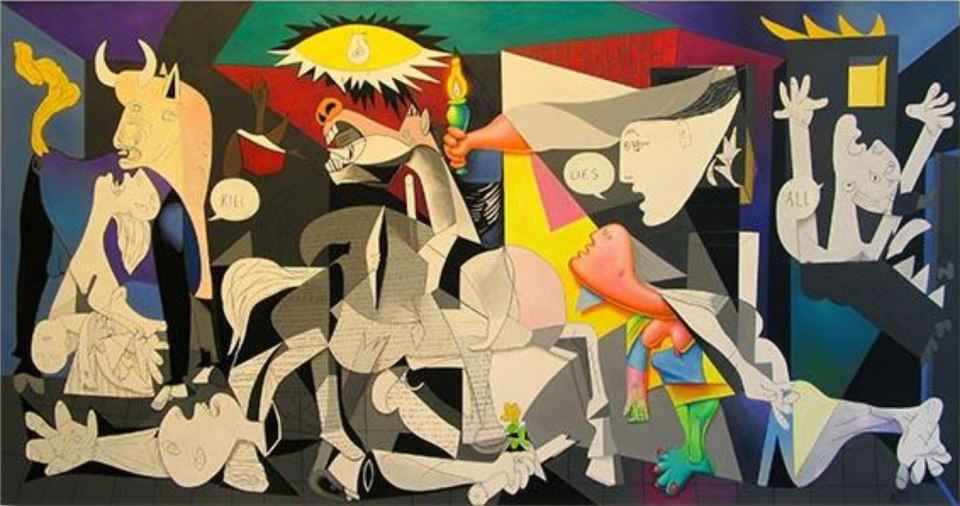
In one of the halls of this exhibition, I was struck by Picasso’s painting “Guernica,” familiar from illustrations in “Ogonek.” This painting was created in 1937, during the Spanish Civil War, commissioned by the government of the Spanish Republic for the Spanish pavilion at the Paris World’s Fair.
The painting is full of allegorical figures: an agonized horse, a weeping mother with a dead child, a bull, torn bodies, and destroyed buildings.
Guernica is a small Spanish town, completely destroyed by German aviation, which Hitler sent to help his friend, the Spanish fascist Franco, who had launched a rebellion against the legitimate government of Spain.
Looking at this painting, I recalled an episode described in the memoirs of the Soviet writer Ilya Ehrenburg. Ehrenburg was friends with Picasso, and he told him how, in 1940, when France was occupied by Nazi Germany, a German officer entered his studio. Seeing the painting “Guernica,” he asked:
— Did you do this?
To which Picasso replied:
— You did this!
Why do I remember all this? Because “Guernica” is an image of the terrible war that is happening today on our long-suffering Ukrainian land.
Picasso, regardless of any interpretation of his painting, was a man of the world. After World War II, when the World Peace Council was established, which included famous scientists, writers, and artists, Picasso also became a member of this council, painting his famous “Dove.”
His “Dove” was printed in millions of copies on postage stamps, postcards, and banners carried by people of different countries during demonstrations in defense of peace.
Unfortunately, humanity has not heeded these lessons. Today, the world is suffering, and new Guernicas are appearing. But I am confident that sooner or later, Picasso’s “Dove” will triumph.
Arkady KHASIN.











