

The Story of One Capture and the Release of Ukrainian Sailors
Twenty years ago, on October 18, 2005, an event occurred that literally blew up the traditional perception of the sailor profession: in the Indian Ocean, near the Horn of Africa, Somali pirates seized the motor ship “Panagia.” 20 Ukrainian sailors were taken captive! Initially, one simply didn’t want to believe such news: what kind of “capture” of a motor ship, what kind of “pirates” – after all, it’s the 21st century!
But before returning directly to the events of October 18, 2005, it is important to answer one, albeit very important, question: in the context of what is happening in Ukraine today, when you hear explosions, the roar of drones, the whistle of missiles, the firing of cannons, when citizens almost every day have to encounter or use the words “hostage,” “prisoner,” “imprisoned,” “released from captivity,” and so on, how appropriate is it to return to events of 20 years ago, especially since the country has not had its own maritime transport fleet for many years, and its sailors work on ships owned by foreign owners?
I believe it is difficult to give a simple answer to this question: is it necessary or not? History, especially one’s own history, always reminds of itself in situations that are impossible to predict. And examples of courageous behavior, the resilience of those around you, which inspire faith in your own strength and confidence in your comrades, have always been respected and honored by Ukrainians.
On October 18, 2005, when Somali pirates seized the motor ship “Panagia,” everyone was struck by the complete uncertainty and ambiguity of the further development of the situation that arose: what would happen to the ship, to the sailors? After all, in that part of the Somali coast, where the captured motor ship was heading at the pirates’ demand, there are no ports, and no one understood where it would be located next. And if there are no ports, the question immediately arose: how would it be supplied with water, fuel, food if its detention was prolonged and its own supplies were insufficient? It was unclear where the sailors would be: on the ship, or would they be forced to disembark and taken somewhere ashore? If taken ashore, then where: there are no settlements there on the shore, just desert all around. In a word – questions, questions, and more questions arose and begged to be asked…
But still: first, the chronology of events.
Early in the morning of October 19, 2005. from the subsidiary enterprise “Seagal,” a message was received by the Ministry of Foreign Affairs of Ukraine (the text is authentic, comments are mine):
“To Deputy Minister Mr. Nalivaichenko V.A. Urgent. Regarding the capture of the motor ship Panagia under the Liberian flag with a Ukrainian crew on board.
SE “Seagal” hereby informs that, according to information received by phone from the captain of the motor ship Panagia, Mr. Shabanov V.V., on October 18, 2005, at 15:50 Kyiv time, this vessel, located in the Indian Ocean 90 miles off the eastern coast of Somalia, was attacked by armed men on high-speed boats using firearms. The vessel is on a commercial voyage, carrying 32,503 tons of coal from South Africa to Turkey. … Communication with the vessel is lost. The fate of the crew, vessel, and cargo is unknown. We request the Ministry of Foreign Affairs of Ukraine to ascertain the fate of the crew through diplomatic channels and take all possible measures to ensure the safety of the sailors and protect their interests as citizens of Ukraine.
Sincerely, Director of SE “Seagal” Volodymyr Yurkov.”
And how did the sailors on board the motor ship “Panagia” at that time perceive the development of these events?
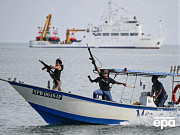
The watch officer, second assistant captain Pavlo Stepanov, and captain Volodymyr Shabanov, who were on the bridge, saw high-speed boats rushing towards the ship and ordered the engine room to increase speed to the maximum. Simultaneously, the watch officer began maneuvering to make it difficult for the boats to approach the ship. However, this did not stop the attackers. Throwing grappling hooks and light ladders on board, the robbers climbed onto the deck of the “Panagia.” According to the sailors’ descriptions, they were black, curly-haired, bearded, appearing frail (skin and bones), but all armed with automatic rifles, some also with grenade launchers. They were dressed in t-shirts, with colored fabric wrapped around their hips like a skirt, wearing flip-flops on their feet, many were barefoot.
The attackers demanded that the crew gather in the bow of the ship. They warned that if the sailors did not behave aggressively, weapons would not be used against them. They immediately confiscated mobile phones and began to rob the sailors’ cabins.
The pirates settled on the ship’s bridge, taking it under round-the-clock continuous control and thus preventing the crew from accessing the control instruments, satellite phone, and navigation equipment.
The pirates allowed the crew to continue living in their previously occupied cabins, permitting them to move around the ship for official duties one or two at a time during the day, but forbidding them to gather together. The pirates ate on board using the ship’s provisions. Cook Serhiy Svitlychenko and steward Volodymyr Yasyuk had to get up at 5 a.m. every day to prepare food for the crew and the robbers. When the captain told the pirates that flour and sugar were running out, and soon there would be nothing to bake bread with, the pirates brought a sack of flour and a sack of sugar from the shore by boat, brought several goats, slaughtered them at the stern, and delivered the meat to the galley. They also brought cigarettes from another ship they had captured.
The days of the sailors’ captivity dragged on monotonously. The motor ship “Panagia” lay at anchor about two nautical miles from the shore; from the ship’s side, one could see the endless expanse of sandy desert covered with sparse thorns. The sailors were engaged in routine maintenance to keep the ship in working order. Captain Volodymyr Shabanov and chief engineer Petro Kulikovsky oriented the sailors towards preparing the ship for weighing anchor and setting sail immediately after receiving permission. The crew members understood that negotiations with the pirates for the release of the ship were ongoing, but they did not know the results, although they greatly hoped for their swift conclusion and release from captivity.
We, the employees of SE “Seagal” in Odesa, knew that negotiations for the release of the ship, cargo, and crew were being conducted in London with representatives of the pirates, and we also hoped for the swift release of the sailors. In the meantime, we had to constantly and very closely work with the Ukrainian media, and with the relatives and friends of the sailors.
Literally from the first days, and I would even say – from the first hours of the ship’s capture by pirates, the management of SE “Seagal” faced difficult, but very important questions that had never occurred in their daily work before. It was necessary to fully meet the requirements of the shipowner, who began active negotiations with the pirates for the release of the ship and crew and demanded our unconditional compliance with all his instructions, which sometimes concerned the terms of the negotiations and contained confidential information.
On the other hand, it was necessary to inform the family members of the sailors about the ship’s capture, the measures being taken for their release, the conditions of the sailors’ stay on board during captivity, their safety, provision of food, water, salary, and the possible timeline for resolving this issue, etc.
Every working morning for me in those days began with messages to the wives and mothers of the sailors about the information received over the past day. I called families living in Crimea, Kherson, Mykolaiv, Vinnytsia, Kharkiv, and other regions of Ukraine. I kept a daily record of all my conversations with the sailors’ families, and at any moment I knew when a particular family had contacted the company. And if I saw from my records that a particular wife or mother of a sailor had not contacted us for more than three days, I called them myself, provided the information I had, answered questions that arose during the conversation, and if necessary, intervened to resolve some requests and questions. All these measures and the work we carried out collectively contributed to the fact that the family members of the “Panagia” motor ship’s sailors did not gather for rallies and protests, did not demand the intervention of the president, the Cabinet of Ministers, the Ministry of Transport, or the Ministry of Foreign Affairs, and did not travel to Kyiv to submit petitions, etc.
Relying on the information received from us, constantly feeling the attentive and trusting attitude towards their problems from our company, they awaited the completion of the shipowner’s negotiations for the release of the ship. And finally, they lived to see the day, namely November 26, 2005, when the pirates left the ship, and the “Panagia” was able to continue its voyage to Turkey. After making the passage from the anchorage near the coast of Somalia to Izmir and handing over duties to the replacement sailors from Ukraine who had arrived, the crew returned to Odesa on December 12, 2005.
As the sailors themselves testified after their return, information about the situation at home, in the sailors’ families, regardless of which city they lived in, reached the motor ship “Panagia” through various channels. And this, in their opinion, undoubtedly contributed to the sailors being more collected, more responsible, and more confident in themselves.
I want to note that the sailors of the motor ship “Panagia” behaved bravely and with dignity in captivity. Despite the pirates’ threats (which were quite real, by the way, Captain Volodymyr Shabanov, for example, was taken to the deck several times by the pirates as if for execution for delaying negotiations with the shipowner!), the sailors tried to maintain the ship and all mechanisms in working order so that they could proceed under their own power without delay after the negotiations were completed. Due to a lack of drinking water, they managed to persuade the pirates to allow them, under their control, to make several passes along the coast so that the ship’s seawater desalination unit would work. The state of the cargo in the holds was the concern of senior assistant captain Artem Demidyuk, boatswain Mykola Yerokhin, and the entire deck crew. Coal is a treacherous cargo, and in the conditions of African heat and high humidity, it could ignite due to methane emissions. The holds had to be constantly opened and ventilated.
Thus, each sailor was engaged in his work, and the crew as a whole strove to be ready to weigh anchor after receiving permission to depart. Through their resilience and behavior, the sailors managed to obtain permission from the pirates to periodically call their relatives in Odesa, which also played an exceptionally important role in this situation, especially in information exchange.
After the sailors of the motor ship “Panagia” returned to their hometown, the President of Ukraine V. Yushchenko, who was on a working visit to Odesa, presented Captain Volodymyr Shabanov with the Order “For Courage” III degree, gave each crew member a watch with state symbols and the inscription “From the President of Ukraine.” The head of the Odesa Regional State Administration presented each sailor with a mobile phone.
Back then, in 2005, after the return of the “Panagia” crew, I did not think that our experience working with the sailors’ families, gained in difficult conditions and very challenging dialogues with some wives and parents of sailors (let’s be honest, there were all sorts of things in these conversations, not always were such conversations pleasant for the parties), would be in demand. It seemed to me that the events with the “Panagia” were an isolated episode, and the acquired experience would hardly be useful to anyone. Unfortunately, I was mistaken in my predictions – the capture of sailors, including Ukrainian sailors sent on voyages through the mediation of our Odesa crewing agencies, especially in 2008-2010, became almost systematic, the duration of sailors’ captivity increased, and pirates’ demands and ransom amounts grew.
The appetites of the then-flibustiers and their thirst for easy money prompted the governments of several countries to develop and implement certain measures aimed at combating piracy on the high seas. In the Red Sea region, near the coast of Somalia, patrols by warships of NATO countries and some states in the region began. However, as it turned out, the combat duty of naval ships was not as effective as expected.
Firstly, the transit time of vessels in dangerous areas increased. After all, it was necessary to form convoys of cargo ships of different types and purposes, tonnage, and year of construction, and move at a single chosen speed to prevent pirates from attacking ships lagging behind the convoy and solitary vessels. High-speed vessels, for example, container ships, lost their speed advantage and had to comply with the general requirements of the convoy.
Secondly, the pirates soon adapted, learning the points where naval sailors stopped escorting and returned or went to the zone where a new convoy of cargo ships was being formed. Cases were recorded when pirates attacked solitary vessels after their escort was completed and warships departed.
Thirdly, unforeseen legal issues arose. For example, a warship spotted a suspicious high-speed boat and decided to detain and inspect it. The boat stopped at the military’s demand and stopped, but when the naval sailors approached the detained boat in assault boats – the people on board… had no weapons with them (though, like no nets or fishing rods)! It is clear that these were not fishermen, and they simply sank their weapons. But what could be presented as an accusation to potential pirates in such a case? Only suspicions!
Furthermore: if suspicious individuals were still detained, as was done at the beginning of the patrols, then how should they be handled further? After all, they had to be taken on board, fed, housed, and guarded, delivered ashore (to where, to which country?) and most importantly: and what next – to judge? According to the legislation of which country: Somalia or the country whose naval sailors detained the potential attackers? After all, the detainees had no documents, and it was impossible to establish their identity and citizenship not only on board the ship but also ashore.
It is clear that in practice, after inspecting such a boat, naval sailors, convinced that there were no weapons on board, most often let the potential “pirates” go. Although there are known cases when detained “pirates” were still delivered to the countries of origin of the warships (for example, to Italy) and tried there. But all this was too costly, required a lot of time and effort, and ultimately, the patrol practice was abandoned, but escort by warships continued for some time.
The practice of shipowners hiring armed security to escort transport vessels in dangerous areas proved to be much more effective. On the wave of increasing pirate attacks, companies providing security services emerged.
The only known limitation to date is that a very small number of countries allow maritime transport vessels with armed personnel on board to enter their territorial waters (let alone ports). Subsequently, security companies also resolved this issue: security personnel board transport vessels in the open sea and also leave them after escorting through the dangerous area.
After the practice of sending armed security on transport vessels became widespread, not a single case of pirate attack on a protected vessel was recorded. Therefore, the issue of safe navigation of transport vessels in areas dangerous due to pirates is a matter of shipowners’ desire (and ability) to bear additional costs for security.
Summing up, it should be noted that any experience is always hard-won. Often, a high price has to be paid for it, which can be not only difficulties of a domestic nature but also human suffering, ruined destinies, and, unfortunately, even severe losses.
20 years ago, the Ukrainian sailors of the motor ship “Panagia” were the first to gain sad experience, spending 39 days in captivity with Somali pirates. Our compatriots endured, withstood all trials, and returned home safely.
Recalling the events of those days, I want to wish all sailors, those who are already at sea or are just preparing for a voyage, calm, safe sailing, and a joyful reunion with their loved ones.











