

An unusual exhibition with this title will be open for a month in the “Apartment No. 6” communicative space of the O.V. Bleschunov Odessa Municipal Museum of Private Collections. The project is based on the private collection of artist, collector, and restorer Nataliia Osadchuk.
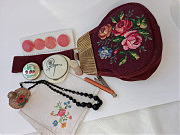
The exhibition features 22 women’s handbags and over 130 authentic accessories from the late 19th to the early 21st century. Each exhibit reveals a page of women’s history, style, and everyday life.
For example, a charming white beaded handbag was gifted to the artist by an admirer from Great Britain. Nataliia restored a velvet Vietnamese handbag, replacing the half-cross stitch embroidery according to the original design. She restored and re-wove a black glass bead handbag. She purchased some items in Denmark, where she spent the first year of the war, some abroad or in Ukraine at auctions, and some at the Starokinny market in Odesa. Sometimes, she was given handbags that were completely ruined by time, and she gave them a second life.
— I also thought about what a woman puts in her handbag, — says Ms. Nataliia. — In mine, there’s always a tailor’s tape measure and other sewing accessories. And next to the handbags, I displayed lipsticks, fans, perfume bottles, buttons, and so on.
On Saturdays, interesting events can be attended at the exhibition. Nataliia Osadchuk’s author’s lecture “The History of the Lady’s Handbag in Europe” is scheduled for August 16 at 3:00 PM. A master class on making a beaded handbag based on an authentic early 20th-century pattern will take place on August 24 at 2:00 PM. You can also bring your favorite handbag, talk about it, and the exhibition will conclude with a viewer’s fashion show.
Nataliia Vasylivna has been embroidering for about 17 years; all the women in her family engaged in the same type of needlework. She used to work as an accountant. Her paintings are examples of multi-layered satin stitch embroidery (glazing) using various decorative stitches and volumetric techniques. Nataliia created a training course based on this methodology. The craftswoman has long been collecting and restoring vintage textile women’s accessories, and in Denmark, she found a new object for restoration.
— I got an antique armchair practically for free when I was holding an exhibition in Aarhus, — says Nataliia Vasylivna. — Aarhus is the second-largest city in Denmark after Copenhagen. It’s located on an island and is very similar to Odesa: it has a huge port, bulk carriers, and piers… The exhibition lasted two weeks. I was given the opportunity to contact someone from the local art center, which is located in a huge old warehouse that artists have adapted into an exhibition space; many people also live there. This art center has a hall for concerts and readings. I went in and saw this armchair. The armchair, standing among many old chairs, stood out with its embroidered upholstery.
As it turned out, food was placed on the seat, and people rested their feet there. The artist took the armchair to Ukraine, and in its place, she offered a quite sturdy chair that she bought for 30 kroons. Nataliia restores the embroidery herself, but wool threads are not cheap, and the wooden parts also need repair. Perhaps she will find a patron for the project? The restored masterpiece of decorative and applied art will be transferred to one of the Odesa museums; at least, it would look very appropriate in the House of Bleschunov.











