

To the Honored Coach of Ukraine, international checkers arbiter G. V. Podstаpkin turned 70 years old
When I asked Georgy Viktorovich about the number of medals won by his students, he paused.
— It’s hard to count everything. If we take world championships, it’s around 140, and in Ukraine — close to 250. Vika Motrichko alone is a 44-time world champion. Don’t be surprised. We award prizes in both “classic” and rapid, and blitz. Besides, she plays both Russian checkers and 100-square checkers.
— Could you have dreamed of such achievements at the beginning of your coaching career?
— If someone had told me many years ago that Zhora would be a coach, I would never have believed it. I grew up in Moldavanka — fatherless, parties, fights. We had our own group, and the guys listened to me. Maybe because I was involved in sports. I have ranks in fourteen sports. I was interested in everything — sambo, table tennis, fencing, skiing, I went to football with Leonid Buryak. I played chess from the age of four. Once, in a winning position, I missed a piece and lost. I was terribly upset: so much time, energy, effort spent, and all for nothing because of one mistake. To hell with chess! That’s how we lived — complete freedom, I ran wherever I wanted, no one controlled me. And I didn’t recognize checkers at all. But in the ninth grade, the physical education teacher asked me to prepare a team for some competition. To figure out what was what, I went to the Pioneers’ Palace, where I used to play chess. I was met with: “Oh, Podstаpkin is here.” It turned out they remembered me. Vladimir Lvovich Sandler led the checkers section. I sat down to play with one of his students and fell for a simple combination. But I fought to the end, we played for about two hours. Vladimir Lvovich offered: “Let me buy you a kilogram of candy, but stop this pointless resistance, your opponent knows how to win.” I replied: “No, we’ll play!” In the end, of course, I lost, but Sandler took notice of me. Once he showed me a position and offered to find a win. Well, I found it. He showed a second position, I solved it again. He showed a third. I looked: it wasn’t working. I struggled with it at home — nothing. When we met, I declared: “There’s no win there.” He said: “There is.” I said: “No.” When he showed me the non-trivial solution, it offended me: how could I, so smart, not solve some checkers position?! That’s how it all started. In a year, I fulfilled the norm for the 1st rank. I had to quit sambo lessons with Nikolai Popescul. My friends even laughed at me: traded sambo for checkers.
— Did the prospect of sports growth play a role?
— Well, how to put it? At the Odessa championship, I made it to the semifinals. In the third round, I played against master of sports Mikhail Stanovsky, mind you, a prize-winner of the USSR championship. After winning, he made a remark: “The first-rank players are getting weak.” After the third round, I went to serve in the army, and when I returned, I beat him in five consecutive games. Including one at his home. During the tournament, I was sent on a business trip. I wrote a statement, saying, here and so, please postpone the game. Stanovsky said he wouldn’t come a second time, let Podstаpkin come to his house. Indeed, who was he and who was I? Well, I won against him. The referee Arkady Muravetsky, who accompanied me, later laughed: winning at Stanovsky’s home is something else. And when I fulfilled the master of sports norm in 1980, Stanovsky was the first to congratulate me: “You have earned this title.”
— It took you quite a long time to achieve the master’s title.
— Five years. I was always half a point short. I was very nervous, often made mistakes in the final rounds and lost. When I became a master, I calmed down. But my own experience later helped me in my coaching work.
— When did the first successes in coaching come?
— In 1974, I was informed that the communications institute needed a checkers coach. And in three years, I created a team that competed on equal terms with professionals. We only had three masters of sports — Grisha and Pasha Opri, and Igor Timashkov. At the Odessa championship, we were on par with the team from Mechnikov University. They had 5 masters and 5 candidates in their lineup. I motivated my players: “You’ll probably lose on the first five boards, but you must win on the rest!” And we managed to draw 5:5. By tie-breakers, the 1st place went to the university, but our 2nd place was considered a sensation. The rector even rewarded us with a trip to Leningrad. Then I took over school No. 113, and in two years my students became champions of Odessa.
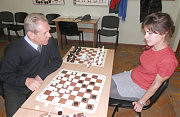
— Tell me, Georgy Viktorovich, why did you, already a titled coach, leave the chess and checkers club, with which you had been associated your whole life?
— It’s important for me to remain true to my principles. I can’t stand it when people try to humiliate me. That’s why I moved to work at the Suvorovsky District House of Children’s Creativity “Tonika.” And I don’t regret it at all.
— Such principledness usually creates problems.
— Well, that’s a given, I have an interesting relationship with our federation. For example, I waited 7 years for the title of Honored Coach of Ukraine: in 1998, my student Valera Grebenkin became world champion, and I became honored in 2005. And Ukraine did not nominate me for international arbiter; the international federation itself, without a nomination, recognized me. What can I do, I’m just a straightforward person — I say what I think.
— It’s interesting, do you demand such principledness from your trainees as well?
— Absolutely. I’ll give you an example. We played against Sandler’s team. He had a strong lineup, but for overall victory, they needed to beat us 4:0. And I had a very strong girl, Zhenya Domogatskaya, a tenacious girl from Peresyp. They were afraid of her. One official called me: “We need your Domogatskaya to lose today. Talk to her, tell her we’ll create conditions for her, she’ll travel to various tournaments at our expense, including the Ukrainian championship.” “Talk to her yourself,” I replied. Well, they talked to her. Zhenya came out of the office and said to me: “Can I hit her (her opponent)?” And she did. Vika Motrichko is the same — after six months of training, I realized: she would be a formidable competitor. I confess, I asked her just once not to win against an opponent from school No. 49. She didn’t listen.
— Did you find Vika at a school where logic, chess, and checkers were taught in the elementary grades?
— Yes, I even had a special permit from the city education department. I gave the children such games and riddles that they screamed when I came. And Vika found me herself. Her brother told me at home that they had such a cool teacher (he was in the fourth grade, and she was in the fifth). She got interested, asked her mom to bring her to a lesson. And she stayed. What impressed me? Her colossal hard work. She read checkers books under the covers at night. She pestered me: after classes, she asked, “Let’s play more.” She completed all the assignments and asked for more. I even made sure she didn’t “burn out.” Once at the Ukrainian championship, I looked at her games — childish, nothing special. “What’s wrong?” I asked. “I don’t know.” “Then,” I said, “we’ll do this: you won’t go to Europe.” She said: “What? The world championship qualifiers are there?” She cried. I stood my ground: “If you don’t want to listen to me, find another coach. You need to rest, to recover. If you do everything I say, everything will be fine.” This happened before the World Mind Games in Beijing. So I even promised her that if she succeeded, I would do everything possible to ensure her achievements were duly recognized in Odessa.
By the penultimate round, Motrichko was one point behind Elena Miskova from Moldova. And then Vika got nervous. “I’m afraid,” she said, “that I’ll lose.” “You’re afraid,” I replied, “then play for a draw.” “But Miskova will win!” “So what? The gap will increase to two points.” (A draw was worth one point, a win — two.) “But in the last round, it will be enough to beat her, and by tie-breakers, you’ll be the champion.” That’s what happened. After the victory, she came up to me, we didn’t say a word to each other, just hugged and stood in silence.
— And how was her Beijing triumph recognized in Odessa?
— I managed to arrange an apartment for her. Later, my colleagues told me: “Zhora, you are a great coach — the only checkers player whose student received an apartment.”
— Did conflicts with Vika happen?
— Of course, they did. Unfortunately, there are always people who say nasty things behind your back. It’s understandable that at 12-13 years old, girls already consider themselves adults. Boyfriends appear. After tournaments, they cry when they say goodbye, exchange addresses. And here she is, a world champion, a beauty. So someone whispered to her that I had said something bad about her. And she stopped coming to my training sessions. I invited her for a talk, she stood somewhat sideways, looking from under her brows. I said: “If you don’t want to work with me, that’s your business. But you’re a talented girl, so let’s do this. I have friends in Kyiv, I’ll pass you on to one of them, they’ll help you.” I arranged with Tolik Gontarenko from the Kyiv Palace of Pioneers. A year later, Motrichko won the World Russian Checkers Championship. I was conducting a 100-square checkers tournament in Yakutia at the time. I congratulated her, and she wrote back: “You promised that when I win the world championship, you’ll quit smoking.” What could I do, I had to keep my promise. And when we met at the train station, Vika unexpectedly asked: “Don’t you want to work with me anymore?” “What do you mean, I don’t want to?” I replied. “You yourself stopped coming to my classes. Besides, I have limited capabilities. I won’t be able to provide you with trips, and besides, they’re giving you a place in a dormitory in Kyiv.” But she insisted: “I still want to be with you.” Then I went to the city sports committee, which was headed by Larisa Anatolyevna Terekhina at the time. She suggested: since Motrichko is a world champion, let’s arrange a scholarship for her as an outstanding athlete. Her deputy objected: the scholarship, he said, is allocated by the city council only to Olympians. I had to intervene: “Where is it stated? The regulation says: ‘To those who bring glory to Odessa.’ What’s the problem?” In short, they gave her a scholarship, and the opportunity to travel arose. And without traveling to competitions, progress is impossible.
— How did Gontarenko react to all this?
— When one official asked him: “Are you going to forgive Podstаpkin for his vile act?” Gontarenko just laughed. We have been friends for many years. I immediately told him: “Tolik, I was absolutely fine with Motrichko staying with you. But she decided it herself. You can still write in the documents that she is your student.” And everything was resolved, that’s true friendship.
— Georgy Viktorovich, how do you manage to gather such beautiful girls under your wing?
— Exactly, my colleagues ask me about this too. I have many attractive female students, not just Vika. Do you know what my colleagues call me? A ladies’ master!
— Wow! And what do the students call you behind your back, I wonder?
— Zhorik (smiles). I love them all, and they love me. If you don’t love children, if you “work hard” only for money or honor, you won’t succeed, nothing will work out.
— Vika, after getting married, moved to Minsk to be with her husband, but continues to play for Ukraine, for Odessa. Does your collaboration continue?
— I still mentor her. I see flaws in her game. Once we played practice games. I, of course, don’t play to win, it’s important for me to see how she understands a particular position. After winning a few games, she remarked: “You’ve started playing weaker, Georgy Viktorovich.” I suggest: “Let’s play again.” I win, then a second time. She says: “What’s this?” I tell her: “You asked for it yourself. You are my child. I know your weaknesses better than anyone else.”
— I hope that among the readers of “Vechernaya Odessa” there will be no rivals of Vika. Name at least one weakness of Motrichko.
— Please. She is proud. She strives to find a win in any position. And sometimes she loses. I tell her: “You’re stepping on the same rake again!” She agrees, but from time to time she does the same thing again.
— Doesn’t she get offended?
— We are friends, we’ve been together for 23 years.
— Georgy Viktorovich, in conclusion, how would you formulate your coaching credo?
— If my student makes a mistake, then only I am to blame. Whether a coach is good or bad is judged by his students. And also. In any business, you need to be a professional. Then you will always be in demand.











