

The capital of Bulgaria, which I considered a transit point on the way to Toledo (about how the forced journey began, was told in the newspaper issue of March 31), gave me a wonderful acquaintance with the phenomena of Bulgarian culture of the 20th century.
SO, early in the morning, I sent an SMS to my sister from the Burgas railway station: I’m heading to Sofia. And her daughter Inna, my niece, who lives in Madrid, has a Bulgarian friend Rada, also in Madrid, married to a Spaniard. The stars aligned for me truly happily. Rada immediately contacted her parents in Sofia. They wrote back to me: I would be received, and the parents even had a vacant apartment.
And so, at the Sofia station, a short, elderly man with serious black eyes approached me and introduced himself: “I am Ivan.” A fragile woman was waiting in the car: “I am Elena.”
The “vacant apartment” turned out to be a comfortable room with breakfast: at a hotel near the house where the Velchevs live – this is the surname of the couple who hosted me. And although I had money with me, and I was eager to pay for the room, Ivan Velchev categorically objected and paid for my stay himself. I was, as they say, floored. Forgive me this slang expression, but it’s impossible to describe my stunned state more accurately. My sister had already informed me that she had bought me a plane ticket for the day after tomorrow. All that remained was to take a shower after a sleepless night, and the evening was planned to be spent at the Velchevs’ home.
And here, the climax of amazement awaited me, miracles awaited. So, meet: Honored Artist of the Republic of Bulgaria, former – and long-time – soloist of the Bulgarian National Opera and Ballet Theatre in Sofia, tenor Ivan Velchev. Roles: Duke in “Rigoletto,” Jose in “Carmen,” Des Grieux in “Manon Lescaut,” Calaf in “Turandot,” with the famous Italian conductor Anton Guadagno; Manrico in “Il Trovatore” – with Elena Obraztsova, who performed the part of Azucena; Golitsyn in “Khovanshchina,” Pollione in “Norma,” with the Bulgarian soloist Alexandrina Milcheva, who sang at the Metropolitan Opera; Ismael in “Nabucco.”
Ivan Velchev debuted with the role of Lensky in the opera “Eugene Onegin” in the city of Liberec, Czechoslovakia, at the age of 27. His favorite composers throughout his artistic career were Puccini and Verdi…
DEAR reader, what do we, in fact, know about each other? What do the peoples of those countries, which were once called friendly, know about each other? Of course, both you and I know that Art helps us to learn about and love each other.
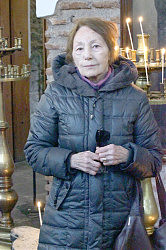
It was the evening of March Eighth. And we celebrated it, at the Velchevs’ home, traditionally. Because for both me and them, any political meaning has long since evaporated from this holiday since childhood: it’s simply Women’s Day, period. And we had remarkable women of Bulgaria to remember together. The outstanding film actress Nevena Kokanova: do you remember the poignant film about love and pride “The Deviation” – with a special golden prize and FIPRESCI prize? The amazing Katya Paskaleva in the unforgettable film ballad by Metodi Andonov “The Goat Horn” – how many remakes there have been since, even in the 21st century, but the original has not been surpassed; and the popular actress Katya Paskaleva, now, alas, deceased, worked at the Sofia State Satire Theatre named after A. Konstantinov… The Velchevs also remembered their good friend: prima ballerina Vera Kirova, who was friends with Alicia Alonso and Maya Plisetskaya.
No, and the story of the Velchev couple itself! That’s where a “love story” for a lifetime turned out. Ivan and Elena were classmates in high school. Both played the violin. Ivan sang from childhood. During his compulsory military service, he was the lead singer. Both came from families with no connection to art. Elena’s father was a dentist, her mother a pharmacist. Ivan’s father headed a fire brigade. His mother was a draftswoman. She died recently, at the age of 102. Her name was Rada, and the Velchevs named their daughter after her.
Both spouses initially trained as engineers. Elena is a civil engineer. It seems unrelated to the creation of works of art… But allow me, being the wife of an opera singer is also a kind of subtle art! In the 90s, everything began to crumble… “Democracy came – we had to save ourselves individually,” Elena tells me with a sad smile, explaining how she had to switch to the sphere of private foreign trade. But they managed to give their daughter Rada a good education: the University of Madrid – international relations and European integration, also an exchange program within the framework of “Erasmus” in Bristol; Rada knows several languages; her husband Fernando is a lawyer, their daughter Elena is almost ten years old.
Yes, you might ask, how did I communicate with the Bulgarian family at all? The thing is, Ivan and Elena speak excellent Russian. That is, they think they speak poorly: they haven’t had much practice lately. In reality, they have a perfect command of the language, may God grant me to master Spanish as well now.
Ivan initially graduated from the Polytechnic University in Prague as an electrical engineer. And here, as the character from Bulgakov said, how whimsically the deck is shuffled, what twists and turns of fate happen in life!
IVAN’S FIRST vocal teacher, when he was still a student at the polytechnic, was Professor Konstantin Karenin of the Prague Conservatory (1897, Kyiv – 1966, Prague). Here is information, for example, from the website “Prague Express” for September 2012: “Opera singer Konstantin Emelyanovich Karenin possessed such an original and temperamental tenor that Fyodor Chaliapin noticed him in Paris, who later became his teacher and a friend. Karenin sang in the best opera houses in Europe and America: Madrid, Sofia, Belgrade, Monte Carlo, Buenos Aires, Paris, and finally, Prague… Among his students was a whole galaxy of Czech pop stars: Václav Neckář, Marta Kubišová, Helena Vondráčková, and the famous Karel Gott. In Prague live… Anna Karenina – his daughter, Zdenka Karenina – the singer’s widow.”
K.E. Karenin came from a noble family, a family of officers. During the turmoil of the Civil War, his parents, brother, and sister perished. By the way, the future singer and teacher studied in Odessa – at the Odessa Military Engineering Academy. After the tragic death of his parents’ family, he joined Wrangel’s army. He emigrated with the army from Crimea. He lived in poverty in Belgrade. He graduated from the Belgrade Conservatory. In 1928, he arrived in Paris.
From 1934, Karenin was a soloist of the Sofia Opera. From 1950 until the end of his life, he taught at the Prague Conservatory. And, of course, not only pop stars shone in his department – perhaps it’s just that the website authors were so drawn to pop music.
This is the continuity, friends. And Bulgaria must preserve its own, just as we must preserve ours. Which is very difficult these days.
AND THE NEXT DAY, they showed me Sofia. First of all, the building of the Bulgarian National Opera and Ballet Theatre, to which Ivan Velchev dedicated his life and work. It’s interesting that the building was originally intended for an agricultural society, as evidenced by the sculptural groups on the pediment, executed with no small elegance, in the notorious “totalitarian” style. In general, the architecture of Sofia from that period is marked by elegance; the solid buildings of “Stalinist Empire” do not look like parodies today; the architects showed noble restraint and a good sense of proportion. The agricultural palace was adapted for art, with the addition of theatrical masks to the facade.
As a capital, Sofia is young, since 1879; as a settlement and city, it dates back to the first century AD, as part of the Roman Empire!
I was shown the grand patriarchal cathedral of the Bulgarian Orthodox Church, erected in honor of Bulgaria’s liberation from Turkish yoke. The style of icon painting in the church seemed very familiar to me – just like the Vladimir Cathedral in Kyiv; I looked it up in an online directory – exactly: Viktor Vasnetsov! And also P.E. Myasoedov, A.M. Korin, and others. The author of the murals is the Bulgarian H. Tachev.
The Church of St. Sophia nearby, with its rather severe exterior, dates back to 313 AD! Under Emperor Constantine the Great, to whom we owe the official establishment of the Christian religion, the temple served as a cathedral, as it did in the Middle Ages. In the 14th century, the city was officially named after the temple: Sofia – Divine Wisdom.
…We talked about many things with the wonderful Velchev couple, raised toasts to the friendship of peoples, to mutual knowledge and understanding, to peace.
Now I hope that nothing will prevent the Velchevs from making their planned trip to Madrid in May – for the celebrations of their granddaughter Elena’s First Communion. And I will be grateful to heaven for our friendship.











