

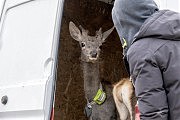
Three red deer and three fallow deer have settled on Yermakov Island in the Danube Biosphere Reserve as part of a partnership program between Rewilding Ukraine and Feldman Ecopark. The animals will supplement the natural grazing on the island and contribute to the development of ecotourism in the region.
The fallow deer and red deer underwent rehabilitation at Feldman Ecopark, and then traveled 900 kilometers to the Danube region to be released back into the wild on Yermakov Island. This release is part of a joint project by the two organizations to restore populations of large ungulates in the Danube Delta. The animals include both males and females. On the island, they will be protected while being able to move freely over a sufficiently large area. The animals are tagged with GPS transmitters, allowing their movements in the wild to be tracked.
“We welcome the release of the red deer and fallow deer, which is the first step in a long-term partnership between Rewilding Ukraine and Feldman Ecopark. Together, we can achieve more in restoring nature in our country. The animals released now will complement the diversity of large herbivores already present on the island. Yermakov is a rather large river island, covering over 23 square kilometers. Therefore, to fully restore the process of natural grazing, as well as to create genetically diverse and stable populations, it is very important to release animals from different locations and in sufficient numbers,” explains Mykhailo Nesterenko, Executive Director of Rewilding Ukraine.
Natural grazing helps maintain the diversity of landscapes on the island. Thanks to the activity of large herbivores, there are meadows, small lakes, and a rich variety of plant species. The mosaic of landscapes attracts a wide variety of insects, birds, and mammals. Herbivores also consume excessive vegetation, which, when dry, could ignite. This significantly reduces the risk of fires. Furthermore, red deer and fallow deer, along with other large animals on the island, are interesting subjects for tourists to observe. After all, our country has beautiful landscapes, but there are very few places left where one can see large wild animals living freely in nature.
“The conservation of wild animals, the restoration of ecosystems, and responsible reintroduction are the goals for which Feldman Ecopark was created. This is the first pilot phase of our cooperation; in the future, we plan to continue releasing animals that successfully breed at Feldman Ecopark and are suitable for the goals of the Rewilding Ukraine program. We are always in favor of joint projects, as only through joint efforts can we help nature revive, giving hope to our children and grandchildren to see and appreciate the full diversity and magnificence of the wild,” noted Oleksandr Feldman, People’s Deputy of Ukraine, President of the World Open Fund for Rehabilitation and Reintroduction of Animals (WOFARR), and founder of Feldman Ecopark.
“It might seem like six animals are a drop in the ocean, but when forming a viable population, inbreeding should be avoided, so we will release animals in small “portions,” from different parents, which is very important – especially at the beginning of group formation. And by the next breeding season, we will replenish the ungulate population with “new,” unrelated blood,” explained Andriy Gapchenko, Head of the Science and Monitoring Department at Feldman Ecopark.
Yermakov Island is located in the buffer zone of the Danube Biosphere Reserve, near Vilkovo. In 2019, with the support and active participation of the reserve and the island’s lessee, Yermak LLC, the process of natural grazing was resumed on the island with the help of wild large herbivore species characteristic of the delta or similar in ecological function. A herd of water buffaloes from Transcarpathia and two herds of Konik wild horses from reserves in Latvia settled on Yermakov. Subsequently, they were joined by a small number of red deer and a herd of fallow deer from southern Ukraine.
Red deer once widely inhabited the landscapes of our country, but their numbers later significantly declined due to poaching and the destruction of natural habitats. The red deer is a large even-toed ungulate; males can reach over 2 meters in length and weigh around 300 kg. Males of this species are adorned with huge antlers, which are used to attract females and for fights between rivals to protect their territory and “harem.” During the rut, males establish dominance by engaging in roaring contests that can last for hours.
The European fallow deer is smaller (length up to 2 meters and weight around 100 kg). It has a striking appearance: large eyes and ears, spotted coat, and characteristic palmate antlers in males.











