

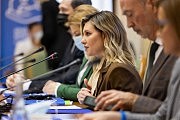
The regular meeting of the Commission on Coordination of Executive Authorities’ Interaction to Ensure Equal Rights and Opportunities for Men and Women was held under the chairmanship of Vice Prime Minister for European and Euro-Atlantic Integration Olga Stefanishyna.
The event was attended by the First Lady of Ukraine Olena Zelenska, Ambassador of France to Ukraine Etienne de Poncins, Minister of Social Policy Maryna Lazebna, Minister of Communities and Territories Development Oleksiy Chernyshov, Government Commissioner for Gender Policy Kateryna Levchenko, and First Deputy Minister of Education and Science Andriy Vitrenko.
Representatives of all communities of Ukraine participated in the event online and offline. Deputy Head of the Odesa Regional State Administration Svitlana Fabrykant, who is the coordinator for ensuring equal rights and opportunities for women and men, and for preventing and combating domestic violence and gender-based violence, joined the event with her colleagues.
The event served as a platform for discussing the results of the implementation of the Action Plan for the realization of commitments undertaken within the framework of the international initiative “Biarrtiz Partnership,” as well as plans for 2022.
The commission’s agenda included issues of ensuring the development of an inclusive and gender-sensitive public space, friendly to families with children and people with limited mobility, and ensuring the consistency of gender equality principles in education. Specific attention was paid to issues of combating domestic and gender-based violence; reducing the gender pay gap; and reforming legislation on social leave related to childbirth and childcare.
In her welcoming remarks, Olena Zelenska emphasized that Ukraine has achieved a lot in a year since joining the “Biarrtiz Partnership” on the path to equality, but noted that there is still much work and many challenges ahead: women have suffered more than men from the crisis caused by the COVID-19 pandemic, and now it will take even more time to overcome gender inequality in the world.
“The corona crisis—and here too, women suffered the most, according to the World Economic Forum. This is because service sectors and small businesses, where women are traditionally more numerous, have mostly closed. Economists have calculated that due to COVID-19, it will now take us not 100, but 136 years to overcome the gender gap. It sounds pessimistic, but I am confident that the speed of overcoming the gender gap actually depends on us,” said Olena Zelenska.
Maryna Lazebna, in her speech, emphasized that domestic and gender-based violence is not the norm, and it should not be silenced or tolerated. “In order for this not to remain just words, we have developed an action plan that implements four components for eradicating this phenomenon: prevention and prophylaxis, combating manifestations, returning victims to a life without violence, and holding perpetrators accountable,” said the Minister of Social Policy of Ukraine. She also stressed that local authorities need not only standardized tools but also the development of appropriate infrastructure for further work.
It is for the development of such infrastructure that the Odesa region has joined the national pilot project this year: the Ministry of Social Policy has allocated a subsidy from the state budget to seven territorial communities of the Odesa region totaling UAH 10,227.98 thousand.
With these funds, in the Odesa region, on the territory of the Odesa city community, a shelter for victims of domestic violence with 20 beds is being equipped; a day center for social and psychological assistance; a “crisis room”; and a mobile social and psychological rehabilitation team is operating.
In the Borodina territorial community—a shelter for victims of domestic violence for 20 people. On the territory of the Pishchana territorial community—a “crisis room” for victims of domestic violence with 3 beds. In the Kuyalnyk territorial community—a day center for social and psychological assistance to victims of domestic violence, a “crisis room” with 9 beds. In the Vilkove territorial community—a specialized consultation service for affected individuals based on the existing Center for Social Services. Rozdilna and Reni territorial communities have introduced primary counseling services.
The head of the Borodina settlement community of the Odesa region, Ivan Kyusse, thanked the President and the First Lady of Ukraine, as well as the Cabinet of Ministers for supporting local self-government.
“It is pleasant to hear that the Odesa region is among the TOP-3 in Ukraine in measures to combat domestic and gender-based violence. The successful cooperation of communities with the central government, in particular with the Office of the President and the First Lady, provides an important impetus for systemic transformations in Ukrainian society,” summarized Svitlana Fabrykant. “The fact that projects in the Odesa region have received such strong support means that we are moving in the right direction—our efforts are timely, in demand, and can serve as an example for all of Ukraine.”
For reference:
On the initiative of the First Lady of Ukraine Olena Zelenska, on September 11, 2020, Ukraine became a full participant of the international “Biarrtiz Partnership,” which was initiated by the leaders of the Group of Seven (G7) countries—Canada, France, Germany, Italy, Japan, the United Kingdom, and the United States—with the aim of strengthening the responsibility of the “Big Seven” and consolidating the efforts of other states to achieve equal rights and opportunities in society and the absence of restrictions based on any grounds. Ukraine undertakes commitments in five areas: development of barrier-free public spaces friendly to families with children and people with limited mobility; teaching children the principles of gender equality; prevention of violence; reduction of the gender pay gap; and creation of greater opportunities for men to care for children.
In the last year alone, in Ukraine:
— A law was adopted that strengthens responsibility for domestic violence. Also, more appeals regarding this have been recorded than ever before—over 200,000. The process of creating 30 new shelters—refuges for women who need to hide from abusers—is underway. For the first time, a separate state subsidy of UAH 274 million has been allocated for this. The government hotline 1547 for assistance to victims of violence received 1790 appeals in just 10 months of this year.
— The first fathers took parental leave: with the relevant law, leave for fathers at the birth of a child for up to 14 calendar days has been introduced. Parental leave for childcare until the child reaches the age of three is now an equal right for each parent.
— The Ministry of Communities and Territories Development, as reported by its head Oleksiy Chernyshov, is updating the country’s regulatory acts—so that all buildings, from public to residential, become convenient for people in wheelchairs and on wheelchairs, of any age and in any physical condition.
— The Ministry of Education and Science has conducted the first examinations of school textbooks for discriminatory content and is introducing a similar practice for university textbooks.
— To overcome the gender pay gap, a national strategy until 2024 has been developed. And by the end of the year, according to the Ministry of Social Policy, this gap has decreased by more than 3%—from 20% to 17%.











