

The Odessa House-Museum of N.K. Roerich invited its regulars to an unusual concert dedicated to the 200th anniversary of Greece’s independence.
Of course, the holiday itself is celebrated on March 25, when Greeks pay tribute to the heroes of the Revolutions of 1821-1829, who liberated Greece from 400 years of Ottoman yoke. But quarantine restrictions prevented the concert from being held in the spring, and finally, two wonderful Greek women were able to come to our city, one of whom is from Odessa.
Pianist Elena Fedko is a graduate of the Odessa Music Academy and now lives in Greece. Soprano Elena Surmeli arrived in our city for the first time and immediately fell in love with it. Elena is from the city of Patras; she performed leading roles in the local opera for three years and leads a choir that participates in festivals in Greece and Europe as a whole.
We remind you that it was in Odessa in 1814 that the secret society “Filiki Eteria” was founded, which marked the beginning of the preparation for the uprising for Greece’s independence from the Ottoman Empire. The society’s meetings were held in the house of the father of the famous Odessa mayor Grigory Ivanovich Marazli, and in 1821 he helped the leader of “Filiki Eteria,” Alexander Ypsilantis, form detachments to fight for the liberation of Greece.
— Greeks call Odessa their second homeland, — reminded the director of the Roerich House-Museum, Elena Petrenko, before the concert. — In the medical institute that I graduated from, children of Greeks who grew up in the Soviet Union studied. This is an example of the cooperation that Roerich spoke about. It is no coincidence that Roerich’s Banner of Peace hangs in our most prominent place; under this sign, like under the Red Cross, cultural values should be preserved inviolate. And if the whole earth were covered with such banners, wars would disappear!
The concert opened with… “La Marseillaise.” However, this version with the chorus “Forward, children of Greece!” was known in Trieste, Epirus, and the Ionian Islands under the name “Massoliatida,” which Byron himself admired. Also performed was the song by the Spanish classical guitarist-virtuoso and composer Fernando Sor (1778-1839), “The Last Cry of the Greeks” (“Forward, friends, let’s go to break the iron chains forever”).
The “Hymn to the Fatherland” by Pavlos Carrer (1829-1896), one of the first Greek opera composers, is no less impressive than “La Marseillaise.” Pavlos Carrer, having spent seven years in Milan, gained many admirers among Greek communities abroad.
Vocal works were interspersed with piano miniatures. Extremely melodious works were performed by Manos Hadjidakis (“Address to the Sea”), Mikis Theodorakis (“Beautiful City”), Alexandros Xenos (fragment of the vocal cycle “Songs for Peace”), Timotheos Arvanitakis (“Free Prisoners from Crete”), Auguste Delacroix (“Procession of Greek Girls”), the Russian composer of Greek origin Vasily Pavlovich Kalafati (“Waltz-Impromptu”), as well as Andreas Seiler (“Tear on the Grave of Governor Kapodistrias”).
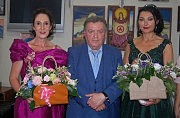
The two talented Elenas were welcomed by the Consul General of Greece in Odessa, Dimitrios Ch. Dohtsis, and Dmitry Bachchevan (Federation of Greek Societies of Ukraine). The concert was supported by the Odessa Branch of the Greek Cultural Foundation, and we hope this is just the beginning of a long collaboration with the talented Elenas. By the way, there were four Elenas that evening; let’s not forget the director of the House-Museum, Elena Petrenko, and the concert host, Elena Dovzhenko. This beautiful Greek name means “light-bearer,” which is very symbolic.











