

Continuation. See here for the full story.
2004, Athens
Triumph and tragedy – that’s how, years later, the performance of the Odesa athletes at the Olympics in Greece can be characterized. The triumph took place in the Olympic arena, and the tragedy insidiously seeped from WADA laboratories 8 years later.
AUGUST 18, 2004. The shot put final took place at the athletics stadium in ancient Olympia. In his very first attempt, American Adam Nelson achieved a rather high result for the start – 21 meters 16 centimeters. Odesa Dynamo athlete Yuriy Bilonoh responded no less worthily, losing by only 1 centimeter. “Silver” was already secured, and “gold” was only 1 centimeter away. A throw – 21.16 m! It’s hard to imagine a more dramatic outcome. Both athletes showed the same result. In such cases, everything is decided by how they threw the shot in their other attempts. Yuriy had a throw of 21.15 meters, while Adam had a string of “zeros”. But Nelson still had one attempt left, and therefore, a chance. Letting out an inhuman cry, the American put all his remaining strength into his final throw; the shot flew very far, but the judges were relentless – the result was not counted. Nelson was hysterical, he refused to admit defeat, but the video replay clearly showed him stepping over the line of the throwing circle. “Gold” went to the Ukrainian!
Two Olympics passed when the IOC medical commission announced that a certain prohibited substance had been found in Yuriy Bilonoh’s old samples. Today, many athletes achieve acquittal by proving that doping entered their bodies accidentally – due to a meal in random company, a wrongly prescribed prescription, lipstick, or even through a sexual partner. But what could Yuriy prove after eight years? He still considers himself an Olympic champion. And so do thousands of his fans.
For some time, Yuriy Bilonoh headed the athletics federation of the Odesa region and tried his hand at coaching. He continues to be a legend of athletics.
YURIY KUCHINOV, a weightlifting coach from Nova Dolyna, near Ovidiopol, received calls from colleagues: “Why are you taking him, he’ll never learn to clean and jerk?”. They were talking about Igor Razorenov, whose clean and jerk technique was recognized as exemplary at the World Championships in China four years later. And nine years later, Olympic recognition followed. 9 years! In sports, that’s a lifetime. But the coach and the student persistently pursued their goal, despite the whims of fortune.
In Atlanta, Igor Razorenov, considered one of the main contenders for victory, was injured literally before stepping onto the Olympic platform. And who could have predicted that the situation would repeat itself exactly eight years later in Athens?!
“During a warm-up exercise, Igor awkwardly snatched the barbell and fell onto the platform,” recalls Yuriy Pavlovich. “I ran up to him. ‘Get up,’ I said. And he said, ‘I can’t stand on my feet.’ What to do? In Atlanta, I wasn’t prepared for such a turn of events. But in Athens, while helping Igor up, I unexpectedly – for him… bit him on the sore spot. He howled, but I achieved my goal: thanks to the new pain shock, his brain and nerves switched to the bite. Then something happened that caused complete bewilderment among my colleagues. We didn’t lift the barbell in the warm-up room anymore – we only simulated the snatch. During the competition, Igor successively snatched 182 and 190 kilograms. Before the second exercise – the clean and jerk – he asked, ‘What place am I in?’ – ‘Seventh for now,’ I replied, ‘but you have no competitors in the clean and jerk.’ And indeed, we started when all the other weightlifters had finished their performances. Igor clean and jerked 230 kilograms, which was enough for Olympic “silver”. If he had clean and jerked 235, he would have been champion. But he had no strength left, especially psychological strength. After the competition, Razorenov told me, ‘Palyich, this medal is yours.’ ‘No,’ I replied, ‘the medal is ours together.'”

Two-time world champion Igor Razorenov, after finishing his performances on the platform, remained to work at the school, where he found a second wind and began to help his coach. Today, the honored coach of Ukraine, Yuriy Kuchinov, heads the women’s national weightlifting team, assisted by his renowned student.
2006, Turin
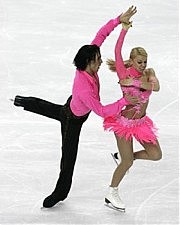
For a full twelve years after Oksana Baiul’s triumph, we awaited the next (and to date, unfortunately, only) Olympic award in figure skating. And again, pupils of the Odesa school triumphed on the podium. In Turin, the ice dancing duo Elena Grushina/Ruslan Goncharov won “bronze”.
UNLIKE singles and pairs skating, ice dancing has no jumps, and the number of lifts is strictly limited. Therefore, the risk of falling on the ice in front of judges and the audience is practically non-existent. Every fall is perceived as something extraordinary. So, how many volts became the measure of Olympic tension if, in Turin, favorites fell on the ice one after another – Barbara Fusar-Poli and Maurizio Margaglio, Margarita Drobiazko and Povilas Vanagas, Marie-France Dubreuil and Patrice Lauzon?! But Grushina and Goncharov stayed on their feet.
After the Ravensburg Waltz, the Italians were in first place. They were followed by the Russians, then the Bulgarians and Canadians. Grushina and Goncharov were placed only fifth, the Americans – sixth. And yet, justice prevailed! The original dance returned logic to the standings. Russians Navka-Kostomarov, Americans Belbin-Agosto, Ukrainians Grushina-Goncharov – the duets were ranked in this order before the free skate. Moreover, the point difference between the competitors was minimal.
The competition of the strongest was opened by the Odesa athletes. They poured all their skill, all the emotions accumulated over years of grueling training into this performance. And the judges could not help but react – masterly scores appeared on the display. But until the very last performance on the ice by the French duo Isabelle Delobel-Olivier Schoenfelder, who desperately tried to unseat Elena and Ruslan from the podium, it was unclear how this tightrope walk – so outwardly aesthetic and frivolous – would end.
The results are known. Navka and Kostomarov became champions. “Silver” was awarded to Belbin-Agosto. Our compatriots lost to them by only 0.21 points.
The path to the Olympic podium was difficult. For many years, the judges stubbornly did not see them as medal contenders. The ice began to thaw in 2004 when they won “bronze” at the European Championships. In 2005, they finished second at the continental championship and third at the world championship, and at the 2006 European Championships – again “silver”. And finally, the peak of their sporting career in Turin.
After the Olympics, the pair left amateur sports. In 1995, Elena and Ruslan got married. They lived in the USA, in Connecticut. They performed in various shows and tours in the USA, Russia, and Ukraine. Elena tried her hand at coaching, working with the Ukrainian dance duo Anna Zadorozhniuk/Sergey Verbilko. In 2009, Ruslan headed the Figure Skating Academy in Brovary (Kyiv region). Fourteen years ago, the figure skaters separated.
2008, Beijing
The Olympics in the Chinese capital marked the beginning of a spectacular career for two great athletes from the Odesa region – a boxer from Belgorod-Dnestrovsky won “gold”, and a rower from Yuzhny, Yuriy Cheban, won “bronze”. The canoeist’s achievements will be covered in the following chapters, and now, about the triumph of Lomachenko and Elena Khomrovaya, who became a winner of the Games as part of the Ukrainian saber fencing team.
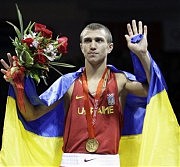
“VASILIY WAS ONLY six years old when we held the city championship,” recalls Anatoliy Nikolaevich Lomachenko, father and sole coach of the future two-time Olympic champion. “In the evening after the competition, I was signing certificates for the winners at home (there were no computers back then), and the medals were right there. My son came up and said, ‘Dad, I want a medal too.’ ‘What do you mean, you want one?’ I replied. ‘You saw the guys go into the ring, compete. They don’t get awards just like that, they earn them.’ ‘Okay, what do I need to do?’ ‘When you can do twenty pull-ups, then you’ll deserve it.’ I must tell you that doing twenty pull-ups at the age of six is a serious achievement. He tried right away – seven pull-ups. The next day – ten! A week later, he finally got his medal! That’s when I realized: he has the determination, the desire to be different from others, to achieve something, that a champion needs. At nine years old, he could do 240 pull-ups! It could probably be entered into the Guinness Book of Records. He was gifted by God with a sense of movement, excellent reaction, plasticity, and, most importantly, a fighting spirit.”
Serious work began at the age of fourteen. And six years later, Vasiliy conquered the Olympic peak.
In Beijing, the draw was extremely unfavorable to him. In his very first fight, he had to enter the ring against Albert Selimov of Russia, who had defeated Lomachenko a year earlier in the World Championship final – the only and, according to specialists, unfair loss. This was perhaps the toughest opponent in the tournament, yet the Ukrainian’s advantage was overwhelming – 14:7. What can be said about the other bouts? Asian champion, Olympic bronze medalist in Athens, Bahodirjon Sultonov was defeated 13:1, Chinese Li Yang – 12:3, Turkish Yacup Kilic – 10:1. And finally, the final. Somehow, Vasiliy had eliminated all the main competitors earlier: Hicham Gigi of France only took 33rd place at last year’s World Championships. But this is the Olympics, who knows? There was no surprise. After three consecutive knockdowns, the referee had to stop the fight in the first round – 9:1.
Four years later, Vasiliy would repeat his success at the London Olympics. He is a two-time world champion, European champion, and honored master of sports. He was named the best boxer of 2016 by HBO and the authoritative boxing portal World Boxing News. In 2017, he was named “boxer of the year” by The Ring magazine. According to ESPN, he topped the pound-for-pound list, becoming the best boxer in the world regardless of weight class. After turning professional, Lomachenko won world championship titles in various organizations several times. After a bitter defeat to Teofimo Lopez, he lost his titles but is determined to get revenge. The renowned boxer’s serious intentions are evidenced by his convincing technical knockout victory over Masayoshi Nakatani of Japan.
IT HAD TO BE SEEN! In the final of the saber tournament at the XXIX Olympic Games, the teams of China and Ukraine met. To reach the final, our girls – Olga Kharlan, Elena Khomrovaya, Olga Zhovnir, and Galina Pundyk – first crushed the Russian team 45:34, and then in the semi-finals defeated the strong US team 45:39. And then, the decisive match, in which the Ukrainians were trailing by 10 points. Could victory really go to the hosts of the Olympics? No, a desperate chase, led by teammates O. Kharlan and E. Khomrovaya, ended in success – 45:44! This comeback, as they say now, became the highlight not only of the fencing competition but of the entire Olympics.
Elena Khomrovaya graduated from the Odesa State Environmental University. She married basketball player Sergey Gladyr and moved with her husband to Mykolaiv. In November 2014, their daughter Eva was born. Elena is the 2009 world champion in team competitions, a bronze medalist at the 2010 World Championships in individual events. She also has two silver medals from the 2010 and 2011 World Championships in the team event.











