

Sergei Parajanov’s world-renowned film “Shadows of Forgotten Ancestors” can serve as a vivid example of how a work of art can introduce a small nation, in this case the Hutsuls living in the valleys and peaks of the Carpathian Mountains, to the whole world and make them popular.
Today, about 60,000 of them live in Bukovina. Despite globalization and technological progress, this region preserves the natural virginity of its mountains and forests, swift rivers and clear springs, and its inhabitants – their crafts, traditions, and culture, based on love for their homeland, Christian values, and morality.
However, if we compare the potential of this region with the standard of living of its inhabitants, we can understand the tens of thousands of local residents who have gone to earn money in foreign countries. There are villages where mainly the elderly live, looking after their grandchildren, and parents only come home for major holidays.
But at the same time, on the highways, against the backdrop of green mountains, one can already find islands of modern civilization and hospitality: luxurious restaurants, comfortable hotels and villas, hospitable resorts for winter and summer recreation, convenient roadside infrastructure… Behind all these achievements are, first and foremost, the labor and intellect of enthusiasts, patriots of their native land, who believe that Hutsulshchyna can become the richest region of Ukraine, one of the centers of European tourism.
Grigory Tomyuk, a local historian, philanthropist, businessman, and one of the leaders of “Green Tourism” in the Kosiv district of Ivano-Frankivsk region, is confident in this.
Places of Power and Inspiration
The first stop on the way from Kolomyia to Kuty was at a waterfall in the village of Sheshory. Its height is relatively small: only a few meters. But the combination of the swift current with the surrounding green mountains and boulders emerging from the water created a very romantic and vivid impression.
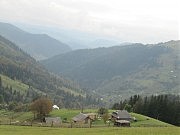
During our five-day tour, we stopped quite often at mountain passes or in valleys to capture the beauty of the gentle peaks covered with dense forests, and the green meadows between them, to enjoy the clean mountain air and the silence of the protected space.
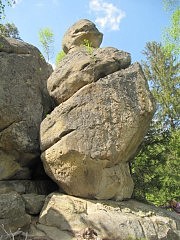
The trek to the rock formation Ternoshorska Lada, in the contours of which one can see the figure of a pregnant woman, was particularly memorable. For centuries, this place of power was especially revered by women who wished to become mothers. From all corners of Hutsulshchyna, they came to the foot of the giant rock to pray and ask the Almighty for the fulfillment of their cherished desire. Popular rumor had it that such requests were usually granted.
With a special feeling, it seems, our Carpathian leader approached this monolith. Before entering the mountain slope where Ternoshorska Lada is located, the river was squeezed between two huge rocks on both sides.
“This place is called the ‘Gates of Paradise’,” Grigory stopped.
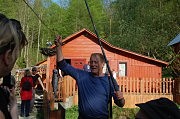
He stood before us with special solemnity, leaning on a staff with images of Jesus Christ, the Virgin Mary, Saint Panteleimon… This attribute of a Hutsul, his powerful figure with a beard, burning eyes, in my opinion, resembled an ancient sorcerer or some fairy-tale character from a Hutsul legend and embodied all the power of this wild nature and its unity with the man named Grigory Tomyuk.
“Legend says that it was at this place that the Tatar-Mongol hordes pursuing the Hutsuls stopped,” Grigory recounts. “The local residents set a trap here in the form of a dam made of stones, and destroyed it at the moment the enemy troops approached. The water flow of unprecedented force drowned part of the invaders. And after this flood, they decided not to go further.”
We, on the other hand, calmly made our way along this not-so-short path with crossings over swift streams and ascents up the mountain. And when this stone sculpture of such familiar forms appeared before us, a peculiar feeling arose. First of all, the stone woman, made of multi-ton boulders, adorned this mountain landscape on one hand, and on the other, it caused amazement. As if some giant hand had placed three rocks one on top of the other. Moreover, these giant stones stood at such an angle to each other that, according to the laws of gravity, they should have fallen. And one can imagine the feeling of reverence for divine forces that this giant statue evoked in the Hutsuls.
Having passed through the crevice in Ternoshorska Lada, we also climbed to its summit. The Carpathians before us. Beauty! Delight! Joy! Union with nature and a sense of power! And before descending, following Grigory’s example, each of us shouted “Dyakuyu!” to these mountains with all our might, to be charged with the power of this nature and its green mountains.
An Enthusiast from the Village of Kuty
The idea of receiving tourists in his home, or rather, in a so-called “sadiba” (guest house), was suggested to Grigory Tomyuk by necessity. About twenty years ago, it was decided to hold one of the first International Hutsul Festivals in the Kosiv district. Thousands of Hutsuls from different countries, scattered across all continents by fate and various historical events, were expected to arrive. Immediately, a problem arose: where would they stay during their forum?
Local residents were asked for help. It was then that many of them got the idea to make working with tourists a permanent occupation.
“I want to emphasize that the first ‘Green Tourism’ association in Ukraine was born precisely in our district,” says Grigory Tomyuk, the owner of the “Eco Karpaty” sadiba. “But it’s one thing to host your compatriot, who understands the living conditions in a rural house, and another to host tourists from other regions of Ukraine, city dwellers.”
Like most of his colleagues, Grigory started by hosting 4-6 tourists in his father’s house. But with each year, he expanded, adding more rooms and creating better conditions for his guests. The accumulated experience was shared in the regional “Green Tourism” association, as well as at international conferences in Eastern European countries.
Today, the “Eco Karpaty” sadiba, awarded the highest quality category in Ukrainian green tourism, “Three Flowers,” can accommodate up to 40 tourists simultaneously. Having extensive travel experience in dozens of countries around the world, I can compare this rural sadiba to the usual star categories of hotels. So, I would give it at least 7 stars. All the requirements for a five-star hotel are met here: parking, rooms of appropriate size and comfort, Wi-Fi, swimming pool, sauna, game rooms, gym, TVs, and other achievements of 21st-century life. But what is especially remarkable here is the unique atmosphere of the sadiba, which no hotel, hosting hundreds of guests at once, can provide, no matter how hard it tries.
First and foremost, the interior of this mini-rural hotel. Here, every centimeter of space breathes with the myths and legends of Hutsulshchyna, allowing you to get your first impressions of the culture, customs, and traditions of the local people right in the lobby and on the stairs, to imagine the richness of the region’s flora and fauna, the soul and heart of the Hutsul, his freedom-loving character, and hospitality.
Stuffed animals and birds of the Carpathian Mountains, paintings by local artists with landscapes of the region, ceramics, wood and metal works characterizing the skill of local craftsmen, towels and carpets embroidered with local patterns are organically displayed on the walls, in the corridors, and on the stairs. The entire wall in the foyer is occupied by portraits of famous writers, poets, and artists who glorified Hutsulshchyna and its people. These include Ivan Franko, Lesya Ukrainka, Mykhailo Kotsiubynsky, Vasyl Stefanyk, Marko Cheremshyna, Mykhailo Sadoveanu, Vincents, and artists such as Kazimierz Sichulski, Aksentowicz, Halyna Zubchenko, and others, whom the colorful culture of the Hutsuls inspired to create works of culture and art in different years.
The official service of a traditional hotel cannot be compared to the hospitality of the sadiba hosts. In this guest farm, like “Eco Karpaty” and other sadibas in “Green Tourism,” there are almost no hired employees. It is mainly a family business, involving only relatives. For example, in this sadiba, Grigory and his wife Anna manage the household, assisted by their son and his wife, as well as close and distant relatives living in Kuty.
This family atmosphere creates a special ambiance for tourists from the very first steps: each of them, immediately after settling in, becomes, first and foremost, a guest of the house, and I would even say, a friend of Grigory Tomyuk. And for friends, as is customary among the Hutsuls, everything is the best, most joyful, and most interesting.
Naturally, each house and its way of life primarily bears the character of the host and hostess. Grigory is a firework of a person, meeting him is always festive and interesting. But perhaps his most important trait is his love for his native land, his thorough knowledge of its history and the people who created it over the centuries, his Hutsul patriotism, and his ability to captivate every guest with the beauty and uniqueness of this corner of his native land.
His wife, the beautiful Anna, fills the house with feminine warmth and care for the guests, with knowledge of service and the ability to take the reins and responsibility for hosting guests during Grigory’s absences.
Perhaps the greatest impression on journalists from the “Eco Karpaty” sadiba is its “museum,” which Grigory has been creating over the past 20 years during his numerous travels around the world. It is difficult to name the theme of this huge, awe-inspiring exhibition of several thousand exhibits, displayed on the walls, ceiling, and floor of the upper floor of the sadiba, covering an area of about 200 square meters. Weapons from different eras and peoples, masks and amulets from all corners of the planet, statues of ancient Greek heroes and Egyptian pharaohs, items characterizing the development of science and technology over the centuries, samples of Carpathian rocks and clothing of local residents, ceramics, household items and works of Hutsul crafts and art, ancient coins from various countries, unique musical instruments by local masters: flutes, jaw harps, dulcimers, led by the world’s longest trembita, staffs, Hutsul axes – bartki, gold dust in a test tube, panned by Grigory in one of the local rivers, and much more can be examined for hours, listening to Grigory’s stories about the history of their acquisition and their place in the life of the countries and people where they were produced.
…And the Bells Rang
Our truck, roaring its engine, barely crawls up the mountainside. There is almost no road, just a direction. But the goal makes us endure the movement over bumps and potholes, clinging to the sides of the car to maintain an upright position. In this situation, Grigory is the happiest about our unusual car trip to the peaks. Periodically, he takes out the car horn and honks it into the surrounding space. The sound spreads through the green-yellow valleys and hills and returns to us many times as an echo, announcing our journey to the local residents and the cows, sheep, and horses grazing on the hills. With such periodic accompaniment, we move towards the highest mountain church in Ukraine, named Sofia Karpatzka.
“The life of these people has practically not changed for centuries,” Grigory points to the houses of local Hutsuls, overgrown with grass. “Despite the fact that many of them have cars, satellite dishes, mobile phones, and TVs, their main occupations remain the same: cattle breeding, forest trades, mushroom and berry picking, crafts, cheese making… To some extent, the development of tourism in this region has begun to influence the Hutsuls.”
“Pay attention to the fences, which practically divide almost the entire Hutsul region into private plots of land,” our guide continues the tour. “This sense of ownership of land and livestock has probably shaped the character of the Hutsul, his inner freedom and independence, his respect for his own laws and traditions. And it is unlikely that any forces will be able to impose anything on a Hutsul if the new order does not correspond to his idea of justice and destroys his usual way of life and thinking.”
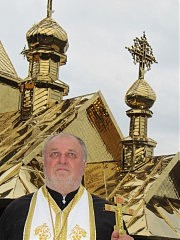
After about an hour of climbing, we reached our destination. This small church with golden domes looked particularly festive against the backdrop of colorful autumn foliage. Father Mykhailo was already waiting for us at the entrance to the temple. He told us that the church was built by Cossacks four years ago. In addition to its high-mountain location, the temple is famous for being considered “pure,” meaning that funerals are not held there. It is much more convenient for local residents to bring deceased relatives for church services to the valleys and bury them in local cemeteries.
Father Mykhailo read a prayer, and we prayed with him. And then another event took place: the ringing of bells. Anyone can pull the rope of the bell on the local belfry at any time. But there are rules here too, so that the loud sound and vibration after the strike pass through the body and remove all ailments and illnesses from it. And we rang the bells to our heart’s content, several times each!
Land of the First Hasidim
This place on the Cheremosh tributary in Kuty is outwardly unremarkable: an overgrown path, a small bridge across the river, and on the other side, in the village of Vyzhnitsa, someone’s estate. But there are days when dozens of Hasidic pilgrims can be seen praying on the riverbank, having come to this area to visit the homeland of their ancestors, pray at their graves, and feel the spirit of this Carpathian town where the Hasidic teaching originated.
One such place in Kuty is this bend in the river, on the bank of which a small sign is placed on a tree with an inscription in Hebrew and Ukrainian: “On this spot, Rabbi Israel Baal Shem Tov bathed when he lived here.”
“We, the local residents, call this place the ‘bath of the Jewish miracle worker,’ and the Jews call it ‘Mikveh Besht’,” says Grigory Tomyuk. “Israeli Hasidim who come to Kuty and stay at ‘Eco Karpaty’ have told me a lot about the legendary Baal Shem Tov, who is the founder of the Hasidic teaching in Judaism. In the mid-18th century, he lived in Vyzhnitsa for seven years, earning a living by mining and trading lime. This is hard physical labor. He also devoted much time to studying the Torah and, according to tradition, discovered many of its secrets. After some time, he became known in his community as a preacher and healer. But Baal Shem Tov did not give public sermons or make records. He expounded his teachings only to his disciples, who became leaders of Hasidism in the next generation.”
Today, descendants of the Vyzhnitsa Hasidim and their followers in Israel number hundreds of thousands, and they even have their own deputies in the Knesset. This is a very authoritative religious organization, famous for its charitable activities and the spiritual energy of its adherents, the origins of which were born on this Carpathian land.
“At the beginning of the last century, Jews lived mainly in Kuty, thanks to whose activities our town and district prospered,” Grigory says. “Wars and Bolshevik terror almost destroyed the Jewish population. The survivors left for the Promised Land. But their descendants treat the homeland of Hasidism with great respect.”
Standing on a “Bag of Gold”
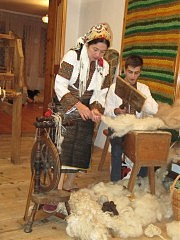
Every workshop of a local craftsman and master class we visited, whether it was pottery, blankets, carpets, or rugs made of sheep’s wool, household items, souvenirs, and wood art, can be called a unique museum where the skills of folk crafts have been passed down from father to son, from mother to daughter for centuries.
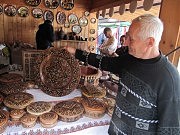
To feel the spirit of Hutsulshchyna, to see the concerns and everyday problems of the region, to appreciate the high skill of local craftsmen in all their diversity, one can visit the local markets in Kosiv and Kuty. In every item made of wood, clay, sheep’s wool, local stones, and minerals, one can feel the artist’s hand, his unique talent. As many centuries ago, all this creative abundance, born from natural raw materials, preserves the energy of the master, his hands, and his talent.
“Yes, considering the natural wealth of this region, one can say that we are standing on a bag of gold, but we cannot lift it,” Grigory muses.
We walk with him through the local fair and admire the patterns on carpets and vyshyvankas, various wooden items, from spoons and combs to intricate Easter baskets and huge cannons; ceramic dishes of various shapes, colors, and purposes; jewelry made of local semi-precious stones…
“The products of our masters are taken away for next to nothing from their native land to other regions of Ukraine and abroad for resale in entire truckloads,” Grigory says. “But in recent years, another trend has emerged: our masters are leaving their native land, most often abroad, to set up similar production there. Businessmen buy them the appropriate equipment, which allows craftsmen from Hutsulshchyna to work much more efficiently. Naturally, the main profit goes to the owner of the machines and equipment. If our masters had the appropriate equipment, then our furniture and other wooden products would have no equal on the world market. We need investments, but where to get them?”
Don’t Teach Us How to Live, Help Us…
It is relatively close from the highway to the village of Velykyi Rozhin in the Kosiv district, about 6-8 kilometers, but the broken road forces us to move forward at a minimal speed. However, we can admire the local landscapes. The village is located along a river, and immediately behind the houses and sheds, the forest-covered mountains begin. We did not meet a single person on the road, although there are signs of life at the houses.
“The children are at school, the elderly are at home, the rest of the population is working abroad,” Grigory sighs. “There is practically no work here. Only household farming.”
The same problem exists in the neighboring village of Velykyi Rozhin. Theoretically, of course, one could raise calves and cows in these green meadows, build butter factories and cheese-making plants. These ecologically clean meat and dairy products could be very popular both in Ukraine and in European countries. Wooden products and furniture could also be in high demand. But to implement such projects, at least money is needed to purchase the appropriate equipment.
Local authorities themselves do not have such funds. On the other hand, they believe that tourism and farming should be developed gradually, taking into account the ecological features of the region and the desire to preserve its natural wealth. But at the same time, to the specific question: “Is there any investment plan for the development of villages and districts and specific proposals?” – the journalists did not receive a clear answer from the local leaders.
Grigory Tomyuk provides his own answer to these problems. His incredible spirit of entrepreneurship, social and business activity, and knowledge of the region’s customs and traditions attract not only local businessmen and their colleagues from other regions of Ukraine but also foreign investors. Some only need advice, others need help with initial capital, and still others need to be pointed to specialists and “the right people”… Ultimately, all this also works for Grigory’s business, in which his honest name and business reputation play a significant role.
One example of such activity can be his project to create a sanatorium based on mineral water near the village of Velykyi Rozhin. It can be said that it began with a call from the United Arab Emirates. A doctor for one of the Arab sheikhs said in a telephone conversation that to cure his patient, he needed water of a specific mineralization from a spring flowing from a rock, and that Mr. Tomyuk was recommended to him as a connoisseur of local nature.
At that moment, Grigory remembered a spring in his wife’s native village, about which her grandfather and father had told him a lot. They and the local residents considered it miraculous, and its water prolonged life. Indeed, people living near this spring rarely got sick and lived long lives.
A couple of weeks later, the Arab doctor and Grigory came to this spring. The doctor took the water for analysis and a few days later returned to Velykyi Rozhin again, but this time with several barrels to ship the water to the Emirates.
Three months later, Grigory received a letter of gratitude from that Arab country with a wish to improve the area around the spring and a check for a large sum of money to carry out this work.
“I have a project to build a small sanatorium on the other side of the river, where healing will take place with the help of this miraculous water, the charms of a nature reserve, where even the air has healing properties, and ecologically clean products without any additives,” Grigory shares his plans. “I have already started looking for investors, and soon an analysis of the water composition will be done to determine its beneficial properties.”
Enthusiasm and… Love Know No Bounds
For four days, journalists, led by Grigory Tomyuk, sometimes 12-16 hours a day, traveled around the Hutsul land to learn about its attractions and the life of this small and colorful people. I confess that if our group had not been led by our chief Hutsul, we would hardly have endured such a pace, the number of meetings, interviews, and events. With his energy, and most importantly, his enthusiasm and love for his land, he charged the surrounding space and everyone who came into contact with him.
Obeying some inner impulse, or remembering that we would soon pass by an unusual place or attraction, he often changed our travel schedule to show us or let us hear the most, most… And immediately, interesting people appeared, they told us and showed us, they surprised us… And Grigory was incredibly happy, showing us another bright facet of his native land, and was filled with pride for this land and its people.
There were also moments when we suddenly stopped on the road, noticing a car on the roadside. To some, he helped with directions, to others – during the acquaintance, with finding buyers for their truck. Thus, in my opinion, he makes new friends and business partners far from Bukovina.
During our press tour of Hutsulshchyna, we only touched upon this Carpathian phenomenon, which originated in the mountains and valleys hundreds of years ago and continues to surprise all guests of this region with its combination of natural beauty and the character, customs, traditions, and talents of its inhabitants. You need to come here to understand the spirit of that Ukraine, which fundamentally continues to live by natural laws, without high politics and diplomacy, globalization and world banks. Here, freedom and independence are valued first and foremost.











