

It is believed that summer is the best time for travel. But how favorably autumn has treated travelers this year! Wandering is the best occupation in the world, Konstantin Paustovsky seems to have said. And indeed, there is nothing better than to emerge from the cycle of affairs, obligations, and circumstances and plunge into a whirlwind of new knowledge, impressions, and acquaintances. Moreover, a chic offer came, as they say in Odessa, to go on a voyage along the coast of the Mediterranean Sea, from Italian Bergamo (with an emphasis on the first syllable, and not as Konstantin Raykin misleads us in the musical “Truffaldino from Bergamo”) and French Marseille to Spanish Barcelona and the island of absolute monarchy – Monaco.
And then a little more – and Provence
Tourists know: you want to see everything. You can’t embrace the impossible, the trip turns into a gallop with constant culture shock, but still…
Upon arrival in Bergamo – of course, to Milan. To the fashion capital – not for seasonal sales (they ended at the end of summer), but to the central square, to the Duomo cathedral. This is my second meeting with the white marble Gothic creation with exquisite stained glass windows, and it is just as impressive. Those who come to Milan will not miss this attraction, and then I recommend visiting the Vittorio Emanuele gallery-passage with its luxurious mosaic floor, and the church of Santa Maria delle Grazie – Leonardo da Vinci’s “The Last Supper” is precisely here. True, you can see the master’s fresco if you hurried in advance and bought a ticket for viewing, which lasts no more than 15 minutes. A monument to Leonardo da Vinci was erected in Milan in a square near the La Scala theater. The famous opera house will hardly impress Odessa residents externally – as they say, feel the difference…
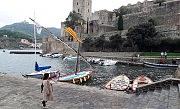
Next on the route is French Provence, which somehow especially touched my soul and left me with the feeling “I want to go there again.” In the capital of Provence, Marseille, it is worth walking along the old port, which today serves as a parking lot for yachts; climb to the church of Notre-Dame-de-la-Garde to see the whole city from above, and find the island of If, known since childhood from Dumas’ book, in the waters of the Mediterranean Sea.
Marseille observation: on the wide embankment, on the sidewalks in different parts of the city, scooters lie around neglected. What is this? As our guide Andrey Kochetov explained, anyone can use electric scooters: using the appropriate smartphone application, you pay 15 euro cents per kilometer, and ride wherever you need to go. You also leave the scooter on the sidewalk anywhere, and exit the program. At night, a special service collects scooters throughout the city. Munich, Brussels, and Paris also actively use this service. Perhaps the members of the delegation of the Odessa City Council, who recently visited Marseille, noticed it and will borrow the idea? By the way, the visit was for a good reason – in the twin city, on the “Prado” beach, the tourist logo of Odessa – an anchor-heart – was solemnly opened.
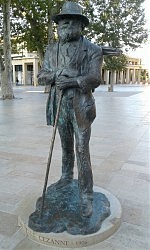
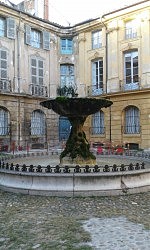
We entered the old town of charming Aix-en-Provence in the morning and could observe how the local utility services were cleaning diligently and thoroughly. A small machine first vacuums all the nooks and crannies in the block, then a stream of water washes the pavements and sidewalks – cleanliness! I’m not hinting at anything. I’m just walking along the plane tree-lined Cours Mirabeau, like in Odessa. Young trees with still fragile trunks are enclosed in a special cage here – they are protected. In the historical center there are narrow streets, well-kept old houses, which, they say, have very small apartments. A two-room apartment, for example, has no more than 40 square meters, there is nowhere to put a washing machine, so it is customary here to arrange automatic laundries separately. Aix-en-Provence is the birthplace of Paul Cézanne, and it is simply unacceptable to miss the sculpture of the impressionist, as well as the town hall with its clock tower, thermal fountains of considerable age, and the tapestry museum.
Dan Brown as a Tour Guide
If you read, like I did, another detective-scientific bestseller by Dan Brown, “Origin,” the day before, then in Barcelona you will constantly find analogies with the route of the main character, Professor Langdon, described in the novel. And first and foremost is the Sagrada Familia. “The complex and porous towers have different heights, giving the shrine the spirit of a whimsical sandcastle.” And indeed it is. The Sagrada Familia is a perpetual construction site, it has been built since 1882 solely on private donations (now every tourist also contributes). The great Antoni Gaudí practically gave his life to the construction; he dreamed of building a Bible in stone, decorating the cathedral with three facades dedicated to the life of Christ. He only managed to complete the Nativity facade; the other two – the Passion of Christ and the Ascension of Christ – were continued by other masters. 12-14 million euros is the annual construction fund. From time to time, the completion date is announced – 2026, but as they assume, the endless extension of this deadline will only increase attention to the famous basilica and prolong tourist interest.
Another masterpiece by Gaudí, described in the novel, is Park Güell. The idea of the Catalan magnate Güell and the poor architect Gaudí was realized in accordance with the fashionable “garden city” concept of that time, in 1900 – residential buildings away from the city bustle. To this day, the creation has survived in the form of a city park with whimsical structures, filled with symbols. Be sure to walk here when you come to Barcelona. And in the evening, visit Montjuïc hill, to the fountains in front of the National Palace. After sunset, you will see a light and water show. Nowadays, such fountains are not particularly surprising, but in 1929 they were perceived as a masterpiece of engineering thought. Time and military events did not spare the structure, and the second life of the ancient fountains began before the 1992 Olympics. From April to October, the show of water and light to the sounds of “Barcelona” performed by Montserrat Caballé and Freddie Mercury attracts thousands of tourists. This is no longer through the eyes of Dan Brown, but my own.
Coffee with Matisse
Collioure, a small town in the south of France, founded by the Phoenicians 600 years BC, could not help but attract artists in its time. The brilliant impressionist Henri Matisse was once told about Collioure, where houses are painted in bright colors, and they match the colors of fishing boats, and the streets here are pink, blue, yellow, lilac. And there are no black and white. The artist, understandably, came to the town and stayed for a long time, and after him, other Fauvists followed – “conveying sensations through intense color and simplified drawing.” There is still an abundance of this intense color in Collioure today, and the town’s landscapes, captured on Matisse’s canvases, can be seen in the “Chez les Templiers” cafe. Imagine, the originals have been preserved – Matisse and his friends paid for wine, meat, and fruit with paintings. The hostess considered all this daubing, but the owner turned out to be more far-sighted. Thanks to Matisse, the once poor fishing town became a fashionable resort, and the cost of apartments here, they say, is comparable to housing prices in Nice and Monaco.
Culinary Chapter
It is an unwritten rule for a traveler: wherever you go, taste what is eaten and drunk in that area.

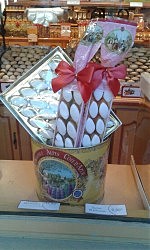
In the same Collioure – the most delicious anchovies in France. From Aix-en-Provence, it is worth bringing calissons – Provençal sweets made from almond flour and dried fruits, covered with white icing. In Marseille, our guide treated us to pastis – an anise liqueur, but it’s an acquired taste, as even diluted, the favorite French aperitif resembled a medicinal mixture. Which cannot be said about low-alcohol Spanish sangria. Jamón is Spain’s culinary calling card. You can buy it pre-packaged, or a whole leg. As for paella – in a hotel on the Costa Brava, it is prepared with seafood and meat simultaneously.
Bon voyage!
You arrive with a “wagon” of impressions, and you want to share so much! To tell about how the Catalan dance sardana was danced in the resort town of Tossa de Mar, how the English Embankment in Nice is properly arranged, how French perfumes are made at the Fragonard factory, how parrots behave in Park Güell, and how the principality of Monaco, called a dwarf state, exudes genuine luxury…
If you have the opportunity, see it all for yourself. Bon voyage, as the French say.











