

Forbes magazine in 2012 included the Odessa tram in the list of the 12 most interesting trams in the world in the nomination “for the greatest mention in folklore, literature, cinema”. But the Odessa tram is interesting not only for this.
The very history of the creation of horse-drawn railways in Odessa is full of mysteries and gaps that have not yet been filled. And only by carefully reading the documents of that time on the principle of “between the lines” can one realize the full grandeur of the intrigues and conspiracies that accompanied the appearance of the tram in Odessa. Odessa is one of the first cities in Ukraine to have a horse-drawn tram. And if it weren’t for intrigues, monopolies, and bribes, the tram in Odessa could have appeared even earlier…
The need for horse-drawn railways was first written about in the 1840s by the head of Vorontsov’s diplomatic chancellery, Pavel Marini. According to Marini’s project, the first horse-drawn railway was to run from Odessa to Kremenchug with a branch to Balta. But this project, by the will of fate, remained unrealized.
In 1870, Odessa entrepreneurs prepared a project for the creation of a horse-drawn tram in the city. The application was accepted by the Odessa Duma, and on February 27, 1870, the entrepreneurs deposited the required deposit of 25,000 rubles into the city treasury. It took a whole year to consider the submitted application, so only on February 8, 1871, did the general Duma decide to approve the contract project and instruct the administrative Duma to conclude the contract with the entrepreneurs in its final form.
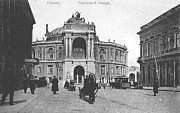
However, the bureaucratic state machine became an insurmountable obstacle to technical progress. The struggle for the Odessa tram lasted almost 10 years. The Odessa entrepreneurs had no chance of success, if only because the monopoly on the creation of tram lines in the then empire belonged to the Belgian Joint-Stock Company, which fully abused this monopoly. Osip Chizhevich, a well-known public figure in Odessa and one of the participants in the tram concession, dedicated an entire book to the adventures of the Odessa entrepreneurs who initiated the tram service in Odessa. It turned out to be a very instructive story…
On August 27, 1879, an agreement was concluded between the city Duma and the agency of the Belgian Society of the Odessa Horse-Drawn Railway, headed by the Frenchman Pierre Bonnet. But already in April 1880, through the city notary Rynsky, the concession for the construction and operation of horse-drawn railways in Odessa was transferred to the authorized representative of the Parisian banker Eduard Iosifovich Otle – the Belgian subject Emil Iosifovich Cambier, about which a notarial record No. 647 is preserved.
On July 8, 1880, the first horse-drawn railway line was consecrated – the Langeron line. It started at the corner of Richelievskaya and Pochtovaya streets and ran along the latter, then along Kanatnaya, along Sabansky Lane, through Alexandrovsky Park, and ended at the end of Langeron.
It is quite interesting to read the regulatory documents that were dedicated to the Odessa tram. For example, clause 25 of the “Mandatory Regulation on the Maintenance of Horse-Drawn Railways in the City of Odessa” (1892): “In the absence of free seats in the carriage, the conductor is obliged to ask any excess passenger to leave the carriage.” In addition, conductors vigilantly monitored compliance with clause 15 of the transportation rules: “Women whose hatpins have sharp ends not protected by special caps are not allowed in the carriages.”
By the beginning of the 20th century, the tram lines in Odessa were so well thought out that one could get from any point in the city to a specific destination either without transfers at all, or with one transfer. That is why at that time there were tickets with the “right of one free transfer”. This right was valid for a certain period from the moment the ticket was sold. And guidebooks to Odessa of that time even described excursions around the city by tram. According to urban legend, it was in a “conka” carriage that Ivan Bunin asked Nikolai Tsakni for the hand of his daughter Anna. And Babel himself overheard the dialogues of his future heroes in the Odessa tram…
Soon after the opening of the “conka” in Odessa, steam tram lines also appeared. The steam tram ran on suburban routes (Khadzhibey Road, Lyustdorf Road, and Fontan). The first “steam tram” line was laid from Novorybnaya Street to the 16th station of Bolshoy Fontan. “…I was born at the Sarachini dacha (Bolshoy Fontan, 11th station of the steam tram) near Odessa. The seashore there is steep, and the steam tram rails ran along the very edge…”, Anna Akhmatova would write in her autobiography. They say that once Sergey Utochekin ran this route on a dare and even outran the steam tram!
The steam tram in Odessa was nicknamed “Vanka-golovaty” (Johnny the Big-headed) because of its disproportionate chimney. The first carriages for the steam tram were manufactured in Belgium, and over time they began to be produced at the Odessa foundry and mechanical plant “Bellino-Fenderich”.
Among the steam tram routes, the most interesting was the “reed tram” (modern route No. 20), which in itself could be included in the list of the most interesting in the world. The history of the “reed tram” begins in 1883. On May 19, 1883, the steam tram route from Narishkinsky descent to Khadzhibey Estuary was opened. At the beginning of the 20th century, the line led to resort areas on the shore of Khadzhibey Estuary, where the dachas of Odessa’s wealthy residents were located, as well as the famous Khadzhibey Park.
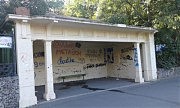
A large part of the route of the 20th tram runs along Khadzhibey Road, which was once called the “road to Fomin khutor” and led to the present-day village of Fomina Balka. One of the stops on this route was named “mirror”. It was called “mirror” because the pavilion was placed perpendicular to the rails, and so that passengers could see the approaching tram, a large mirror was hung opposite the stop. Approximately halfway along the route of the 20th tram, one finally understands why it was called the “reed tram”, as reeds grow on both sides of the tram tracks, and their height often exceeds a person’s height.
The only artifact related to horse-drawn railways in Odessa accessible to tourists today is a piece of rail with the stamp of the Belgian factory in Liege and the date “1895”. Currently, this artifact serves as a handrail for the stairs in the Kherson Descent area. At present, tram architecture of the electric tram, whose history began in 1907, has been preserved in Odessa. But that’s a separate story…











