

Sad news from last week— journalist Vera Vladimirovna Krokhmaleva passed away in Israel. She was 66 years old.
Vera’s path into journalism began at “Evening Odessa”; for many years, she worked in the letters and city life department. Therefore, it is expected that many condolences and memories of days of joint work are now flowing to our editorial office from all over.
We grieve with everyone, wish strength of spirit to Vera’s daughters, Lyusya and Sonya, and in memory of a person from the “vecherka” cohort, we offer readers a small selection from the editorial mail of these sad days.
She had the most Odessan family I’ve ever known. An old two-story house right opposite “Privoz.” Now that whole street has been demolished. The front door never closed. About a dozen string bags hung on the coat rack. Friends didn’t need to ask, just come in, take one, “go shopping.”
Grandma Rakhilka, precisely Rakhilka, managed everything in the house. She fed Verochka and her friends, hung up the string bags, and even scolded Verochka’s mother—a cheerful and immense woman. A few years after I first visited the Krokhmalevs, I accidentally learned that Verochka’s parents had, in a way, “adopted” Rakhilka, if she hadn’t been old enough to be their mother. They found her after the war, homeless, and brought her home… Verochka also didn’t realize for a long time that Rakhilka wasn’t her biological grandmother.
Verochka’s mother worked at a sewing factory and was very proud of her journalist daughter. We, her colleagues from the department, had carte blanche in that family. In the corner, behind the dressing table, her mother would always miraculously find an unopened bottle of cognac for us.
Verochka first came to “Vecherka” for an internship as a student at Irkutsk University. She didn’t write feuilletons, and perhaps because of that, she idolized the “king of the genre” and, concurrently, our boss, Semyon Livshin, even more. She was clearly jealous of him towards us, Dima Romanov and me. We took advantage of the situation, entrusting Verochka with all the feuilleton mail (“Thank you for your attention to the newspaper. We will consider your opinion when preparing future publications…”) and the care of our small zoo—parrots and a guinea pig. The guinea pig lived in Semyon Adamovich’s office and ate yellowish writing paper. As soon as a page was rejected and crumpled, the white creature with reddish spots, twitching its whiskers, would appear from under the cabinet…
Verochka was younger and kinder than us. “How do you talk to people?!”, “inhumane executive committee,” “if you can’t answer the elderly on time, ask me or Arkady Romm…”—this was all from her repertoire. It goes without saying that she was the last to leave the editorial office.
She considered it necessary to feed us and always give us something for all the holidays. Once, she knitted woolen socks for February 23rd: two for Semyon, and one each for Dima and me. Our suffering from wearing only one sock and the most terrible assumptions about why she didn’t knit a second one for us became the subject of jokes and scary stories for a long time.
This newspaper was our whole life. Here we fell in love; sometimes at night, we played football with my deflated basketball; we put out silly and funny wall newspapers; we pretended to be Verochka’s older brothers, and all together, the unsuccessful and, as she was sure, “semi-literate” children of our main typist, Rai Naumets; we argued at quick meetings with the editor-in-chief, Boris Derevyanko…
How recent it was, and how incredibly long ago!
…Forgive us, Verochka, for often taking advantage of your touching kindness and belief that people are better than they seem. “Vecherka” is the right place to say goodbye to you. We were happy here.
Viktor LOSHAK
It seems we should get used to it—we are all mortal, but the departure of each loved one is still perceived as a collapse.
And so we bid farewell to Verochka Krokhmaleva, a basketball player, a journalist, one of the most open, soulful people in our circle.
There’s an expression—an open wound. But Vera had an open soul. And into it, she welcomed the sorrows and joys of her friends. To shelter someone there, to feed someone there, to warm someone there….
If I were asked to define her essence in one word, I would say—WARM.
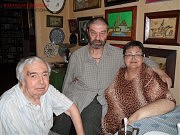
At “Vecherka,” she harmoniously fit into the “Antelope Gnu” crew. Alongside Livshin, Romanov, and Loshak, she gathered material for feuilletons.
People asked me—is Vera in love with Livshin? I answered—you’re mistaken, she’s in love with all three, Dima, Vitya, and Semyon, and doesn’t know herself who she loves the most.
We had many headquarters where we could sit, drink, and talk. Sometimes we gathered in Arkady Tsykun’s kitchen, sometimes at mine, conveniently, house to house, but even more often on Privoznaya, at Vera’s… Oh, that courtyard—windows overlooking “Privoz,” with verandas, perhaps that’s why we jokingly called Vera—Veranda… Here, plans for the next “infiltrations”—into the housing office, the ambulance service, the fire brigade—were discussed…
And unexpectedly for myself, I saw a different Vera at the newspaper “Vestnik Region.” In the difficult times of the nineties’ collapse, she managed to find sponsors to assemble a new newspaper from the staff of the suffocated “Odessky Vestnik.” She turned out to be both an entrepreneur and a manager. She worked 25 hours a day. But she treated people, everyone in the team, not just with respect, but with love.
And yet, she had her own twins—Sonya and Lyusya…
But even then, she managed to write. I remember a feuilleton by Vera and Dima Romanov about the then-all-powerful Sergey Kivalov… But that work to the point of exhaustion ended with a stroke.
She recovered. Her speech returned. And yet, she had to continue her treatment in Israel.
Vera visited Odessa three times. She remained cheerful and witty, intelligent and ironic.
Two years ago, we were sitting in my kitchen—Vera, Gubary, Valya, me… We were talking about children. And there was happiness in Vera’s eyes.
Evgeny GOLUBOVSKY
A “teacher” from my 103rd school came to me. No, she didn’t teach in our class. But she started the conversation as if we were relatives. The essence of her request was this: a room was becoming available in a communal apartment (neighbors were moving to the US permanently), and they wanted to move someone in, and her family had been on the waiting list for a long time.
I never dealt with such conflicts in the economics department, so I went with the applicant to the city life department. There, like a cloud settled on a chair, Vera Krokhmaleva sat at her desk. I wasn’t the one explaining, but a “shkrab” (school worker).
“Rozov, we’ll work together. Understood?”—Veranda said. And we went to the head of the housing office. He looked at Krokhmaleva with rabbit eyes. She greeted him affectionately. She pulled the phone closer, dialed a number, and cooed: “Anechka Trofimovna, is the director himself busy? I need to tell him a few words. I’ll be waiting… Ivan Semenovich? Yes, Krokhmaleva. Thank you, I’ll come…” The housing office director’s face changed color: from crimson to white.
Our visit ended quickly and successfully. A couple of days later, the misbehaving building manager reported to Krokhmaleva that my teacher had received an order for the room. About two weeks later, Vera and I were walking from some meeting at the city council. That same “teacher” was walking towards us. Seeing us, she sharply increased her pace and crossed to the other side.
Krokhmaleva smiled and said to me: “Rozov, remember: not all investigations end with articles, and don’t expect gratitude from anyone…”
I’ve been living with these lessons from Vera ever since.











