

At the World Club of Odesites (Marazlievskaya St., 7), the exhibition “The Return of Aristarkh Kobtsev” is open until the end of May.
Aristarkh Kobtsev (1884-1961) was a graduate of the Ostromensky Private Art School in Odessa, a teacher of graphics, a professor of painting, and worked in Odessa his entire life. He is the author of many works in various genres. He was a member of the Association of South Russian Artists (TYURKh), the Society of Independent Artists (ONKh), the Kiriyak Kostandi Association of Artists, and the Unions of Artists of the Ukrainian SSR and the USSR. Kobtsev is a prominent representative of the Odessa South Russian artists, who mastered many artistic techniques – oil, watercolor, tempera, pencil, ink. Many of Kobtsev’s works are being presented at the exhibition for the first time in almost 100 years. These include landscapes, portraits, fantasy works, caricatures, and icons. At the beginning of the last century, contemporaries advised the artist to leave Odessa and settle in Paris or Florence, where his art would be appreciated, and his works would be sold, bringing him world fame. But Aristarkh Kobtsev preferred Odessa and remained loyal to it until the end, accepting all the consequences of such a decision. As the exhibition organizer, collector Alexey Stopakevich, explained, during the occupation, the Romanian authorities involved Kobtsev in the restoration of the lower church of the Transfiguration Cathedral, where his author’s icons were created. After the occupation, he taught, painted landscapes and portraits of his loved ones, did not strive to create for the sake of the day, and did not create opportunistic paintings depicting leaders.
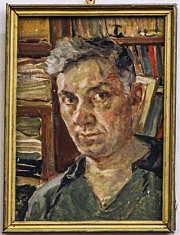
The vice-president of the club, Evgeny Golubovsky, spoke about the importance of this exhibition for art history:
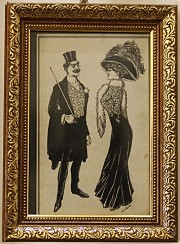
— Once, the famous Odessa collector Sergey Sergeevich Seredinsky, showing me his collection, which included masterpieces of the South Russian school, said that he had at least one work (he spoke technically – at least one item) from each member of the Association. It was from him that I remembered an exquisite erotic drawing by Aristarkh Kobtsev, whom I didn’t know then, which reminded me of the sheets for Konstantin Somov’s “The Book of the Marquise.” I became interested in the master. But I encountered his works very, very rarely. I saw another small watercolor, almost abstract, although it depicted fireworks, in the collection of the artist Nikolai Zenoviyovich Yukhnevich – a professor, a doctor, one of the participants in the exhibitions of independent artists. We communicated in the early sixties. I asked what Nikolai Zenoviyovich knew and remembered about Kobtsev. His last exhibition was before the war. Of course, it wasn’t as bright and interesting as in the first decades of the century. He didn’t change himself, he didn’t start painting industrial landscapes, glorifying labor, although he came from a working-class background, he didn’t join the party, he didn’t do any shoddy work for the art fund. He painted quiet landscapes of Blizhnie Melnitsy. He was also a poet, illustrating – for himself – poems. He had an excellent library of Russian poetry. Aristarkh Aristarkhovich died in 1961; he is buried at the Second Christian Cemetery, plot 47. A few months ago, Alexey Arkadyevich Stopakevich, an associate professor at the Odessa Polytechnic University, called me. He had read my article about the mysteries of Nikolai Gumilev’s Odessa poetry collection, where I suggested that Aristarkh Kobtsev had drawn the cover of a book published in Odessa in 1943. And he decided to tell me that he is the artist’s grandnephew, that all his preserved creative legacy, about 1000 paintings and drawings, has passed to him, that he is now compiling a catalog, and is willing to show Kobtsev’s paintings at an exhibition. Fantastic, I thought, this is a real miracle. Not just a name, but the work of an interesting artist is returning to Odessa’s culture.











