

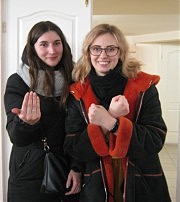
Doctors in Odessa are learning sign language. They are being taught by volunteers from the “Surdo” school. I recently met with three of them – Ekaterina Khomenko, Daniela, and Roma Kharchuk – by visiting the “lessons” at children’s polyclinic No. 6.
It is pleasant to recall that the director of KNP “Children’s State Polyclinic No. 6” of the Odessa City Council, Sergey Gorishchak, became a laureate of the “Evening Odessa” competition “People of Action” based on the results of 2018. It is interesting that the esteemed jury, when voting for his candidacy in January, was not yet aware of such a new and useful endeavor to which S. Gorishchak is also directly involved.
“Teaching doctors sign language is our social project,” says Ekaterina Khomenko. “I have been working with deaf people for over six years. I learned sign language of my own volition.”
She was inspired to do so by hearing-impaired peers from her school years. She wanted to communicate with them in a way that was comfortable for them too. In the tenth grade, she met Daniela’s current husband, Roman Kharchuk. Daniela from Chernivtsi and Roma from Odessa became friends at VSEI – the non-state Vinnytsia Socio-Economic Institute, where both were fortunate enough to study. Today, Daniela, a future social worker, is preparing to defend her thesis, and Roman is already working as a massage therapist. They are also volunteers and friends of Ekaterina, and together they conduct classes with doctors.
Katya recently graduated from the Odessa State Academy of Construction and Architecture. She is an artist-designer. And she cannot imagine herself without volunteer work – specifically in teaching “speaking people” (as deaf people call us, the fortunate possessors of hearing) sign language. Katya herself tried to find various sources of knowledge – she visited UTOG (Ukrainian Society of the Deaf), where she found people who understood her desire to communicate with those who are deaf. She also learned, she says gratefully, from sign language interpreter Maria Yulianovna Usova, may she rest in peace.
By the way, Katyusha shared that in all of Odessa, where there are 1600 to 1900 deaf people (including visitors), there are only two sign language interpreters. That is, only two certified specialists who know sign language! And in the region, for 3,000 hearing-impaired people, there are only four sign language interpreters. According to her, today this profession is… not popular. The salary of such a specialist is minuscule.
Katya strongly disagrees with this situation. In fact, she says, deaf people are discriminated against. Although their rights are defended by the current Law “On the Fundamentals of Social Protection of Persons with Disabilities in Ukraine,” by and large, information is not fully accessible to deaf people. Without an intermediary who is proficient in sign language, it is impossible to master a university program, for example. And to prepare them for university admission, a sign language interpreter is needed. Not to mention that there are very few universities in Ukraine where deaf students could study, meaning where there are sign language interpreters on staff.
These young people, believes Katya Khomenko, can become doctors, architects, lawyers, and other highly qualified specialists. Among them are many talented individuals. But today, the volunteer is convinced, only a “standard set of professions” is open to most of them. Seamstress, cleaner, packer… Well, they can also get a profession in vocational schools, say, as a cook, dental technician, electrician, fitter, painter, or other blue-collar specialty.
What can we say, if even in everyday life there are many barriers for deaf people (and according to the law, the environment should be barrier-free). Have you ever thought, dear readers, how such a person can call an ambulance, or in case of fire or other emergency, contact the Ministry of Emergency Situations specialists – to give an address, explain what happened? We know little about them. In developed countries, Katya said, there are, for example, terminals for deaf citizens, and there are special applications on phones, so they are not helpless at home or on the road. For us, however, the world of the deaf is essentially closed.
Ekaterina, for example, told about a case where a deaf girl left a doctor’s appointment feeling offended. The doctor was wearing a mask (and the doctor can be understood – flu and measles are circulating), but he didn’t know that with such patients, one should communicate without a mask – some of them can read lips. Or another nuance in communication. You, for example, ask in sign language: “What are you reading?” A normal question, isn’t it? And you will be answered: “I am not reading today.” That is, concreteness is more accessible to them. They paint the general picture as if “with brushstrokes.” Like an artist paints their picture. For example, it is difficult for them to read long texts. I observed how the volunteer guys with their “students” – doctors – acted out everyday scenes, and it even seemed to me that in some cases they used symbols like, say, Japanese hieroglyphs. Partly, Katyusha confirmed, this is true. And she also said with regret that in Ukraine, sign language does not exist as a state language, although it has been developed.
“I was shocked by this fact,” the volunteer shares her observations. “When we, volunteers, organized summer camps for deaf children, gathered them from boarding schools, it turned out that every third child was deprived of the opportunity to communicate normally with their parents: they do not know sign language. Such parents send their children to a boarding school, and they themselves do not even try to learn sign language. This is primarily characteristic of ‘speaking’ families in which a child with total hearing impairment was born. It is naive to believe that they, like their parents, will suddenly start speaking as if by magic. They also do not understand that sign language reveals the uniqueness of their children, their ‘self,’ individuality, and, in the end, sign language is a reliable bridge for communication with other people, including ‘speaking’ ones. Provided, of course, that ‘speaking’ people also know such a language.”
The realization of this, undoubtedly, also prompted the volunteers to start teaching doctors sign language (there are such lessons for teachers in Odessa as well). Katyusha says that not only doctors come to the classes in their group (and I saw this for myself). And she herself began her volunteer-teaching activities by engaging her grown-up hearing friends. It was something like chatting over a cup of tea or coffee. And then the guys got hooked. Especially since Katya clearly explained to them what gap in our society’s life they could fill, at least in everyday terms, if they knew sign language.
As of today, Katya says with pride, about a hundred people have been trained in sign language. But for doctors, such training is being conducted in Odessa for the first time. Interests have happily converged here. Katya was found by the head of the early intervention center, a branch of which is based at children’s polyclinic No. 6, Oksana Krivonogova. Sergey Gorishchak is also a staunch advocate for organizing an accessible environment for children with disabilities, in this case, hearing impairments. In short, everything turned out as dreamed.
The doctors are enjoying the classes, having fun. Katya, as well as Roma and Daniela, perceive mistakes and unsuccessful sign language expressions with humor: they understand how difficult it is for their students. “We really need such classes,” admits Nadezhda Sobolev, a nurse at children’s polyclinic No. 6, on behalf of the entire audience. “Sometimes it is necessary to communicate in sign language with our young patients or their accompanying parents. Thank you to the volunteers for taking on such a kind and necessary endeavor.”
The current course of classes is ending. Will there be a continuation?
“We intend to conduct such classes in other polyclinics as well, and we hope to be supported,” shares Ekaterina Khomenko her plans. “We have scheduled a new training course for March. People are willingly responding to our offer. For example, in just four days, more than twenty people have already signed up.”
Well, for those who are not yet aware of the opportunity to learn sign language, we inform you how to contact the volunteers from the “Surdo” school: instagram.com/surdo_school_odessa or facebook.com/surdoschool.











