

For several years now, the reform of decentralization of power has been ongoing, the name “united territorial community” has taken root, and few people wonder: what is it, actually? Our newspaper has dedicated more than one publication to the topic, and continues to talk about the life of newly created communities, patronized by the Center for Local Self-Government Development and the Odesa branch of the Association of Cities of Ukraine. These two institutions, which provide legal and methodological assistance to those wishing to create UTCs, are also willing to assist journalists in obtaining information during press tours “Success Story”. Marazliivska, Baltska, Belyaevska UTCs – readers are already familiar with them. Our next route is to the Tuzlivska united territorial community.
In the extreme south, in the steppes of Budjak
More than 100 km off-road, and we are in the Tatarbunary district, the village of Tuzly – the central estate of the community, which also includes the villages of Veselaya Balka, Novomikhailovka, Lebedevka, Bezymyanka, Veseloye, Sadovoye. 10 thousand hectares of territory, 2600 inhabitants, one support school, two kindergartens, a primary healthcare center – a brief description. Larisa Kornovan-Moiseyenko, who has headed the community since 2015, spoke in more detail.
— Tuzlivska is one of the first eight communities in the region, created against the opinion of the regional council of the previous convocation – it was the only one that the deputies did not support at the session, and we, disagreeing with this, appealed to the Cabinet of Ministers and went through a simplified procedure. As a result, elections were held, and the community is moving forward, sometimes faster, sometimes slower.
The head of the community noted that the budget of the UTC has significantly increased over two years – if before the merger it was 3 million 271 thousand UAH, then in 2016 the community budget exceeded 14 million 408 thousand UAH, and in 2017 – 26.5 million UAH. Of course, in addition to its own revenues, the UTC receives state subsidies. This promised and fulfilled bonus for the support of the first communities is very valuable. Infrastructure subsidies are used to solve the most pressing problems in the villages. As Larisa Kornovan-Moiseyenko said, in 2016, the community used almost two and a half million hryvnias of such subsidies for the reconstruction of the water tower in Veselaya Balka, major repairs of the road surface of several streets in Tuzly, repair of the heating system in the school, and major repairs of the kindergarten in Bezymyanka… In 2017, almost two million hryvnias of subsidies were directed to repair the heating system in the primary healthcare center and a three-apartment building for doctors. Street lighting appeared in Sadovoye and a sidewalk in Lebedevka, and the stadium in Tuzly was improved. This year, the community expects 1 million 257 thousand UAH in subsidies and already knows that they will definitely deal with street lighting in Tuzly and Bezymyanka. They note the victory of the thermal modernization project of the Tuzlivsky UVC in the competition of the State Fund for Regional Development as a special achievement – more than 7 million UAH were spent on the roof and thermal modernization itself, now 266 students of the school and their teachers are in comfortable conditions.
To someone, the scale of activity and the scope of problems may not seem so significant. Yes, they rejoice here at a new bus stop, streetlights, an indoor toilet in the school and hospital, and a real wrestling mat. For a simple reason – all this has been missing for years! And they make plans for the future: they have developed a development strategy until 2020, in which the main goals are “development of the tourism industry, effective agriculture, formation of a comfortable and safe living space for people.”
Svetlana Bashnyakova’s dolls, a museum, and football

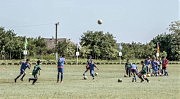
Guests want to see the best. And this is the House of Culture in the central estate, with a comfortable auditorium, a chandelier of “non-rural” size, a library, and handmade dolls by the director of the House of Culture, Svetlana Bashnyakova. You see them in the picture of our photojournalist – you can’t pass by such a pair. And in the local history museum, we were met by Efrosiniya Shevchenko – the keeper of the history of this area for 20 years. Both old and young know here that Tuzly is 230 years old, the settlement in the Budjak steppe arose thanks to shepherds who roamed with their flocks near the salt pans, hence the name from the Turkic “tuz” – salt. Efrosiniya Shevchenko’s story concluded with songs by the ensemble “Dzherelo”, whose oldest performer is over 80, accompanied by the accordionist Alexander Karpenko. On our route, we had a stadium – the training ground for two football teams, “Bურნás” and “Bურნás-2”. The community pays special attention to this facility. There are two sports instructors on staff – Sergey Didenko and Alexander Petkov. For the funds of the community development budget, simulators were purchased, and equipment was bought. The plans include the construction of a locker room for athletes, and the documentation will be prepared this year.
Medicine in the Tuzlivska community is represented by a primary healthcare center headed by Sergey Nesterenko. The institution has undergone changes during the community’s independent journey: it is now warm, tidy, and has a day hospital, a physiotherapy room, and a laboratory. The question about family doctors turned out to be a “trick question”. As it turned out, there were two of them, but for various reasons, there are none now. Hello, doctors! You are expected in the Tuzlivska community, and a service house has already been prepared.
Lebedevka Spit
A significant advantage of the Tuzlivska community over others is the sandy spit between the sea and the Burnas estuary, the resort of Lebedevka, which comes alive by summer. A good addition to the budget? Not everything is so simple, explained Larisa Kornovan-Moiseyenko. The settlement is part of the community’s territory, but the spit is outside its borders, and lease agreements with those who conduct business on the spit are concluded by the district administration. But the head of the community confirmed her intention to “fight for the spit.”

“Green” tourism is one of the strategic goals of the community, and Svetlana Petrakovskaya, a leading specialist of the Tuzlovskiye Limany National Nature Park, spoke about it in detail.
— In the recreational zone, only ecotourism is possible, and the park has developed two routes: from the geodetic marker “0 km” to the saltworks along the estuary bank, where you can see artificial islands built by park employees and volunteers for birds, and the birds themselves, of which there are 257 species and birdwatchers from different countries strive to see them; the second route “Forest by the Sea” impresses with a five-kilometer journey through a man-made forest, where pheasants roam and wild cats live. Eco-trails have also been laid by teacher Inna Karpenko – there are six of them. Horse and bicycle routes can be developed and local residents can be involved. Those who come to observe birds will gladly settle in rural households. Transportation, local cuisine, souvenirs – this will bring significant income to people and the community.
A separate topic is health tourism, which, however, requires significant investment. This is generally a sad page in the history of the Primorskaya Spit. Burnas, famous for its reserves of silt and hydrogen sulfide mud, has long attracted those seeking healing from diseases of the musculoskeletal system, nervous system, and skin. The sanatorium, built here a century ago, where children with polio were treated, lasted until the 1980s. Locals still remember with kind words Dr. Fedor Kryzhanovsky, who achieved results even in the most hopeless cases with the help of therapeutic mud. Today, only the place where the sanatorium was remains…
What is needed for the dreams of SPA hotels to come true? A good team, a clear action plan, investors, and, of course, roads. This is what they think in the community.
“The village is used to having women in leadership”
Since the role of the individual has not been canceled, we get to know better those who dared to take the lead of the community. Larisa Kornovan-Moiseyenko was born in Tuzly and is essentially transforming her small homeland. An economist by specialty, a master of public administration. She worked in the district in accounting positions for more than ten years, and in 2015 she won the elections and headed the community. Husband, son-graduate, daughter Arina, whom she gave birth to “without interrupting” work. “I am a lodger at home, I am very grateful to my family, my parents for their support and help,” says Larisa. She is fully immersed in the affairs of the community, is interested in the experience of others, including foreign ones. As she said, she traveled to Lithuania, Poland, and learned about the European approach to decentralization. Not everything and not immediately applicable from what she saw and learned, but she believes that the time will come, and this experience will be useful. And how without faith?
The староста of the village of Bezymyanka is Nelya Zagranichnaya, the right hand of the head of the community. She is also from the Tatarbunary district, a graduate of the university’s mechanics and mathematics faculty, and came to management work from a teaching position. In 2016, the residents of the village of Bezymyanka elected her as староста. Women are in charge? “The village is used to it,” both answer the question with a gender subtext.











