

Fyodor Izotovich Litvyakov has dedicated 36 years of his life to the difficult fire-fighting profession. Since 1995, he has headed the Odessa Regional Council of Veterans of the Main Directorate of the State Emergency Service of Ukraine in the Odessa Region. The veteran firefighter has a lot to tell about the formation of the fire service in Odessa and the region. He is the author not only of articles in the periodical press but also of several books, in the process of creating which he delved into what he considers the most interesting and noteworthy facts from the history of Odessa fire brigades and units. However, judge for yourself.
The First Was the Boulevard Police Fire Station
According to international canons and traditions, the date of creation of any service or settlement, for all peoples and throughout the world, begins with a documented, literary, or legendary date.
From the report of the police chief to the mayor of Odessa: “In accordance with the decree of Mr. Sostati, acting Mayor of Odessa, No. 11856, dated September 10, 1801, please be so kind as to release the sum of 5256 rubles 82 kopecks, spent on the purchase of 3 fire horses and a water pipe, to the said council under the signature of the acting civil affairs bailiff, titular councilor Pridun.
Police Chief (signature) G. Kiryakov
No. 2963
September 27, 1802”.
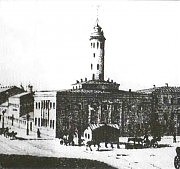
This date is considered the day of the organization of the first – Boulevard (named after the district) police fire station.
The city was rapidly expanding. In 1805, a new – Alexandrovsky police district was organized in Odessa with a fire station of the same name. The second in order. From May 10, 1817, Odessa was granted the status of “Porto Franco”. The “Free City” was becoming one of the most important trading centers. Odessa began to play an important role in Ukraine and Southern Russia in promoting foreign markets. Many palaces and mansions, public buildings were erected. Fires became more frequent. In 1825, the Kherson police district was built with a fire station of the same name, the third in Odessa.
Each station had a sworn chimney sweep, whose duty was to monitor “the cleaning of residents’ chimneys and to report any malfunctions to the fire chief.” All expenses for the maintenance of the fire chief, chimney sweep, horses, water pipes, and tools were “at the expense of the town hall and covered from city expenses.”
The provision of fire-fighting personnel was the responsibility of the homeowners (residents), who, upon the alarm signal, gathered at the assembly yard (police station) with their assigned equipment. Here they were divided into three groups. One was on duty at the fire cart and was the first to respond to a fire. The second reported to the fire chief and was deployed at his discretion – mainly providing water to those working at the fire. The third was on duty at the police station, in case another fire broke out… The fire duty created many difficulties for the population. People hired various vagrants and other ruffians to take their place, for whom a fire, to tell the truth, was a place of profit.
On October 29, 1825, according to the highest approved staffing, the Odessa fire brigade was to have 32 fire employees, 3 water pipes, 8 barrels, 3 hook-and-ladder carts, and 20 horses. But due to a lack of funds to acquire this equipment for the Kherson police station, the Odessa fire brigade was not formed. The provision of fire-fighting personnel continued based on and under the terms of the “Charter of Decorum or Police” – “in kind.”
Only by January 1, 1827, did the new mayor – actual state councilor, member of the State Council F. P. Palen find the opportunity and acquire all the missing inventory for the fire cart. The Odessa fire brigade was created in the style of St. Petersburg and Moscow – “from retired soldiers unfit for front-line service” from the Nicholas era, who served for 25 years.
The value of creating such a brigade was that the provision of fire-fighting personnel “in kind” was abolished for the residents of Odessa. “All residents of Odessa are to be freed from maintaining fire-fighting personnel, and neither night watchmen nor servants are to be demanded or assigned from anyone.” On January 12, an announcement was published in the “Odessky Vestnik” that the brigade required a fire chief. Andrei Ivanovich Shemyakin became the first in this position.
…And They Named a Street Kolontaevskaya
Previously, it descended directly into the Vodyanaya Balka (now Balkovskaya Street). Before the construction of the water supply system, the street remained the main thoroughfare, along which water carriers delivered water from local wells and city ponds to the city. And this, in case of fires, was the only salvation at that time.

After the Napoleonic Wars, Odessa rose as a young star of the global grain exporter. Ruined Europe needed agricultural products, and the city managed to meet this demand. Navigation was seasonal, partly because in the off-season or winter, grain caravans could not reach the city from the hinterland due to poor roads. It happened that several local and Mediterranean ships accumulated in the Odessa port, waiting for loading and departure. And once, in 1814, a fire broke out on one of them, and its crew, as well as the crews of nearby sailing ships, went ashore. The fire quickly gained strength, threatening neighboring vessels.
In those years, there were no insurance companies yet, the sailing ships owned by merchants were not insured, and the loss of a vessel threatened the owner with bankruptcy. Each person treated the preservation of their livelihood with care, personally ensuring that neither workers nor passengers started fires on board. Smoking on deck was strictly forbidden. The extinguishing of fires that occurred on ships and rafts was mainly reduced to isolation and anchoring. In this state, the ship either burned down without harming others, or the crew managed to extinguish the fire and save it. In extreme cases, the ship was scuttled.
Fortunately, the commander of the fire-watch gunboat No. 58, Lieutenant E. I. Kolontaev, did not panic. Yegor Ivanovich, who had been trained in the flotilla of Rear Admiral De Ribas, had extensive practical experience in rapid actions in emergency situations. In an instant, he skillfully boarded the burning vessel. Smoke stung his eyes, his throat was scratchy, flames burned his hands. But the thought of the terrible consequences forced the lieutenant to act without losing time, clearly. He quickly unmoored. He carefully steered the sailing ship out of the harbor into the open sea, dropped anchor, and extinguished the fire. Only then did he feel the burns on his hands and face. Thus, Yegor Ivanovich Kolontaev saved all the ships that had accumulated in the port.
At that time, rescuers were loved, and their advice was heeded. The local merchant community marked this feat with a Certificate of Merit and a gold bracelet with the engraving: “Grateful Commerce – E. Kolontaev.” Soon, the street where E. I. Kolontaev lived was named after him. From February 1, 1819, he retired with the rank of captain-lieutenant, and in 1821 he returned to service as captain of the Quarantine Port. This position involved the general management of the port.
In the era of Count M. S. Vorontsov, the combat naval officer, the port captain became the manager of the city theater. Experience showed that the legendary theater could not survive without subsidies, and Kolontaev coped with his new position. Subsequently, gradually rising through the ranks, Yegor Ivanovich served Vorontsov as a special envoy, including for extremely complex and delicate matters. He had three daughters and four sons.
E. I. Kolontaev died on October 23, 1842. It is comforting that he still managed to walk along the street named after him in 1839…











